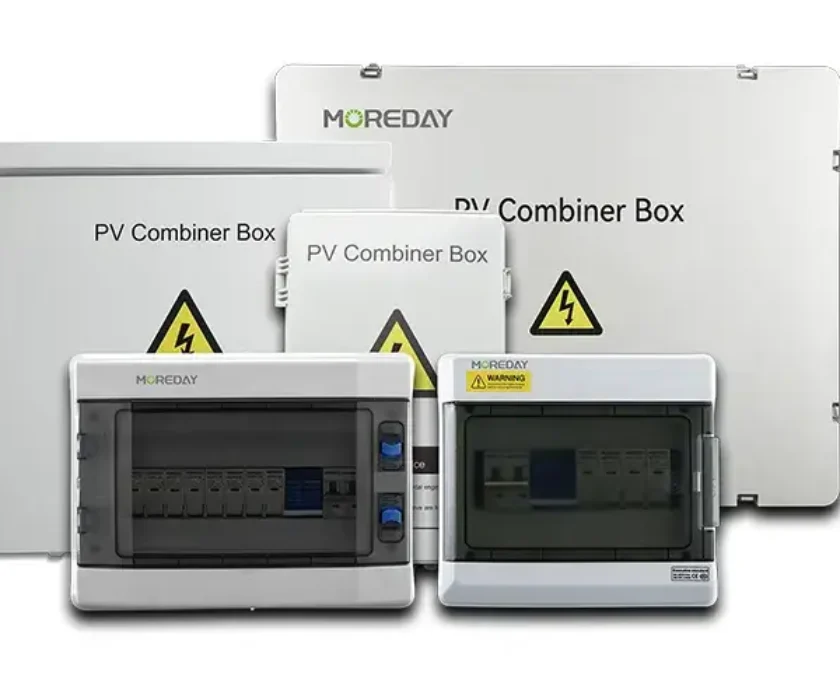

DistributionSolar
In a solar photovoltaic (PV) system, electricity generated by multiple solar strings must be collected, routed, and protected before it reaches the inverter. A DC combiner box brings together the outputs of multiple PV strings and can integrate protective and isolation devices in one enclosure.
By organizing DC connections and centralizing selected protection functions, a properly specified PV combiner box can simplify system wiring, inspection, and maintenance. Its configuration depends on the number of PV strings, inverter architecture, system voltage, protection requirements, and installation environment.
What Is a DC Combiner Box?
A DC combiner box is an electrical enclosure installed on the direct-current (DC) side of a solar PV system. It connects multiple PV string circuits to a common output circuit when the system design calls for this arrangement.
Depending on its design, a DC combiner box may provide:
- String combining: Collecting the outputs of multiple PV strings.
- Overcurrent protection: Providing appropriately selected string fuses or other protective devices where required.
- Isolation: Incorporating a DC disconnect or isolator when specified by the system design.
- Surge protection: Accommodating DC surge protection devices (SPDs) to help limit transient overvoltages.
- Connection management: Organizing terminals, conductors, and outgoing connections within an enclosure.
Not every DC combiner box includes all these components. The actual configuration should match the PV system design, equipment specifications, and applicable electrical requirements.
Where Is a DC Combiner Box Used?
A DC combiner box is commonly used between a PV array and an inverter in systems where multiple string circuits need to be collected into a common DC output.
Typical applications include:
- Commercial and industrial rooftop solar installations
- Ground-mounted solar PV plants
- Distributed PV systems with multiple string circuits
- Projects that require centralized DC protection or connection management
Whether a separate combiner box is necessary depends on the system architecture. Some inverters accept multiple strings directly and provide specified protection functions at their inputs. Other installations require an external combiner box to accommodate the number of strings, protection devices, or connection arrangements.
Therefore, a combiner box should be selected based on the actual electrical design rather than system size or voltage alone.
Main Functions of a DC Combiner Box
1. Combining PV Strings
A PV string consists of solar modules connected in series. Multiple strings may be connected in parallel to supply an inverter, subject to the inverter’s input configuration and the electrical design.
A DC combiner box provides a centralized point for connecting these string circuits to a common output. This can reduce the number of separate outgoing cable runs and make the DC wiring layout easier to organize.
The allowable number of strings and the resulting output current must be determined from the system design and the ratings of the connected equipment.
2. Overcurrent Protection
PV string protection may be necessary when current from other parallel strings or connected sources could create an unsafe reverse-current condition in a faulted string.
String fuses are commonly used for this purpose when required by the design. Their selection must account for the PV module’s maximum series fuse rating, expected string current, possible reverse current, conductor ampacity, and applicable standards.
A fuse should not be selected solely by matching the normal operating current. Its DC voltage rating, current rating, interrupting capability, and suitability for PV applications must also be checked.
For more information about protection-device selection, see MOREDAY’s DC fuse product range.
3. Isolation for Maintenance
A DC isolator or disconnect switch may be installed in a combiner box or elsewhere in the PV system to provide a means of disconnecting the relevant circuit.
Its location and function depend on the overall system design and applicable requirements. An isolator must be suitable for the DC voltage, current, switching duty, and installation conditions.
A disconnect device should not automatically be treated as an overcurrent protective device. Its function must be distinguished from that of a fuse or circuit breaker.
Learn more about DC isolator switches.
4. Surge and Lightning Protection
Solar PV installations can be exposed to transient overvoltages caused by lightning-related events and electrical switching. A DC surge protection device can help limit these transient voltages and reduce stress on connected equipment when correctly selected and installed.
SPD selection depends on factors such as the PV system’s maximum voltage, the required protection level, lightning exposure, external lightning protection arrangements, grounding, and the applicable standards.
The SPD’s voltage rating and protection characteristics must be compatible with the DC circuit. Installation details, including conductor routing and connection length, also affect protection performance.
For product information, visit the MOREDAY SPD range.
Main Components Inside a DC Combiner Box
The components inside a DC combiner box vary by model and application. Common components include the following.
| Component | Main function | Key selection consideration |
|---|---|---|
| DC fuse or fuse holder | Provides specified string overcurrent protection | DC voltage, current, interrupting capability, PV suitability, and coordination |
| DC isolator or disconnect switch | Provides circuit isolation when included in the design | Rated voltage, current, switching duty, and applicable requirements |
| DC surge protection device (SPD) | Helps limit transient overvoltages | Maximum system voltage, protection characteristics, grounding, and lightning risk |
| Busbars and terminals | Provide electrical connection and current distribution | Current capacity, conductor compatibility, temperature rise, and connection requirements |
| Enclosure | Houses and protects internal components | Environmental exposure, ingress protection, corrosion resistance, and installation conditions |
| Monitoring components | Provide selected measurements or status information when fitted | Monitoring requirements, communications, and compatibility with the system |
Monitoring functions are optional and should not be assumed to be available in every model. Likewise, a combiner box does not necessarily contain a separate isolator or SPD unless the specified configuration includes it.
The final bill of materials should be confirmed against the manufacturer’s technical documentation and the project’s electrical drawings.
Why DC Combiner Boxes Are Important
Organized DC Wiring
A combiner box provides a defined connection point for multiple string circuits. This can make cable routing more organized and help technicians identify circuits during inspection and maintenance.
Coordinated Protection
Where the design requires string fuses, surge protection, or isolation devices, the combiner box can accommodate these functions in a centralized enclosure. The protective devices must still be correctly rated and coordinated with the PV modules, cables, inverter, and other equipment.
Easier Inspection and Maintenance
A well-documented layout can make it easier to identify terminals, inspect protective devices, and trace circuits. Maintenance requirements depend on the equipment, operating environment, and manufacturer’s instructions.
Adaptation to Project Requirements
Combiner boxes can be specified for different numbers of inputs, voltage classes, protection arrangements, and environmental conditions. This allows the configuration to be matched to the project rather than relying on a one-size-fits-all design.
These benefits depend on correct specification, installation, commissioning, and ongoing maintenance. A combiner box alone does not guarantee system safety or reliability.
When Do You Need a DC Combiner Box?
A separate DC combiner box may be appropriate when:
- Multiple PV strings need to be connected to a common DC output.
- The inverter’s available inputs or built-in functions do not meet the project’s connection and protection requirements.
- The design calls for centralized string protection, surge protection, or isolation.
- The project requires a particular arrangement for cable routing, inspection, or maintenance.
- The electrical drawings specify an external combiner assembly.
A separate box may not be necessary when the inverter and overall system architecture already provide the required string connections and protection functions.
The decision should be based on the number of strings, inverter input limits, string-current calculations, protection requirements, cable routing, and applicable local standards. System voltage by itself does not determine whether a combiner box is required.
How to Choose the Right DC Combiner Box
Selecting a DC combiner box requires more than matching the number of inputs. The enclosure, internal components, and electrical ratings must be suitable for the complete PV system.
1. Confirm the Number of PV String Inputs
Determine how many string circuits will connect to the box. Confirm that the available input channels match the electrical drawings and that the outgoing connection is suitable for the intended arrangement.
Do not assume that a box with more inputs is automatically better. Unused inputs, future expansion, and spare capacity should be considered as part of the project design.
2. Verify the Maximum DC System Voltage
The combiner box and every component installed inside it must be suitable for the maximum DC voltage expected under the system’s operating conditions.
PV string open-circuit voltage changes with temperature. The design should account for the relevant module data and the lowest expected cell temperature in accordance with the applicable calculation method.
Do not select a box solely from a nominal system-voltage label. Check the ratings of the enclosure assembly, fuses, disconnect devices, SPDs, terminals, and other installed components.
3. Check Current Ratings and Overcurrent Protection
Confirm the expected string current and combined output current. Verify conductor ampacity, terminal ratings, busbar capacity, and the ratings of any installed protective devices.
Where string fuses are required, select them according to the module specifications, potential reverse current, conductor protection requirements, and applicable standards.
The fuse rating, output current capacity, and enclosure rating should be considered together rather than selected independently.
4. Determine Whether an SPD or Isolator Is Required
Review the system’s lightning risk, external lightning protection arrangements, grounding design, inverter requirements, and local electrical rules.
If an SPD is required, check its maximum continuous operating voltage and protection characteristics against the PV system. If a disconnect device is required, confirm its DC rating and intended switching or isolation function.
Do not assume that every combiner box needs an identical protection arrangement.
5. Match the Enclosure to the Environment
The enclosure should suit its actual installation location. Consider exposure to rain, dust, ultraviolet radiation, humidity, corrosive atmospheres, temperature extremes, and mechanical impact.
Check the specified ingress protection rating and any applicable corrosion or environmental test requirements. An IP rating alone does not establish suitability for every outdoor or coastal environment.
The installation instructions should also define appropriate mounting, cable entry, sealing, ventilation where applicable, and clearance requirements.
6. Check Standards and Documentation
Before specifying a combiner box, verify the applicable requirements for the project location and the equipment category.
Review the manufacturer’s documentation for rated voltage and current, short-circuit or fault-current withstand capability where specified, component ratings, wiring diagrams, terminal compatibility, enclosure protection, and installation instructions.
Do not assume that a product complies with a particular standard or carries a particular certification unless the relevant documentation confirms it for the exact product and configuration.
7. Confirm Compatibility with the Inverter and PV Modules
Check the inverter’s input arrangement, permitted string configuration, maximum input current, and specified protection requirements. Compare these with the PV string calculations and the proposed combiner-box design.
Also verify that the module’s electrical characteristics and maximum series fuse rating are compatible with the selected protection devices.
A technically suitable enclosure can still be unsuitable for a project if its internal configuration does not match the inverter, modules, or electrical drawings.
DC Combiner Box vs Direct String Connection
A separate combiner box and direct string connection are different design approaches. Neither is universally better; the appropriate option depends on the inverter, number of strings, protection requirements, cable layout, and project constraints.
| Consideration | With a Separate Combiner Box | Direct Connection to the Inverter |
|---|---|---|
| String connections | Multiple strings are collected at a dedicated enclosure | Strings connect to the inverter’s available inputs |
| Protection arrangement | Selected protection devices may be centralized in the box | Protection may be provided at the inverter, externally, or through a combination of devices |
| Cable routing | Can provide a centralized outgoing cable route | May simplify wiring when the inverter accepts the required strings directly |
| Maintenance | Can provide a separate point for inspecting included components | Access and inspection depend on the inverter and overall installation |
| Suitability | Useful when the design calls for external combining or centralized protection | Suitable when the inverter input configuration and protection arrangements meet project requirements |
Before choosing either approach, compare the total wiring arrangement, equipment requirements, installation cost, maintenance access, and applicable electrical rules.
Basic DC Combiner Box Maintenance
Maintenance should follow the manufacturer’s instructions, the site’s maintenance plan, and applicable electrical safety procedures. PV DC circuits can remain hazardous in daylight, even when some equipment has been disconnected.
Key inspection considerations include:
- Enclosure condition: Check for physical damage, corrosion, damaged seals, or signs of water or dust ingress.
- Connections and terminals: Inspect for signs of overheating, discoloration, loose connections, or corrosion using the manufacturer’s approved procedures.
- Protective devices: Check fuse status and SPD indicators where provided. Investigate repeated fuse operation or SPD failure rather than simply replacing a component without identifying the cause.
- Cable entries and conductors: Look for damaged insulation, poor sealing, or signs of mechanical stress.
- Labels and documentation: Ensure that circuit identification and warning labels remain legible and that the as-built documentation is available.
Inspection and electrical testing must be carried out by qualified personnel using the required isolation, verification, and safety procedures. Do not open or work on energized equipment unless the work method and applicable rules explicitly permit it.
For installation-related guidance, see How to Install a Combiner Box for Solar Systems.
Summary
A DC combiner box collects multiple PV string circuits and can provide a centralized location for selected protection and isolation functions. Its value lies in organizing DC connections and accommodating the protection devices required by the system design.
Choosing the right unit involves confirming the string count, maximum DC voltage, current ratings, protection arrangement, inverter compatibility, enclosure conditions, and applicable electrical requirements. The final configuration should always be checked against the project drawings and the manufacturer’s technical documentation.
For project-specific requirements, explore the MOREDAY combiner box range and confirm the required input configuration, voltage rating, protective devices, and installation environment with the technical team.
What Is a DC Distribution Box (Solar / PV DC Distribution Box / DC Combiner Box)?
Solar power generation systems are extremely beneficial in residential, commercial, and industrial sectors, and the trend towards safe, orderly, and reliable DC power management is becoming increasingly important. The DC distribution box (also often referred to as a solar DC distribution box or photovoltaic DC distribution box) is one of the key components that plays this crucial role.
What is a Combiner Box?
The combiner box is an electrical device used to centrally manage multiple current inputs, mainly used in photovoltaic power generation systems, wind power generation systems and other scenarios. Its core function is to connect the DC output of multiple power generation units (such as photovoltaic strings and wind turbines) in parallel and transmit it to the inverter or energy storage system through a unified output terminal. By optimizing the current path, the combiner box can significantly reduce line losses and improve system efficiency.
How to Install a Combiner Box for Solar Systems?
Before starting, ensure you have all necessary components and tools ready.
Step 1: Choose the Right Location
Step 2: Turn Off the Power
Step 3: Mount the Combiner Box
Step 4: Connect Solar Strings
Step 5: Wire the Output to the Inverter
Step 6: Install Fuses or Breakers
Step 7: Test the System