
DistributionSolar
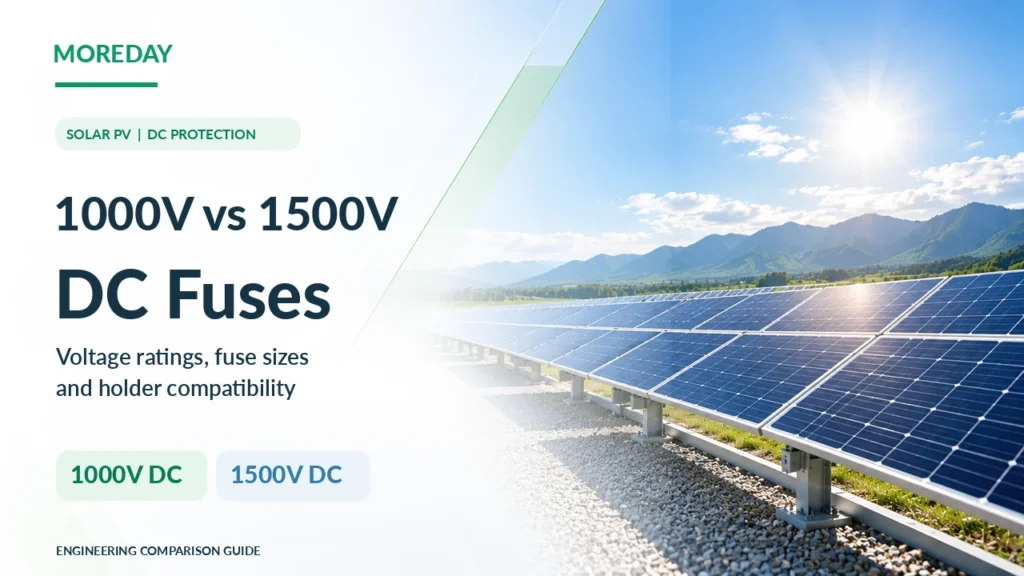
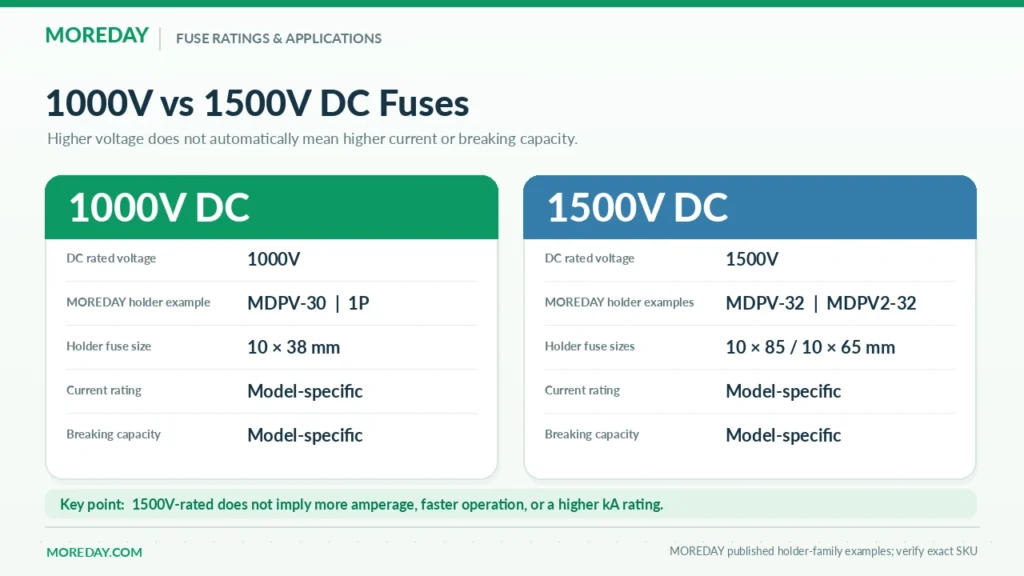
The main difference between a 1000V and a 1500V DC fuse is the maximum direct-current voltage at which the fuse is rated to operate and interrupt specified fault currents. A 1500V DC fuse is designed for a higher voltage rating, but it is not necessarily rated for a higher current, faster operation, or greater breaking capacity.
In solar photovoltaic systems, choosing the correct voltage rating is essential because PV string voltage changes with temperature. A fuse that appears suitable under normal operating conditions may be underrated when the string reaches its maximum cold-weather open-circuit voltage.
The selection also affects fuse dimensions, holder compatibility, equipment coordination, and the design of the DC protection assembly.
This guide compares 1000V and 1500V photovoltaic fuses, explains their technical differences, and provides practical recommendations for engineers and solar equipment buyers.
What Is the Difference Between 1000V and 1500V DC Fuses?
A DC fuse has a rated voltage that defines the conditions under which it is designed and tested to interrupt fault currents.
In photovoltaic applications, the rated voltage must be suitable for the maximum DC voltage that can occur across the protective device under relevant fault conditions.
A 1000V DC fuse is rated for applications within its specified 1000V DC limits.
A 1500V DC fuse is rated for applications within its specified 1500V DC limits.
The difference matters because interrupting direct current becomes challenging at high voltage. Unlike AC, DC does not have periodic natural current-zero crossings that assist arc extinction.
Why Higher DC Voltage Requires Different Fuse Performance
When a fuse element melts during an overcurrent fault, an electrical arc can form.
The fuse must extinguish this arc and withstand the recovery voltage.
Its ability to do so depends on the internal design, fuse element configuration, arc-quenching materials, and specified operating conditions.
A fuse rated only for 1000V DC must not be installed in a circuit requiring a 1500V DC rating.
Conversely, a 1500V DC fuse may be appropriate in a lower-voltage circuit if its complete specifications and manufacturer instructions permit the application.
Why Solar Systems Use 1000V and 1500V Architectures
PV system voltage ratings influence how many modules can be connected in series.
Higher-voltage system architectures can accommodate longer strings when the modules, inverter, and other equipment are rated accordingly.
This can reduce the number of parallel strings required for a given array power and may reduce some balance-of-system costs in large installations.
However, moving to 1500V requires appropriately rated inverters, protection devices, connectors, wiring, and other DC equipment.
A 1500V fuse alone cannot convert a 1000V-rated solar installation into a 1500V system.
For a broader explanation of PV protection devices, see MOREDAY’s DC Fuse Product Range.
1000V vs 1500V DC Fuse: Technical Comparison
The following table compares the two voltage classes in photovoltaic applications.
| Feature | 1000V DC Fuse | 1500V DC Fuse |
|---|---|---|
| Rated DC voltage | 1000V DC | 1500V DC |
| Typical application | PV systems designed within 1000V limits | PV systems designed within 1500V limits |
| PV protection characteristic | gPV where specified | gPV where specified |
| Rated current | Depends on the fuse model | Depends on the fuse model |
| Breaking capacity | Depends on the tested product | Depends on the tested product |
| Fuse dimensions | Often available in compact cylindrical formats | Available in several cylindrical and larger formats |
| Fuse holder | Must be rated for the selected fuse and circuit | Must be rated for the selected fuse and circuit |
| Arc interruption | Verified under specified DC conditions | Verified under specified higher-voltage DC conditions |
| Installation requirements | Appropriate 1000V-rated equipment | Appropriate 1500V-rated equipment |
| Applicable PV fuse standard | IEC 60269-6 where specified | IEC 60269-6 where specified |
The voltage rating alone does not determine the rated current, breaking capacity, or physical size.
Does a 1500V Fuse Have a Higher Current Rating?
Not necessarily.
A 1000V fuse may be rated at 30A, while a 1500V fuse may be available at 20A, 25A, 30A, or other current ratings.
The available range depends on the manufacturer and specific product series.
A higher DC voltage rating does not automatically mean that the fuse can carry more current.
The current rating must still be selected according to the PV modules, circuit design, conductor limits, and applicable installation requirements.
Does a 1500V Fuse Have a Higher Breaking Capacity?
Again, not necessarily.
Breaking capacity is a separate specification describing the maximum prospective fault current that a fuse is rated to interrupt under specified conditions.
For example, a manufacturer may offer a 1000V gPV fuse and a 1500V gPV fuse with the same rated breaking capacity.
Another manufacturer may offer different values.
The actual breaking-capacity rating must be verified for the particular fuse link and DC voltage.
It must not be inferred from the voltage rating alone.
Are Both Types gPV Fuses?
Both voltage classes can be manufactured with the gPV utilization category, which is intended for photovoltaic protection.
However, a fuse marked only with a DC voltage rating is not necessarily a gPV fuse.
For conventional PV string overcurrent protection, engineers should verify that the fuse has the required PV characteristics under the applicable product requirements.
The relevant international standard is IEC 60269-6, which establishes supplementary requirements for photovoltaic fuse links.
How to Determine Whether a PV System Needs a 1000V or 1500V Fuse
The correct fuse voltage rating is determined by the maximum system voltage, not simply the inverter’s normal operating voltage or the nameplate voltage of one solar module.
Photovoltaic module voltage changes with cell temperature.
As temperature falls, the module’s open-circuit voltage generally increases.
For this reason, engineers must calculate maximum string voltage under the relevant low-temperature design conditions.
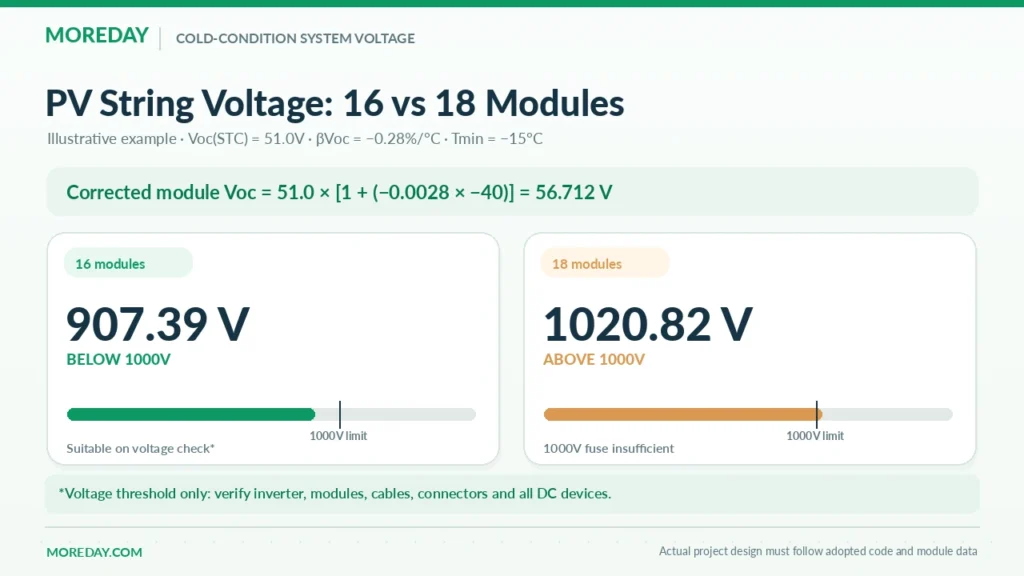
Calculate Maximum PV String Voltage
For a conventional string of identical PV modules, a simplified temperature-corrected calculation is:
Voc,cold = Voc,STC × [1 + βVoc × (Tmin − 25°C)]
Where:
- Voc,cold = temperature-corrected module open-circuit voltage.
- Voc,STC = module open-circuit voltage at Standard Test Conditions.
- βVoc = signed temperature coefficient expressed per °C.
- Tmin = minimum design cell temperature used in the calculation.
The maximum string open-circuit voltage is then:
Vstring,max = Ns × Voc,cold
Where Ns is the number of modules connected in series.
If the module datasheet lists βVoc in %/°C, convert it to a decimal coefficient before calculating.
The actual design method must follow the applicable code, module manufacturer’s instructions, and relevant corrections for the project.
Worked Example: 16 vs 18 Solar Modules
Consider the following hypothetical module data:
| Parameter | Value |
|---|---|
| Module open-circuit voltage at STC | 51.0V |
| Voc temperature coefficient | −0.28%/°C |
| Minimum design cell temperature | −15°C |
| String configuration A | 16 modules |
| String configuration B | 18 modules |
First, convert the temperature coefficient:
βVoc = −0.0028/°C
Calculate the temperature difference:
ΔT = −15 − 25 = −40°C
The corrected module open-circuit voltage becomes:
Voc,cold = 51.0 × [1 + (−0.0028 × −40)]
Voc,cold = 51.0 × 1.112
Voc,cold = 56.712V
Now calculate both string configurations.
Configuration A: 16 modules
Vstring,max = 16 × 56.712 = 907.39V
A 1000V DC fuse meets this calculated voltage threshold, subject to the remaining design requirements.
Configuration B: 18 modules
Vstring,max = 18 × 56.712 = 1020.82V
A 1000V DC fuse is insufficient for this calculated maximum voltage.
A suitably rated 1500V DC fuse becomes a possible choice, provided all connected equipment is suitable for the system’s maximum voltage.
What This Example Demonstrates
The same PV module can produce different protection requirements simply by changing the number of modules connected in series.
A system’s normal operating voltage may remain considerably below its maximum cold-temperature open-circuit voltage.
Therefore, fuse voltage selection must be based on the applicable maximum-voltage design calculation, not average operating voltage.
The example assumes that the minimum design cell temperature is −15°C and uses a linear temperature coefficient. Actual projects may require a different method or additional factors.
Do Not Ignore the Inverter’s Operating Voltage Range
Selecting a 1500V fuse does not guarantee that a longer PV string is compatible with the inverter.
Engineers must also verify:
- Maximum permitted DC input voltage.
- MPPT operating voltage range.
- String voltage at high module temperatures.
- Module maximum system voltage.
- Insulation and other equipment ratings.
- Any module-level electronics and manufacturer restrictions.
An array can satisfy the maximum open-circuit voltage requirement but still have an unsuitable operating voltage range for its inverter.
For complete current and voltage calculation methods, see How to Size a Solar PV Fuse.
1000V vs 1500V Fuse Dimensions and Holder Compatibility
Physical dimensions are a major practical difference between many 1000V and 1500V fuse product families.
However, there is no universal rule that every 1000V fuse uses one specific size and every 1500V fuse uses another.
Common cylindrical PV fuse sizes include:
- 10 × 38 mm
- 10 × 65 mm
- 10 × 85 mm
- 14 × 85 mm
The correct size depends on the manufacturer’s product design and fuse-holder system.
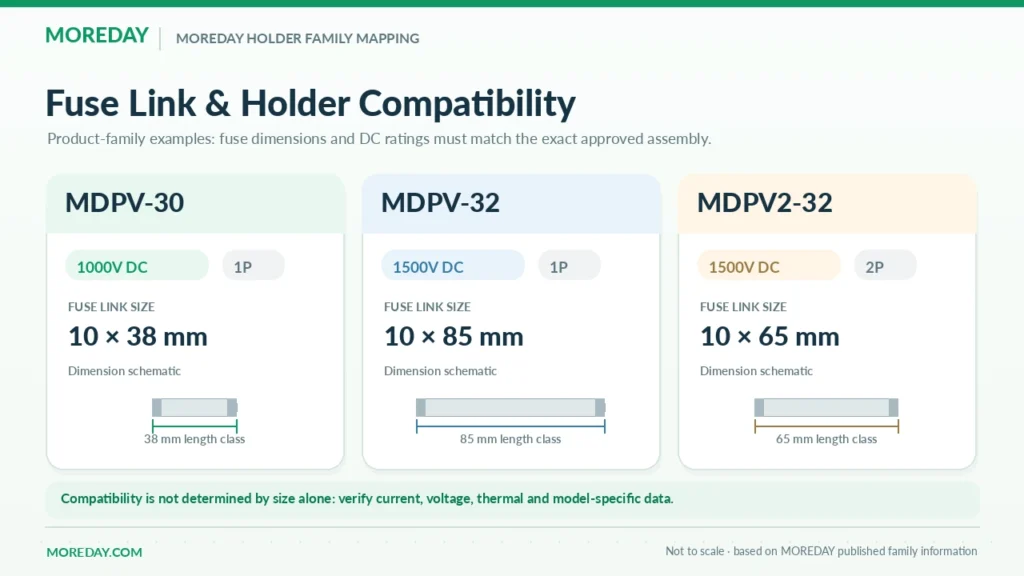
MOREDAY 1000V and 1500V Fuse Holder Examples
MOREDAY lists the following photovoltaic fuse-holder configurations.
| Product Series | Listed DC Voltage | Fuse Link Size | Configuration |
|---|---|---|---|
| MDPV-30 | 1000V DC | 10 × 38 mm | 1P / 2P variants |
| MDPV-30B | 1000V DC | 10 × 38 mm | 1P variants |
| MDPV-32 | 1500V DC | 10 × 85 mm | 1P |
| MDPV2-32 | 1500V DC | 10 × 65 mm | 2P |
These are examples from MOREDAY’s published product range, not a universal mapping between voltage and dimensions.
The precise fuse-link model, current rating, and permitted combination must be verified from the manufacturer’s documentation.
Can a 10 × 85 mm Fuse Fit a 10 × 38 mm Holder?
No. These fuse sizes have substantially different lengths and require appropriately designed holding equipment.
A 10 × 38 mm holder cannot be assumed to accept a 10 × 85 mm fuse link.
Mechanical incompatibility also affects contact engagement, terminal arrangements, insulation distances, and heat dissipation.
Never modify a fuse holder to fit an incompatible fuse link.
Can a Fuse and Holder Have Different Voltage Ratings?
The fuse link and holder may have different nameplate voltage ratings, but the installed assembly must be suitable for the maximum voltage of the intended circuit.
For example, installing a 1500V fuse link inside a holder rated only for 1000V does not create a 1500V-rated assembly.
The holder remains a limiting component.
Similarly, placing a 1000V fuse link in a 1500V holder does not upgrade the fuse link’s voltage rating.
The assembly must satisfy all applicable component and combination ratings.
Thermal and Mechanical Compatibility
Voltage and physical dimensions are not the only considerations.
Verify:
- Fuse holder current and temperature ratings.
- Compatible fuse-link references.
- Terminal size and tightening requirements.
- Heat dissipation and enclosure temperature.
- Number of poles and protection arrangement.
- DIN rail mounting and available installation space.
- Suitable fault-current performance for the complete assembly.
The holder should be selected using the manufacturer’s compatibility information, not only the dimensions printed on the fuse link.
Breaking Capacity, Safety and Standards for High-Voltage PV Fuses
The shift from 1000V to 1500V DC places additional demands on the design and verification of electrical equipment.
At higher voltages, appropriate insulation distances, component ratings, and fault-interruption performance become especially important.
DC Arc Extinction and Fuse Performance
When a DC fuse operates, its internal element melts and an electrical arc may form.
The fuse must extinguish the arc without causing an unsafe failure.
The required performance depends on factors including:
- Rated DC voltage.
- Prospective fault current.
- Fuse construction.
- Specified circuit conditions and time constant.
- The fuse’s breaking range and operating characteristics.
A product suitable for 1000V DC must not be assumed to interrupt the same fault safely at 1500V DC.
Why gPV Characteristics Matter
PV arrays can generate fault currents that are relatively low compared with the short-circuit currents available in conventional power distribution systems.
A suitable gPV fuse link is designed to address specified photovoltaic overcurrent conditions.
The selected fuse must provide appropriate protection for the circuit, including its relevant operating range and time-current behavior.
The gPV marking alone does not determine whether a particular ampere rating will adequately protect the installation.
Applicable IEC and North American Standards
Important references include:
| Standard | Application |
|---|---|
| IEC 60269-6 | Supplementary requirements for photovoltaic fuse links |
| IEC 60269-1 | General low-voltage fuse requirements |
| IEC 62548-1 | PV array design and protection requirements |
| UL 248-19 | Photovoltaic fuse product requirements for relevant North American applications |
IEC 60269-6:2010+A1:2021 addresses PV fuse links used in circuits with nominal voltages up to 1500V DC, with limited additional applicability defined in its scope.
The current consolidated IEC 62548-1:2023+A1:2025 provides a broader framework for PV array design.
A manufacturer’s statement that a product is designed according to IEC 60269-6 does not independently prove third-party certification.
For projects requiring specific approvals, request documentation identifying the exact model and its evaluated ratings.
Never Use an Ordinary Fuse Holder as a Load-Break Switch
A fuse holder is not automatically designed to interrupt normal operating current when opened.
Unless the complete device is specifically rated for that switching duty, it must not be opened under load.
Installation and replacement must follow the manufacturer’s safety instructions and the appropriate isolation and verification procedures.
This applies to both 1000V and 1500V photovoltaic protection assemblies.
Can You Use a 1500V Fuse in a 1000V Solar System?
A 1500V DC-rated fuse may be used in a 1000V DC photovoltaic circuit when the manufacturer permits that application and all other electrical, mechanical, and protection requirements are satisfied.
The higher voltage rating is not inherently a problem.
However, it does not automatically establish interchangeability.
Conditions for Using a 1500V Fuse at 1000V
Before substitution, confirm that:
- The fuse has the required rated current.
- Its operating characteristic is suitable for the protected PV circuit.
- The relevant breaking-capacity and breaking-range requirements are satisfied.
- The fuse link fits an approved or manufacturer-specified compatible holder.
- The holder and complete assembly are rated for the installation.
- The applicable code and certification requirements are met.
A higher voltage rating alone is not a reason to replace an otherwise suitable fuse.
Can You Use a 1000V Fuse in a 1500V System?
Not where the fuse may need to withstand or interrupt a voltage exceeding its 1000V DC rating.
A 1000V fuse cannot safely be treated as a 1500V-rated component simply because the PV array’s normal operating voltage is temporarily below 1000V.
The maximum possible voltage and relevant fault conditions determine the requirement.
When Should a Project Use 1000V or 1500V Equipment?
The choice depends on the complete electrical system.
| Project Situation | Recommended Evaluation |
|---|---|
| Existing 1000V PV installation | Retain suitable 1000V components unless redesign is justified |
| PV string maximum voltage below 1000V | A suitable 1000V fuse may be sufficient |
| Calculated maximum voltage above 1000V | Evaluate a higher-voltage system architecture and rated components |
| Large commercial or utility PV project | Compare complete 1000V and 1500V architectures |
| Replacement fuse for existing holder | Match the approved fuse family, dimensions, and electrical ratings |
| OEM combiner box design | Verify complete assembly ratings and documentation |
Does a 1500V System Always Cost Less?
Not necessarily.
A higher-voltage PV architecture can reduce the number of strings, cable runs, and some balance-of-system components for a given array capacity.
However, the actual economic result depends on project scale, module selection, inverter design, DC equipment prices, installation conditions, and maintenance considerations.
The U.S. National Renewable Energy Laboratory has examined the potential balance-of-system cost advantages of increasing utility-scale PV architecture from 1000V to 1500V.
Those project-level savings should not be confused with a guaranteed reduction in the price of an individual fuse link or holder.
A 1500V fuse should be selected because it meets the electrical requirements—not because a higher voltage rating is automatically more economical.
MOREDAY 1000V and 1500V DC Fuse Solutions
MOREDAY provides photovoltaic DC fuse links and fuse holders for different solar system voltage requirements.
The available product families include 1000V and 1500V configurations for PV array protection equipment.
1000V DC Fuse Solutions
For installations within the applicable 1000V DC limits, MOREDAY offers products such as the MDPV-30 1000V DC Fuse Holder.
This series supports 10 × 38 mm fuse links according to the published product information.
When specifying an assembly, the fuse-link characteristics and the holder’s electrical and thermal ratings must both be confirmed.
1500V DC Fuse Solutions
For systems designed within the 1500V DC equipment class, MOREDAY offers products including the MDPV-32 1500V DC Fuse Holder.
The published MDPV-32 series is designed for 10 × 85 mm fuse links.
Additional 1500V configurations are available within the broader product range, including different pole arrangements and fuse-link dimensions.
The precise configuration should be selected according to the technical datasheet and project requirements.
DC Fuse Link Product Range
MOREDAY’s 1000V and 1500V DC Fuse Link range covers several cylindrical formats for photovoltaic applications.
Before selecting a particular fuse, confirm the available ratings for that exact reference, rather than assuming all ratings and dimensions listed for the overall series are available in every combination.
Information Required for a Technical Quotation
For EPC contractors, distributors, and OEM combiner box manufacturers, the following information helps identify suitable components:
| Required Information | Example |
|---|---|
| Maximum PV system voltage | 1000V DC or 1500V DC |
| Fuse current rating | According to the completed protection design |
| Protection characteristic | gPV where required |
| Fuse-link size | 10 × 38 / 10 × 65 / 10 × 85 mm |
| Fuse holder configuration | 1P / 2P as required |
| Available fault current | Project-specific calculation |
| Installation conditions | Temperature, enclosure, terminals |
| Required documentation | Datasheet, drawings, conformity evidence |
Conclusion
The difference between 1000V and 1500V DC fuses is primarily their verified DC voltage capability.
A 1500V fuse is designed for a higher voltage class, but it is not necessarily rated for greater current, faster operation, or higher breaking capacity.
For photovoltaic applications, engineers must calculate the maximum cold-weather string voltage, verify the protection characteristic and fuse operating limits, and select a compatible fuse holder.
The entire installation—not just the fuse—must be suitable for its maximum system voltage.
Explore the MOREDAY DC Fuse Product Range to review available fuse links and holders for solar PV systems, or contact MOREDAY with your project specifications for technical selection support.