
DistributionMOREDAY
Last updated: July 2026
When it comes to electrical safety, circuit breakers play a pivotal role. These devices protect electrical circuits from damage caused by overloads or short circuits, safeguarding both infrastructure and the people around it. With so many manufacturers on the market, choosing the right one can feel like finding a needle in a haystack. This guide walks through the leading circuit breaker manufacturers worldwide, the trends reshaping the industry, and why MOREDAY, a China-based manufacturer, has become a name worth watching in this competitive market.
1. The Importance of Circuit Breakers in Electrical Systems
Circuit breakers are the unsung heroes of modern electrical systems. Without them, electrical overloads would go unchecked — causing fires, equipment damage, and putting lives at risk.
As electrical infrastructure grows smarter and more interconnected — with smart grids, distributed solar, energy storage, and IoT devices all sharing the same networks — the demands placed on circuit breakers have grown with it. Today’s breakers are expected to do more than trip on fault: they need to report real-time data, adapt to variable loads, and integrate into automated energy management systems. That shift keeps pushing manufacturers to innovate faster than in previous decades.
2. Leading Circuit Breaker Manufacturers
These companies stand out for their innovation, product breadth, and global presence in the electrical protection market.
1. Eaton
Eaton has been a dominant force in the electrical sector for decades, known for durable, high-quality circuit breakers used everywhere from residential buildings to heavy industrial plants. The company continues to push into energy-efficient, smart-grid-ready product lines, including breakers designed to integrate with home and commercial energy storage systems.
Eaton homepage: https://www.eaton.com/us/en-us.html

2. Schneider Electric
Schneider Electric is a global name in electrical management and automation. Its circuit breakers are known for reliability and energy efficiency, with particular strength in industrial and commercial applications where smart-building integration matters.
Schneider Electric homepage: https://www.se.com/
3. Siemens
Siemens brings engineering rigor to its breaker lineup, with robust, versatile products built for high-protection environments. The company has continued expanding its digital circuit breaker portfolio, offering remote monitoring and control across its industrial-grade product families.
Siemens homepage: https://www.siemens.com/

4. ABB
ABB is a global leader in power and automation technology, with a circuit breaker lineup spanning residential to large-scale industrial and grid-level applications. Its sustained investment in sustainability and energy efficiency has made it a preferred partner in the renewable energy sector.
ABB homepage: https://global.abb/

5. Mitsubishi Electric
Mitsubishi Electric’s circuit breakers are engineered for reliability across a wide product range, from compact residential units to heavy-duty industrial models. The company remains particularly strong in protection and control technologies for manufacturing environments.
Mitsubishi Electric homepage: https://www.mitsubishielectric.com/

6. General Electric (GE)
GE’s circuit breakers combine solid performance with user-friendly features, serving residential, commercial, and industrial markets. The company continues to focus on cost-effective solutions that don’t compromise on safety.
General Electric homepage: https://www.ge.com/

7. Legrand
Legrand is a leading global specialist in electrical and digital building infrastructure. Its circuit breakers are known for ease of installation and reliability, designed to integrate cleanly into smart buildings and energy management systems.
Legrand homepage: https://www.legrand.com/
8. Rockwell Automation
Rockwell Automation focuses on industrial automation and control systems, and its circuit breakers are essential components in automated production environments — particularly favored in manufacturing and process industries.
Rockwell Automation homepage: https://www.rockwellautomation.com/
9. MOREDAY
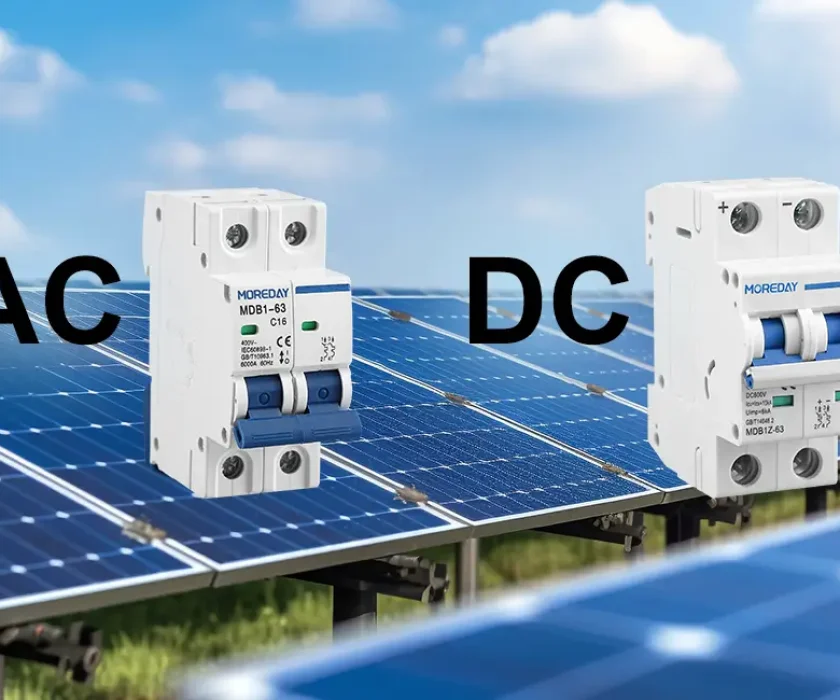
MOREDAY, based in China, has built its reputation on quality, technical innovation, and customer-centric OEM/ODM solutions. The company’s product range spans AC and DC circuit protection — including breakers purpose-built for solar PV and energy storage systems, a segment where general-purpose breakers often fall short on DC arc-interruption requirements. With internationally recognized certifications and a growing global distribution footprint, MOREDAY has continued to gain traction as a reliable OEM/ODM partner, particularly for solar, storage, and EV charging applications.
MOREDAY homepage: https://moreday.com/

10. Chint
Chint remains one of the largest Chinese manufacturers of electrical equipment, including circuit breakers. Known for cost-effective, durable products, Chint continues to hold a strong position in both domestic and emerging international markets.
Chint homepage: https://www.chint.com/

3. Circuit Breaker Market Trends to Watch
Smart and AI-Assisted Circuit Breakers
Smart grid and IoT integration continue to push breakers beyond simple trip functions. The newer generation adds predictive maintenance powered by usage-pattern analysis — flagging a breaker likely to fail before it actually does, rather than after an outage. Remote monitoring and automatic load adjustment are increasingly standard rather than premium features.
DC and Solar-Specific Protection
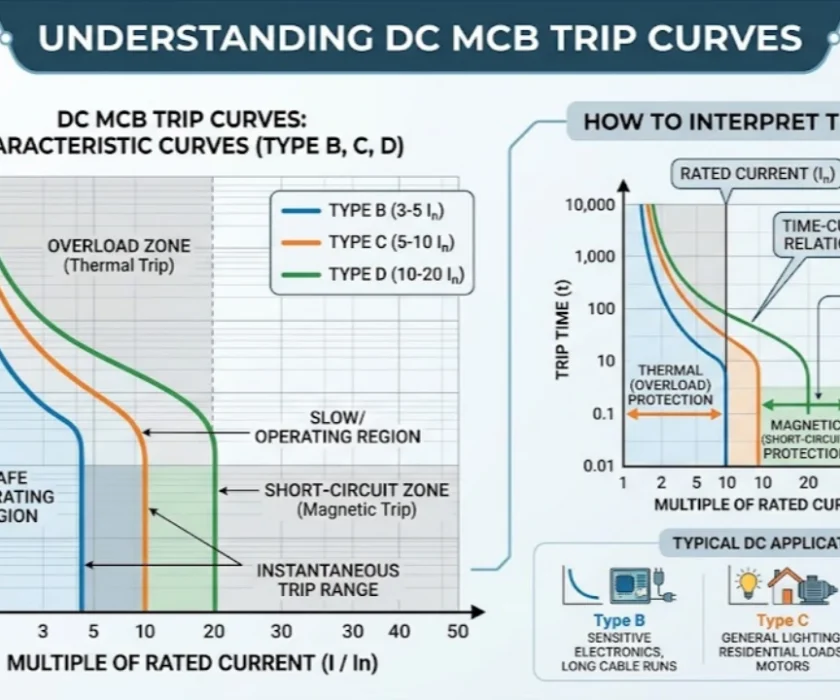
As distributed solar, battery storage, and EV charging infrastructure scale up, demand has shifted toward circuit breakers engineered specifically for DC arc characteristics — not AC breakers repurposed for DC use. This is one of the fastest-growing segments in circuit protection, and it’s an area where manufacturers with dedicated PV/DC product lines (rather than general-purpose catalogs) tend to have a real technical edge.
Energy Efficiency and Sustainability
Manufacturers continue to prioritize energy-efficient designs and lower-impact materials in production. Reduced energy loss and smaller environmental footprints are now baseline expectations from commercial buyers, not differentiators.
Customization and OEM/ODM Services
As electrical systems become more application-specific, OEM and ODM services have grown in importance — particularly for companies building integrated solar, storage, or EV charging products that need protection components matched precisely to their system architecture.
4. How to Choose the Right Circuit Breaker Manufacturer
Quality and Certification
Confirm the manufacturer holds relevant certifications — UL, CE, IEC, or region-specific equivalents — for your target market. Certification isn’t a formality; it’s the baseline evidence that the product has been independently tested against safety standards.
Technology and Innovation
Favor manufacturers actively investing in R&D — particularly those offering smart monitoring, DC-specific product lines (if relevant to your application), and integration with automation systems.
Customer Support and After-Sales Service
Technical support, spare parts availability, and troubleshooting responsiveness often matter more over the life of a project than the initial purchase price.
Price vs. Value
A slightly higher upfront cost for a quality breaker is almost always cheaper than the downstream cost of an electrical failure. Weigh total cost of ownership, not just the unit price on a quote.
5. MOREDAY: A Circuit Breaker Manufacturer Built for Solar, Storage, and EV Applications
MOREDAY has focused its product development specifically on the protection needs of solar PV, energy storage, and EV charging systems — rather than trying to be a general-purpose breaker supplier. That focus shows up in a few concrete ways:
- DC-specific engineering: Product lines built around DC arc-interruption characteristics, not AC breakers adapted after the fact.
- OEM/ODM flexibility: Tailored solutions for businesses integrating circuit protection into their own solar, storage, or charging products.
- Recognized certifications: Products tested and certified to meet international safety and performance standards.
- End-to-end support: Technical assistance, production capacity, and after-sales service built around the pace that solar and EV manufacturers actually operate at.
Conclusion: Choosing the Right Circuit Breaker Manufacturer
The right circuit breaker manufacturer can make the difference between an electrical system that quietly does its job for a decade and one that becomes a recurring maintenance problem. Weigh certifications, technical fit for your application (especially if DC or solar is involved), and after-sales support alongside price. Among the manufacturers covered here, MOREDAY stands out for buyers specifically working in solar, storage, and EV charging, where general-purpose breakers often aren’t the right technical fit.
FAQs
1. What is the role of a circuit breaker in electrical safety? A circuit breaker protects electrical circuits from overloads and short circuits by interrupting the flow of electricity when a fault is detected, preventing equipment damage and fire hazards.
2. What are smart circuit breakers? Smart circuit breakers add remote monitoring, real-time data collection, and predictive maintenance capabilities, integrating with smart grids and automated energy management systems.
3. Why choose MOREDAY for circuit breaker needs? MOREDAY offers circuit breakers engineered specifically for solar, storage, and EV charging applications, backed by OEM/ODM flexibility and international certifications.
4. How can I verify the quality of a circuit breaker? Check for international certifications such as UL, CE, or IEC — these confirm the product has been tested against recognized global safety and performance standards.
5. Do I need a different circuit breaker for solar or DC applications? Yes. DC arcs behave differently from AC arcs and require breakers specifically rated for DC interruption. Using an AC-rated breaker in a DC circuit is a common and risky mismatch.
Recommended reading: Why Circuit Breakers DON’T Protect People?