
Distribution
IEC 60947-2 DC circuit breaker certification is the first thing a project engineer should verify — before current rating, before breaking capacity, before price. A breaker that carries the wrong certification for its intended market may pass every visual inspection and still fail a commissioning audit, delay grid connection by weeks, or void an insurance policy on a completed installation.
Yet certification markings are among the least-understood elements on a circuit breaker’s nameplate. Most buyers can read a current rating. Far fewer can explain the difference between Icu and Ics, what a CB Scheme certificate actually confirms, or why a UL 489-listed breaker cannot simply be substituted for an IEC 60947-2 certified device on a European PV project — even if the headline ampere rating is identical.
This guide demystifies DC circuit breaker certification: what IEC 60947-2 and UL 489 actually test, how their ratings structures differ, which standard applies to your project and market, and how to verify that the certification on a device’s label is genuine and applicable.
Why DC Circuit Breaker Certification Standards Exist
A certification standard for DC circuit breakers is not a design specification. It does not tell a manufacturer how to build a breaker. It defines a set of performance tests that a finished device must pass to be sold under that standard’s mark — and it defines exactly how those tests must be conducted, in what sequence, under what conditions, and using how many samples.
This distinction matters because two breakers with identical nameplate ratings can behave very differently under fault conditions, depending on their internal design. The standard’s job is to establish a minimum performance floor — a guarantee that any device carrying the DC circuit breaker certification has demonstrated, in an accredited laboratory, that it can interrupt its rated fault current, survive its rated number of operating cycles, and operate reliably across its rated temperature and voltage range.
What certification does not guarantee: that the device is optimal for your specific application, that it will perform at the upper limit of its rated range under all conditions, or that a device certified under one standard is equivalent to one certified under another. These are engineering judgments that sit above and beyond the certification baseline.
IEC 60947-2: The Global DC Circuit Breaker Certification Standard
The IEC 60947-2 DC circuit breaker certification standard is published by the International Electrotechnical Commission and covers low-voltage circuit breakers for industrial and similar applications, including devices used in solar PV, battery energy storage, and EV charging infrastructure. It applies to devices rated up to 1500V DC — which encompasses the full voltage range of current solar and storage systems.
The Dual Breaking Capacity Rating: Icu and Ics
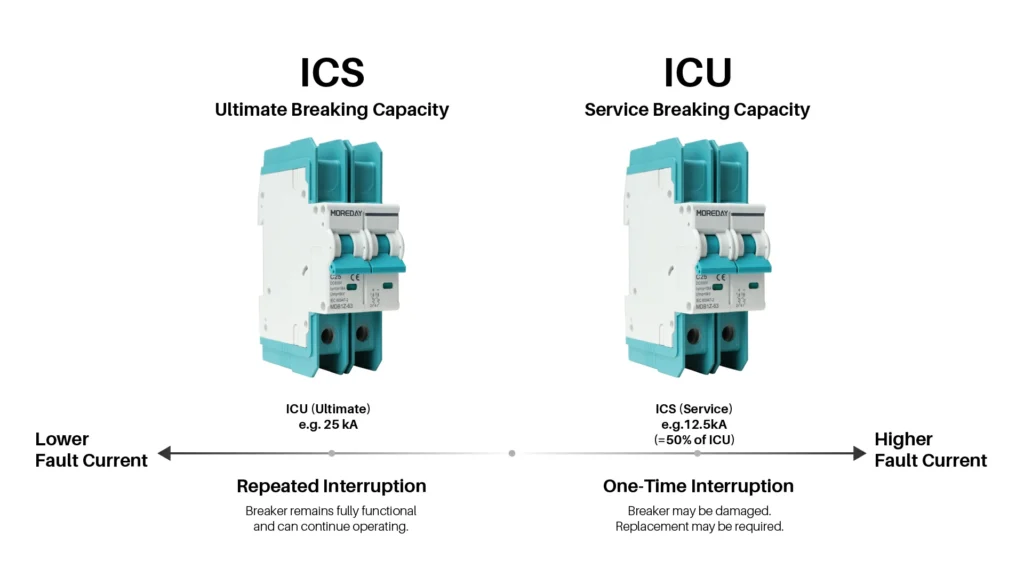
The most important technical distinction of any IEC 60947-2 DC circuit breaker is its two-tier breaking capacity system. Every IEC 60947-2 DC circuit breaker carries two separate fault interruption ratings:
Icu — Ultimate Breaking Capacity: The maximum fault current the breaker can interrupt once, under defined test conditions. After interrupting a fault at Icu, the breaker is not required to remain functional — it may need replacement. This is the absolute ceiling of the device’s fault interruption capability.
Ics — Service Breaking Capacity: The fault current the breaker can interrupt while remaining fully functional and ready to operate again immediately. Ics is always expressed as a percentage of Icu — typically 25%, 50%, 75%, or 100% depending on the device class. A breaker with Icu of 25 kA and Ics of 50% Icu has a service breaking capacity of 12.5 kA: it can interrupt 12.5 kA faults repeatedly in service and still remain operational.
Why this distinction matters in practice: In a solar PV combiner or battery system, the DC circuit breaker may need to interrupt a fault and then remain in service — allowing the rest of the system to continue operating while the fault is investigated and cleared. If you size your protection purely on Icu, you may be selecting a device that technically passes a single-fault test but will require replacement after every significant fault event. For installations where operational continuity matters, Ics is the more relevant specification.
The common mistake: Comparing the Icu of one manufacturer’s device against the single interrupting rating of another without understanding that these may represent fundamentally different post-fault service expectations.
IEC 60947-2 DC Circuit Breaker Test Sequence: Why Order Matters
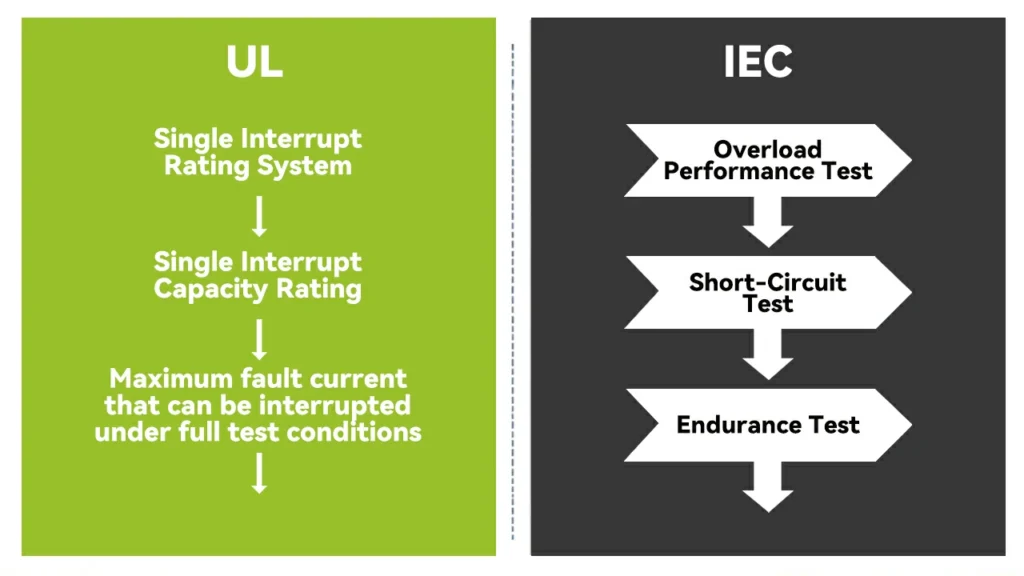
One of the distinguishing features of IEC 60947-2 DC circuit breaker testing — compared to UL testing methodology — is its sequential test structure. The same physical test samples undergo multiple tests in a prescribed order: overload performance tests first, followed by short-circuit tests, followed by endurance tests. A single set of samples must survive all three stages.
This sequential approach captures cumulative stress effects that separate testing of fresh samples would miss. A breaker whose contacts have been stressed by overload testing must still demonstrate reliable fault interruption at short-circuit current levels. A device weakened by overload and short-circuit testing must still complete its rated mechanical and electrical endurance cycle count.
The practical implication: IEC 60947-2 certified DC circuit breakers have demonstrated performance under conditions that simulate real-world cumulative stress — not just isolated performance in ideal laboratory conditions. This is one reason IEC certification carries significant weight with project engineers specifying equipment for long-service-life applications.
DC-Specific Requirements in IEC 60947-2
Every IEC 60947-2 DC circuit breaker must meet DC-specific requirements that go beyond its AC counterpart, including:
- DC voltage ratings independent of AC ratings: A device certified at 1000V AC is not automatically rated for 1000V DC. The standard requires separate DC testing, and the DC voltage rating will typically be lower than the AC voltage rating for the same physical device due to the arc extinction challenges in DC circuits.
- Polarity and connection requirements: For polarized DC breakers, the standard specifies testing in the defined polarity. Non-polarized DC breakers must be tested in both polarities.
- Series connection of poles: DC circuit breakers that achieve their voltage rating by connecting multiple poles in series — a common approach for achieving high DC voltage ratings in multi-pole devices — must be tested in the series-connected configuration, not pole by pole.
UL 489: The North American Standard
UL 489 is maintained by Underwriters Laboratories and governs molded-case circuit breakers for branch circuit protection in North American markets. It is the mandatory certification framework for circuit breakers installed in the United States and Canada under the National Electrical Code (NEC) and Canadian Electrical Code (CEC).
Single Interrupting Rating vs Icu/Ics
The most immediate structural difference between UL 489 and IEC 60947-2 is UL’s single interrupting rating system. Under UL 489, a circuit breaker carries one interrupting capacity value — the maximum fault current it can interrupt under full test conditions. There is no Icu/Ics distinction: the UL interrupting rating corresponds most closely to Ics at 100% — the device must remain functional after interrupting its rated fault current.
This means that on a headline comparison, a UL 489 breaker’s interrupting rating and an IEC 60947-2 device’s Ics rating are the most comparable figures — not Icu. Comparing a UL 489 interrupting rating directly to a device’s Icu will make the IEC device appear more capable than the comparison actually justifies.
UL 489 vs UL 1077: A Critical Distinction
Within the US market, two different UL standards apply to circuit breaker-like devices, and the distinction between them matters significantly for solar PV and DC system applications:
UL 489 — Branch Circuit Protection: The full-strength circuit breaker standard. UL 489 devices are “Listed” — they carry the UL Listed mark and are approved for branch circuit protection. They must demonstrate 6,000-cycle mechanical endurance and interrupting capacity of 10 kA or higher. UL 489 is the appropriate standard for DC circuit breakers used in main protection roles in solar PV combiners, battery main disconnects, and EV charging supply circuits.
UL 1077 — Supplementary Protection: A lower-tier standard for supplementary overcurrent protectors. UL 1077 devices are “Recognized” — they carry the UR mark, not the UL Listed mark. They have lower endurance requirements and typically lower interrupting capacities than UL 489. They are appropriate for supplementary protection within equipment enclosures, not for branch circuit protection in the main electrical system.
The risk: a device carrying the UR mark (UL 1077 Recognized) may appear visually similar to a UL Listed device and may be marketed using language that implies equivalence. For solar PV string protection, battery protection, or any role defined by NEC as requiring branch circuit protection, only UL 489 Listed devices are code-compliant. UL 1077 devices are not interchangeable with UL 489 for these applications.
UL 489 and Solar PV: NEC 690 Considerations
For solar PV applications in the US market, NEC Article 690 references UL 489 as the applicable standard for overcurrent protection devices used in PV source circuits and PV output circuits. However, not all UL 489 devices are automatically suitable for PV DC applications — the device must also carry a DC voltage rating appropriate for the system voltage, and that DC rating must be explicitly listed on the device’s UL DC circuit breaker certification and nameplate.
A UL 489 breaker rated for 240V AC and used on a 600V DC PV string is not code-compliant, regardless of the UL 489 listing — the DC voltage rating is a separate specification that must be verified independently of the AC certification.
IEC 60947-2 DC Circuit Breaker vs UL 489: Side-by-Side Comparison
| Parameter | IEC 60947-2 | UL 489 |
|---|---|---|
| Governing body | IEC (International) | UL (North America) |
| Market applicability | Europe, Asia, most export markets | US, Canada (NEC/CEC markets) |
| Breaking capacity structure | Dual: Icu (ultimate) + Ics (service) | Single interrupting rating |
| Test sequence | Sequential on same samples | Independent samples per test type |
| Calibration temperature | 30°C (IEC 60947-2) | 40°C (UL 489) |
| Endurance cycles | 8,000+ (electrical + mechanical) | 6,000 cycles minimum |
| DC voltage rating | Up to 1500V DC (explicit DC testing) | DC rating listed separately per device |
| Certification mark | CE marking + CB Scheme | UL Listed mark (UL 489) |
| Equivalent for supplementary use | IEC 60898 (household/MCB) | UL 1077 (supplementary protector) |
The Calibration Temperature Difference
One detail in the comparison table deserves additional attention: IEC 60947-2 calibrates at 30°C, while UL 489 calibrates at 40°C. This means that a device’s thermal trip threshold — the current level at which the bimetallic strip actuates — is set at different ambient references. At elevated temperatures above the calibration reference, both standards require derating, but the starting baseline differs.
In practical terms: a device tested and calibrated under IEC 60947-2 at 30°C will reach its thermal trip threshold at a lower current in a 40°C installation environment than the nameplate rating suggests. This is one reason temperature derating calculations must account for the calibration temperature of the specific device’s certification standard, not simply the device’s nominal rated current.
Other Relevant Standards for DC Circuit Breakers
IEC 60947-2 and UL 489 are the two primary standards, but a complete understanding of DC circuit breaker certification includes several additional standards that appear regularly on device documentation and project specifications:
IEC 60898-3: Covers DC miniature circuit breakers for household and similar installations — the residential and light commercial equivalent of IEC 60947-2 for industrial applications. DC MCBs rated under IEC 60898-3 cover lower current and breaking capacity ranges than IEC 60947-2 devices. Both standards appear in solar PV applications: IEC 60898-3 for smaller residential string protection, IEC 60947-2 for commercial and industrial applications.
IEC 62109-2: Safety of power converters for use in PV power systems. This is the inverter standard, not a circuit breaker standard directly — but it references the DC circuit breaker requirements for transformerless inverters, making it relevant context for specifiers.
IEC 60364-7-712: The installation standard for solar PV power supply systems. References IEC 60947-2 as the applicable circuit breaker standard and sets the framework within which device selection and sizing must occur.
CB Scheme (IECEE): The IEC System of Conformity Assessment for Electrotechnical Equipment and Components. A CB Scheme certificate from an accredited National Certification Body (NCB) is the international recognition mechanism for IEC 60947-2 certified devices. A CB certificate significantly simplifies multi-market certification — a device with CB Scheme certification can be recognized by NCBs in 54 member countries without full re-testing.
How to Read a DC Circuit Breaker Certification Marking
Understanding what to look for on a device’s nameplate and documentation is the practical skill that separates informed procurement from guesswork.
On the Nameplate
A correctly certified IEC 60947-2 DC circuit breaker will show:
- DC voltage rating: Marked with the “—” or “DC” symbol followed by the voltage, e.g., 1000V DC or =1000V. This is separate from any AC voltage rating and confirms the device has been tested for DC operation.
- Icu value: Marked in kA, e.g., Icn 10kA or Icu 25kA. Verify this is a DC-rated Icu, not an AC figure.
- Ics as percentage of Icu: May appear as Ics = 50% Icu or as an absolute value.
- Standard reference: IEC 60947-2 or EN 60947-2 (the European adoption of the IEC standard, technically identical).
- CE mark: Mandatory for sale in European Economic Area markets. Confirms conformity with applicable EU directives including the Low Voltage Directive.
A UL 489 Listed device will show:
- UL Listed mark: The UL circle-U-L symbol. Verify this is the Listed mark, not the Recognized Component mark (UR), for branch circuit applications.
- Interrupting capacity: In amperes or kA, e.g., AIR 10,000A or 10kA AIC. This is the single-tier UL interrupting rating.
- DC voltage rating: Must be explicitly listed for the DC application — e.g., 125V DC (1-pole) or 250V DC (2-pole). Not all UL 489 devices carry DC ratings.
- File number: UL maintains a public database (UL Product iQ) where file numbers can be verified. A genuine UL Listed device will have a verifiable file number in this database.
Verifying Authenticity
Counterfeit or misrepresented certifications are a genuine risk in DC circuit breaker procurement, particularly for high-volume solar PV projects sourcing devices from unfamiliar manufacturers. Two verification steps that take under five minutes:
For IEC/CB Scheme: Search the IECEE CB Scheme database (iecee.org) by manufacturer name or certificate number. Genuine CB certificates are publicly searchable and show the exact product series, ratings, and issuing NCB.
For UL: Search UL Product iQ (iq.ul.com) by manufacturer name, product type, or file number. UL’s database shows the specific products covered by each file number and their exact listed ratings — including whether DC ratings are included.
If a device’s certification cannot be verified through these databases, treat the DC circuit breaker certification as unconfirmed regardless of what the label or datasheet states.
Matching DC Circuit Breaker Certification to Market and Application
The practical decision framework for certification selection:
Project in Europe, Middle East, Africa, Asia, or most export markets: IEC 60947-2 is the baseline requirement. Verify CE marking for European projects. For projects in markets with national adoption of IEC standards (most of the world outside North America), IEC 60947-2 plus CB Scheme certification provides the broadest acceptance.
Project in the United States or Canada under NEC/CEC: UL 489 Listed devices are required for branch circuit protection. Verify the DC voltage rating on the UL listing matches or exceeds the system voltage. For supplementary protection within equipment enclosures (not branch circuit protection), UL 1077 Recognized devices may be acceptable — confirm with the AHJ (Authority Having Jurisdiction).
Projects requiring dual-market compliance: Dual-certified devices carrying both IEC 60947-2 and UL 489 certifications exist and simplify multi-market procurement. They are worth the typically modest price premium for projects with components or equipment destined for both North American and international markets. Verify both certifications independently using the databases described above.
Solar PV in the US: NEC 690 projects require UL 489 Listed devices with explicit DC voltage ratings matching system voltage. IEC 60947-2 devices are not automatically acceptable as substitutes even if their technical ratings exceed the UL 489 device in every parameter — the listing authority (AHJ) requires the applicable US standard.
Common Certification Mistakes in DC Circuit Breaker Procurement
Substituting UL 1077 for UL 489 in branch circuit applications. UL 1077 Recognized devices are not approved for branch circuit protection under NEC. This substitution is common in cost-reduction procurement and is a compliance and safety failure.
Reading Icu as the service-level interrupting capacity. Icu is the once-only ultimate capacity. Ics is the repeatable service capacity. For systems where the breaker must remain functional after fault interruption, Ics is the relevant specification.
Assuming AC certification covers DC operation. An IEC 60947-2 device with AC ratings only has not been tested for DC arc extinction. The DC voltage rating must be explicitly shown on the nameplate and supported by DC-specific test reports.
Not verifying DC voltage rating within a UL listing. Many UL 489 devices are listed for AC operation only, or for DC at voltages much lower than the system voltage. Always verify the specific DC voltage rating in UL Product iQ, not just the presence of a UL mark.
Accepting certificates without database verification. Certificate documents can be forged or misrepresented. Two minutes in the IECEE or UL database is the only reliable way to confirm a certification is genuine, current, and covers the specific product being purchased.
Summary
IEC 60947-2 DC circuit breaker certification and UL 489 are not interchangeable frameworks — they measure different things, use different test methodologies, and apply to different markets. IEC 60947-2’s dual-tier Icu/Ics system, sequential test structure, and 30°C calibration baseline reflect a design philosophy oriented toward cumulative real-world performance. UL 489’s single interrupting rating, independent sample testing, and 40°C calibration baseline reflect North America’s regulatory requirements and grid characteristics.
For any DC circuit breaker procurement, three verification steps are non-negotiable: confirm the correct standard for the project’s market, verify the DC voltage rating is explicitly listed and matches system voltage, and confirm the certification is genuine through the IECEE or UL public databases. Everything else — current rating, breaking capacity, trip curve — sits on top of this DC circuit breaker certification foundation.
For further reading on DC circuit breaker selection principles, see our DC Circuit Breaker: All You Need to Know guide. For device type selection between MCB and MCCB formats, see DC MCB vs DC MCCB: What’s the Difference and How to Choose. For solar PV sizing that references IEC 60364-7-712, see DC Circuit Breaker Solar PV Sizing: 6 Critical Steps.
External references: IEC 60947-2 — Low-voltage switchgear and controlgear, Part 2: Circuit-breakers (iec.ch); UL 489 — Molded-Case Circuit Breakers, Molded-Case Switches and Circuit-Breaker Enclosures (ul.com); IECEE CB Scheme database (iecee.org)