
DistributionEnergy StorageEV ChargingSolar
Every article on this topic tells the same story: manual is cheaper and needs a person, automatic is pricier and needs nobody. That’s accurate, and if your backup source is a portable generator sitting next to your house, it’s probably all you need to know.
It stops being the whole story once solar, battery storage, or EV charging enters the system. At that point “automatic” isn’t just a comfort upgrade — in a lot of jurisdictions it intersects with the same anti-backfeed and anti-islanding rules that govern grid-tied inverters, and the switch’s job shifts from “save someone a walk outside” to “prevent a solar system from energizing a dead grid line while a utility crew is working on it.” That’s a different decision, made for a different reason, and it deserves different guidance than the generator-focused advice everyone else is publishing.
There’s also a real middle option — remote-operated manual switching — that almost nobody mentions, and a detail about how “automatic” switches actually behave that changes how much interruption you really experience.
If you’ve already settled on automatic and are working through the rest of the specification, see ATS sizing, PC vs CB class, transition type, and pole selection.
Quick Answer
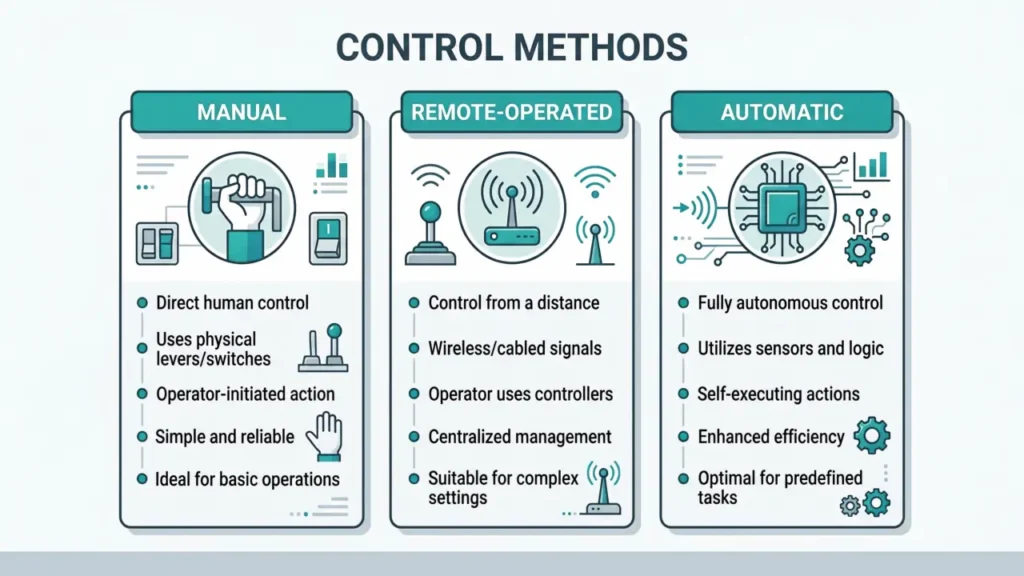
A manual transfer switch (MTS) requires a person to physically operate it — connect the backup source, then move the load over. Lower cost, simpler, and it forces a deliberate human decision at every transfer.
An automatic transfer switch (ATS) senses a source failure and transfers on its own, typically within seconds, and transfers back once the primary source is confirmed stable. Higher cost, no human required, and it can operate while nobody’s home.
For a portable generator and non-critical loads, manual is a completely legitimate, widely used choice. For solar, battery storage, unattended sites, or anything code requires to isolate automatically, automatic is usually the answer regardless of budget preference.
The Middle Option Almost Nobody Mentions
Most guidance presents this as a two-way fork, but there’s a real category between them: a remote-operated (motorized) manual switch. Mechanically and electrically, it’s still a manual transfer switch — there’s no sensing logic deciding when to transfer, no automatic fallback. What’s different is that the physical operating handle is replaced or augmented with a motor that can be triggered from a control room, a building management system, or a remote signal, so a person can make the transfer decision without walking to the switch itself.
This matters for sites where you want a human in the loop — someone confirming the backup source is genuinely ready, rather than a sensor deciding on its own — but the switch is in a location that’s inconvenient, hazardous, or simply far from where the decision gets made. It’s a legitimate middle ground, not a compromise, and it’s worth asking about explicitly if your requirement is “no manual walk to the panel” rather than “no human decision at all.” Not every manufacturer’s manual line includes this option, so if it’s what you need, confirm it’s actually available before assuming a standard manual switch covers it.
What “Automatic” Actually Does, Step by Step
This is the part most articles simplify into “it switches instantly,” and the simplification hides something worth knowing.
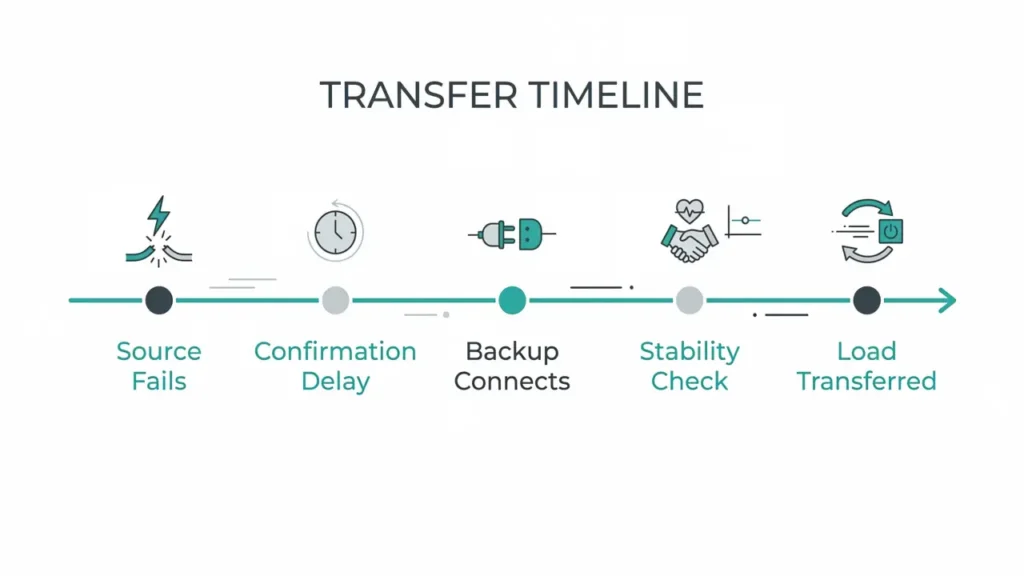
There are two deliberate delays built into a properly designed automatic transfer switch, and both exist on purpose:
A confirmation delay before declaring the source failed. If the switch transferred the instant it saw any dip in voltage, a momentary utility sag — the kind that happens routinely and corrects itself in a fraction of a second — would trigger a full transfer cycle every time. So there’s a short window where the switch waits to see if the source genuinely stays down before doing anything. This is why “automatic” doesn’t mean “instant” in practice; it means “fast, once it’s sure.”
A reconnect delay after the primary source comes back. When utility power returns, most automatic switches don’t transfer back immediately. They wait to confirm the returning source is actually stable — utility power sometimes flickers on and off a few times before settling, especially after storm damage — and only transfer once it holds. Skip this delay and you get a switch that bounces the load back and forth every time the grid hiccups, which is worse for connected equipment than staying on backup a little longer.
Neither delay is a flaw. They’re the reason automatic switches are reliable rather than twitchy. If your application is genuinely time-critical, ask your supplier for the actual transfer time and the actual reconnect delay for the specific model — these are configurable and vary, and “automatic” alone doesn’t tell you the number.
Where Solar and Battery Storage Change the Decision
This is the section the generator-focused articles don’t have a reason to write, because the concern doesn’t exist in a pure utility-plus-generator system.
Backfeed prevention isn’t optional once an inverter is involved. A grid-tied or hybrid solar system connects to the same wiring a utility line worker might be treating as dead during an outage. Preventing that system from energizing the grid side — backfeeding — is a safety requirement, not a nice-to-have, and it’s the same underlying concern that anti-islanding protection in the inverter itself addresses. A manual transfer switch relies entirely on a person doing the right thing at the right time to keep sources isolated. An automatic switch does it by design, every time, without depending on someone remembering the correct sequence during a stressful outage. This is a large part of why automatic switching is treated as close to mandatory, or explicitly required by code, in many grid-tied and hybrid solar installations, rather than being a convenience upsell.
A hybrid inverter often already contains an automatic transfer function internally. Many hybrid and battery inverters detect grid loss and switch their backup output on their own, in milliseconds, with no external ATS involved at all. Before specifying a separate automatic transfer switch, it’s worth establishing exactly what job it’s doing that the inverter isn’t already doing itself — is it managing a source the inverter doesn’t control, such as a generator alongside the solar-plus-battery system, or handling a subpanel the inverter’s own backup output doesn’t reach? Sometimes the honest answer is that the external switch is providing redundancy or handling a source outside the inverter’s scope, and sometimes it reveals that a full automatic ATS is solving a problem the inverter had already solved. Our guide to solar transfer switch applications goes into where an ATS does and doesn’t belong in a PV system, and if you’re also working with fault classification, PC vs CB class covers the equipment side of that.
EV charging load management is a genuinely good use for manual switching, deliberately. Unlike the solar backfeed situation, this is a case where manual isn’t a compromise — it’s often the better design. A manual transfer switch that routes backup power to only a fixed, pre-selected set of circuits can be used deliberately to exclude an EV charger from the backup load during an outage, when generator or battery capacity is limited and you’d rather keep the refrigerator and lighting running than half-charge a car. An automatic whole-system ATS, by contrast, assumes everything downstream gets backup power, which means your generator or battery sizing has to account for EV charging load even during the rare outage when you’d honestly rather it didn’t.
Comparison
| Manual | Remote-Operated | Automatic | |
|---|---|---|---|
| Requires a person present | Yes | No — decision made remotely | No |
| Decision logic | Human judgment | Human judgment, remote trigger | Sensor-based, automatic |
| Typical downtime | Minutes (time to reach site and act) | Seconds to minutes (depends on response) | Seconds |
| Relative cost | Lowest | Mid-range | Highest |
| Load management | Often limited to pre-selected circuits — can be a deliberate advantage | Same as manual, remotely triggered | Typically whole-system |
| Solar/ESS backfeed prevention | Depends entirely on correct human procedure | Depends on correct human procedure, faster to execute | Built into the switching logic |
| Best for | Portable generators, budget-limited or selective-load backup | Unattended or hard-to-access sites where human judgment is still wanted | Solar/ESS systems, unattended sites, code-mandated automatic isolation, continuity-critical loads |
Decision Checklist
- [ ] Is a grid-tied or hybrid inverter part of this system? If yes, check whether automatic isolation is a code requirement in your jurisdiction before treating this as a budget decision.
- [ ] Does your hybrid inverter already switch its own backup output automatically? If yes, clarify exactly what job an external ATS would still be doing.
- [ ] Is the site regularly unattended? That points strongly toward automatic, or at minimum remote-operated.
- [ ] Do you want to deliberately exclude certain loads (like EV charging) from limited backup capacity? Manual, with pre-selected circuits, may be the better design, not the cheaper compromise.
- [ ] Is the switch location hazardous, remote, or simply inconvenient to reach, but you still want a human decision? Ask about remote-operated manual switching specifically.
- [ ] Is any interruption, even a few seconds, unacceptable? Neither manual nor standard automatic switching alone solves that — you need stored energy in the path, with the transfer switch working alongside it, not instead of it.
Common Mistakes
Assuming automatic is always the “better” choice regardless of application. For a portable generator with a person usually on site, manual is a mature, reliable, lower-cost solution — not an inferior one.
Sizing backup capacity without deciding whether EV charging should be included. This is exactly where a manual, selective-circuit design can outperform an automatic whole-system switch, if managed deliberately.
Assuming “automatic” means “instantaneous.” The confirmation and reconnect delays are there on purpose. Ask for the actual numbers if timing matters.
Treating solar backfeed prevention as the transfer switch’s job alone. It’s a system-level safety requirement involving the inverter’s own anti-islanding behavior as well as the switch. Confirm both, and confirm they’re coordinated with each other rather than assuming either one covers it independently.
Forgetting that manual vs automatic is independent of class, transition type, and pole count. All four are separate decisions. A manual switch can still need the correct pole configuration for its earthing system, for example — see 3 pole vs 4 pole ATS.
MOREDAY’s Range
MOREDAY’s NSIS AC Changeover Switch is a manual, panel-operated changeover switch certified to IEC 60947-3, available in 1P/2P/3P/4P configurations, suited to budget-conscious residential and small commercial backup where automated switching isn’t required or where deliberate selective-circuit control is preferred.
For automatic switching, the MDQ2-63 and MDQ3-63 cover residential and small commercial 63A applications, the MDQ5R-100 covers mid-size solar and storage systems, and the MDQ8 covers larger commercial and industrial installations. Browse the full ATS range.
If your project needs a human-in-the-loop decision without a site visit — the remote-operated middle ground described above — talk to MOREDAY’s engineering team about your specific requirement, since this isn’t a standard configuration across every series.
FAQ
Is an automatic transfer switch worth the extra cost for a home generator? If you’re regularly away, have medical equipment that needs uninterrupted power, or simply want the outage handled without going outside, yes. If someone is reliably present and comfortable operating the generator manually, a manual switch is a completely sound, widely used choice.
Do I need an automatic transfer switch for solar? Often yes, particularly for grid-tied or hybrid systems, because of backfeed-prevention requirements — check the specific rules in your jurisdiction. Also check whether your inverter already performs automatic transfer internally before assuming you need a separate one.
Why does my automatic transfer switch take a few seconds instead of switching instantly? Two deliberate delays: a short confirmation period to avoid transferring on a momentary sag, and a longer reconnect delay to make sure the returning source is genuinely stable before switching back. Both improve reliability.
What’s a remote-operated transfer switch? A manual switch — no automatic sensing — with a motorized operator so a person can trigger the transfer remotely instead of walking to the panel. A middle ground for sites where you want human judgment but not a site visit.
Can a manual transfer switch be safer for EV charging specifically? It can be a better fit, not because it’s inherently safer, but because it lets you deliberately exclude EV charging from limited backup capacity — an automatic whole-system switch typically doesn’t make that distinction on its own.
Does the manual vs automatic choice affect pole count or PC/CB class? No, these are independent decisions. A manual switch still needs the correct pole configuration for its earthing system and, where relevant, the correct class.
The Bottom Line
For a straightforward generator-and-utility setup, manual vs automatic really is mostly about cost and convenience, and either answer can be right. Once solar, battery storage, or EV charging is in the system, the question picks up a second dimension — safety and code compliance on one side, deliberate load management on the other — that a generic comparison won’t tell you about.
Work out what your inverter already does automatically before buying a switch to do it again, and if the reason you want automatic is code-driven backfeed prevention rather than convenience, say so when you’re specifying the system — it changes what “automatic” actually needs to guarantee.
Standards referenced: IEC 60947-6-1, Low-voltage switchgear and controlgear — Transfer switching equipment; IEC 60947-3, Switches, disconnectors, switch-disconnectors; IEEE 1547 and UL 1741, interconnection and anti-islanding requirements for distributed energy resources.