
Distribution
The 1000V vs 1500V DC circuit breaker decision is not simply about picking a higher voltage rating for future-proofing. It is a system-level architectural choice that affects every DC protection component in the installation — breakers, fuses, cables, connectors, surge protective devices, and inverters — and one that cannot be made in isolation from the rest of the system design.
The shift toward 1500V DC architecture in solar PV has been rapid. A decade ago, 1000V was the near-universal standard for utility and commercial PV. Today, 1500V systems dominate new large-scale installations because longer strings reduce balance-of-system costs. But that cost reduction comes with engineering trade-offs that are frequently underestimated: higher arc energy, more demanding insulation coordination, a smaller supply base for compliant components, and a full-system replacement requirement if voltage class is changed mid-project.
This guide covers the 1000V vs 1500V DC circuit breaker comparison in full — not just the headline efficiency numbers, but the arc physics, the component ecosystem, the standards landscape, and the decision framework that tells you which voltage class is actually right for your project.
What Changes When You Go From 1000V to 1500V DC
The difference between a 1000V and a 1500V DC circuit breaker is not a 50% scaling of all parameters. The relationship between voltage and arc behavior in DC circuits is non-linear, and understanding this non-linearity is the foundation of the entire 1000V vs 1500V decision.
Arc Energy Scales Faster Than Voltage
When a DC circuit breaker interrupts a fault, the energy that must be dissipated in the arc chamber is proportional to the system voltage, the fault current, and the arc duration. At higher voltage, the arc takes longer to extinguish — because the higher system voltage sustains the arc against the arc chamber’s extinction mechanisms for longer — which means arc duration increases. The combined effect of higher voltage and longer arc duration means that arc energy in a 1500V DC circuit breaker does not increase by 50% relative to a 1000V device. It increases by significantly more.
This is why a 1000V rated DC circuit breaker cannot simply be “upgraded” to 1500V service by de-rating its current. The arc extinguishing chamber — the plates, the blow-out system, the chamber geometry — must be specifically engineered for 1500V DC arc extinction. A device rated at 1000V DC and used at 1500V will fail to extinguish arcs reliably under fault conditions, regardless of whether the current is within its rated range.
Insulation Requirements Escalate Throughout the System
Increasing the system voltage from 1000V to 1500V affects not just the DC circuit breaker, but every insulation interface in the system:
Cable insulation: The dielectric strength of cable insulation must be rated for the maximum system voltage. Moving from 1000V to 1500V typically requires upgrading cable insulation class — not just the circuit breaker.
Connector and junction insulation: PV connectors (MC4 and equivalents), junction box insulation, and terminal block spacing must all be rated for the higher voltage. Creepage and clearance distances specified in IEC 60664-1 increase with voltage, requiring larger physical spacing between conductors at higher voltages.
Surge Protective Device (SPD) ratings: A 1000V DC SPD cannot be used in a 1500V system. The SPD’s maximum continuous operating voltage (Uc) must be at least 120% of the maximum system voltage — meaning a 1500V system requires an SPD with Uc ≥ 1500V, which is a fundamentally different device from a 1000V SPD.
Inverter DC input: The inverter must be specifically rated for 1500V DC input. Not all inverter platforms support both voltage classes — many 1000V platform inverters cannot be field-upgraded to accept 1500V string inputs.
The practical implication: transitioning a project from 1000V to 1500V is not a matter of swapping circuit breakers. Every component with a DC voltage interface must be re-specified and replaced. This makes mid-project or mid-lifecycle voltage class changes extremely expensive.
1000V DC Circuit Breakers: Where They Still Win
Despite the industry momentum toward 1500V, the 1000V vs 1500V DC circuit breaker decision is not automatically resolved in favor of 1500V for every application. There are specific scenarios where 1000V is the correct and more economical choice.
Residential and Small Commercial PV
Residential solar installations and small commercial rooftop systems typically use fewer modules per string — commonly 20–30 panels — with per-module Voc in the 40–55V range. At these string sizes, the maximum temperature-corrected system voltage often falls comfortably within the 1000V ceiling:
20 modules × 50V Voc × 1.15 temperature correction = 1150V — which would require a 1500V system. But 16 modules × 50V Voc × 1.15 = 920V — which fits within 1000V architecture with margin.
For systems where the string design naturally falls within 1000V, upgrading to 1500V adds component cost (1500V-rated breakers, fuses, and SPDs carry a 30–50% price premium over equivalent 1000V devices) without delivering the efficiency or cable cost savings that justify 1500V in large ground-mount projects.
Additionally, the component ecosystem for 1000V DC protection is more mature and more broadly available than for 1500V. In markets where 1500V-rated inverters, breakers, and fuses from multiple manufacturers are not yet consistently available, 1000V architecture offers supply chain reliability that 1500V cannot always match.
Retrofit and Expansion Projects
Existing solar installations designed and built for 1000V DC operation cannot be partially upgraded to 1500V. Adding new strings at 1500V to an existing 1000V combiner box is not permissible — the combiner box’s internal busbar, breakers, fuses, and SPDs are all rated for 1000V maximum. If the expansion requires 1500V strings, a separate 1500V protection circuit and combiner infrastructure must be installed in parallel.
For retrofit and capacity expansion projects on existing 1000V systems, specifying 1000V DC circuit breakers for the new strings maintains system consistency, simplifies maintenance, and avoids the cost and complexity of parallel voltage-class infrastructure.
1500V DC Circuit Breakers: The Case for Higher Voltage
The primary economic argument for 1500V DC architecture is straightforward and well-established: longer strings mean fewer strings, fewer strings mean fewer combiner inputs, and fewer combiner inputs mean less DC cabling, fewer protection devices, and lower balance-of-system installation costs.
String Length and System Economics
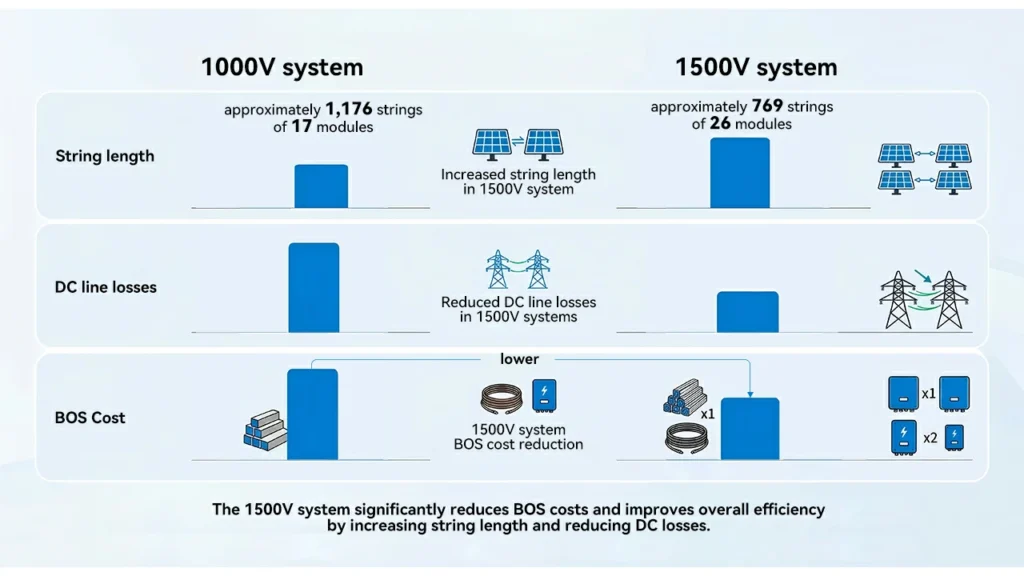
At 1500V DC, a string using modules with 50V Voc can accommodate up to 26 modules in series before approaching the temperature-corrected voltage ceiling (26 × 50V × 1.15 = 1495V). The same modules in a 1000V system are limited to approximately 17 in series (17 × 50V × 1.15 = 977.5V).
For a 10 MW ground-mount project:
- 1000V architecture: approximately 1,176 strings of 17 modules (assuming ~8.5 kWp per string)
- 1500V architecture: approximately 769 strings of 26 modules (assuming ~13 kWp per string)
The reduction from 1,176 to 769 strings translates directly to fewer combiner box inputs, shorter total DC cable run length, fewer DC circuit breakers, and reduced installation labor. Field data from large projects consistently shows DC collection cost reductions of 15–25% when transitioning from 1000V to 1500V architecture — a significant saving at utility scale that more than offsets the 30–50% component cost premium of 1500V-rated protection devices.
Inverter Efficiency at Higher DC Voltage
Modern central and string inverters operating at 1500V DC input voltage can achieve slightly higher conversion efficiency compared to the same inverter platform at lower DC voltage, because higher DC voltage at a given power level means lower DC current — and lower current means lower resistive losses in the DC wiring and within the inverter’s input stage. This efficiency gain is typically modest (0.1–0.3 percentage points), but at utility scale and over a 25-year project life, even small efficiency improvements translate to meaningful additional generation revenue.
Module Technology Trends Favor 1500V
Current high-efficiency module technology — large-format modules with cell counts of 144 and higher — is producing Voc values of 55–65V per module. At these Voc levels, 1000V architecture limits string length to 13–15 modules, which is short enough to require more parallel strings and more combiner infrastructure than is economically optimal. 1500V architecture accommodates 20–22 modules at these Voc levels, enabling the longer strings that match current module economics.
This trend is accelerating. As module technology continues to push toward higher voltages, 1000V architecture will become increasingly constraining for new-build projects using current-generation panels, and 1500V will become the practical default for all but the smallest systems.
1000V vs 1500V DC Circuit Breaker: Technical Comparison
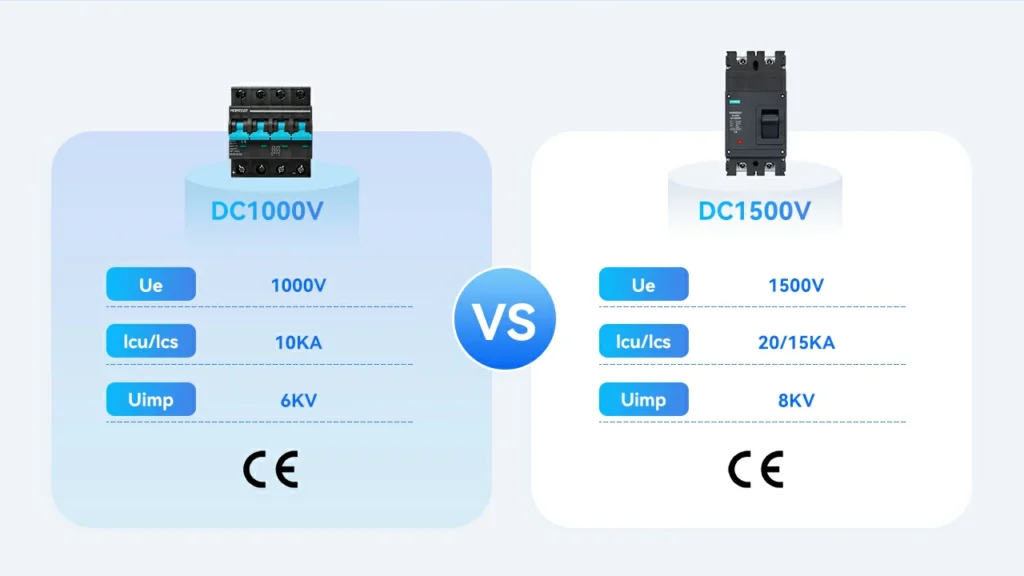
| Parameter | 1000V DC Circuit Breaker | 1500V DC Circuit Breaker |
|---|---|---|
| Maximum system voltage | 1000V DC | 1500V DC |
| Arc chamber design | Standard DC arc plates, moderate blow-out | Enhanced arc plates, stronger magnetic blow-out |
| Typical breaking capacity | 6–25 kA (MCB), 25–100 kA (MCCB) | 6–15 kA (MCB), 25–65 kA (MCCB) |
| Component cost premium | Baseline | 30–50% above 1000V equivalent |
| Component availability | Broad, mature supply base | Narrower, growing supply base |
| Applicable standards | IEC 60947-2, IEC 60898-3, UL 489 | IEC 60947-2 (1500V DC clause), specific testing required |
| Typical application | Residential, small commercial, retrofit | Large commercial, utility-scale, ground-mount |
| String length (50V Voc modules) | Up to ~17 modules | Up to ~26 modules |
| System-level DC cable savings | Baseline | 15–25% reduction at scale |
Breaking Capacity Differences
One important and often overlooked difference in the 1000V vs 1500V DC circuit breaker comparison is breaking capacity. While 1500V devices must handle higher arc energy, the practical maximum breaking capacity available in 1500V-rated DC MCBs is typically lower than in equivalent 1000V MCBs — because the arc chamber design required for 1500V operation uses more physical space within the device envelope, leaving less room for the arc splitting plates and blow-out magnets that contribute to higher breaking capacity.
For 1500V systems where high breaking capacity is required — particularly at the combiner output or main disconnect level — DC MCCBs are almost always the appropriate solution rather than DC MCBs. The MCCB’s larger physical envelope accommodates both the enhanced arc extinction required for 1500V operation and the breaking capacity needed for the higher fault currents that larger parallel arrays produce.
Standards and Certification for 1500V DC Circuit Breakers
The 1000V vs 1500V DC circuit breaker distinction is explicitly addressed in IEC 60947-2, which covers DC circuit breakers up to 1500V DC. However, the 1500V DC ratings require separate and additional testing compared to the 1000V ratings — a device’s IEC 60947-2 certification at 1000V DC does not automatically extend to 1500V DC operation.
When specifying 1500V DC circuit breakers, verify:
- The device’s IEC 60947-2 certificate explicitly states 1500V DC as the rated operational voltage
- The DC-specific test reports confirm performance at 1500V — not at 1000V with a claimed extrapolation
- The breaking capacity (Icu and Ics) figures are certified at 1500V, not at a lower voltage
For North American projects, UL 489 currently covers DC breakers up to 1000V DC for most listed devices. At 1500V DC, NEC 690 projects may require alternative listing arrangements or special inspection — consult the Authority Having Jurisdiction (AHJ) early in the design process for 1500V DC US projects, as listing availability for 1500V DC circuit breakers under US standards is less uniform than under IEC.
Altitude Considerations: When 1000V Becomes 1500V Territory
One scenario that bridges the 1000V vs 1500V DC circuit breaker boundary is high-altitude installation. As discussed in our DC Circuit Breaker Solar PV Sizing guide, reduced air density at altitude impairs DC arc extinction, requiring a voltage derating of approximately 1% per 100m above 2000m altitude.
At 3500m altitude, a 1000V-rated DC circuit breaker must be derated to approximately 85% of its sea-level voltage rating — meaning it should be treated as a 850V DC device at that altitude. If your temperature-corrected system voltage is 900V, a 1000V breaker at 3500m is undersized even though the system voltage is within the 1000V ceiling at sea level. In this scenario, a 1500V DC circuit breaker — derated to approximately 1275V DC at 3500m — provides the necessary margin.
High-altitude PV installations in mountain regions, plateau environments, or elevated terrain must account for this derating. Failing to do so results in a circuit breaker that cannot reliably extinguish DC arcs under fault conditions, despite carrying a voltage rating that appears adequate from the nameplate alone.
The Decision Framework: Which to Choose
Choose 1000V DC circuit breakers when:
- System maximum voltage (temperature-corrected Voc × string length) falls below 900V with margin
- Installation is residential or small commercial (fewer than 20 strings in parallel)
- Project is a retrofit or expansion of an existing 1000V system
- Local supply chain for 1500V components is limited or lead times are extended
- Budget constraints make the 30–50% component premium difficult to justify against system-level savings at the given project scale
- AHJ or grid connection authority requires 1000V maximum for the installation category
Choose 1500V DC circuit breakers when:
- Temperature-corrected maximum string voltage exceeds 1000V (requiring 1500V regardless of economic preference)
- Project is large commercial or utility-scale (100 kWp and above) where DC cable and combiner savings outweigh component premium
- Module technology produces Voc above 55V per module, constraining 1000V string lengths unacceptably
- Inverter platform is 1500V-native and full system design is optimized around 1500V architecture
- Future expandability to higher power at the same site is a design requirement
The non-negotiable rule:
Never mix voltage classes within a single combiner box or DC protection circuit. 1000V and 1500V strings cannot share a common combiner box, busbar, or protection device. If a project uses both voltage classes — for example, an existing 1000V phase and a new 1500V expansion — they must be treated as entirely separate electrical systems with separate protection infrastructure from string to inverter.
Summary
The 1000V vs 1500V DC circuit breaker decision is ultimately determined by system voltage — if temperature-corrected string Voc exceeds 1000V, the choice is made for you. Where both options are technically viable, the decision hinges on project scale: 1500V’s system-level cost advantages materialize meaningfully at large commercial and utility scale, while 1000V remains the practical and cost-effective choice for residential, small commercial, and retrofit applications.
Whatever voltage class is selected, every DC component in the protection chain — circuit breakers, fuses, SPDs, cables, connectors, and inverters — must carry voltage ratings appropriate to that class. A 1500V system with a single 1000V-rated component is not a 1500V system — it is a 1000V system with an undersized weak point waiting to fail.
For a full overview of DC protection principles, see our DC Circuit Breaker: All You Need to Know guide. For sizing methodology that applies to both voltage classes, see DC Circuit Breaker Solar PV Sizing: 6 Critical Steps. For certification requirements covering both 1000V and 1500V devices, see DC Circuit Breaker Certification: IEC vs UL 489 Guide.
External references: IEC 60947-2 — Low-voltage switchgear and controlgear, Part 2: Circuit-breakers (iec.ch); IEC 60364-7-712 — Requirements for special installations: Solar photovoltaic power supply systems (iec.ch)