
Distribution
When sizing protection devices for a solar PV string, a battery rack, or a DC distribution panel, the DC MCB vs DC MCCB decision comes up almost every time. Both interrupt DC fault current — but treating them as interchangeable is one of the most common mistakes in DC system design.
This guide breaks down the real differences between DC Miniature Circuit Breakers and DC Molded Case Circuit Breakers: not just the spec-sheet numbers, but the engineering reasoning behind them, and a clear decision framework so you always pick the right one for your application.
What They Have in Common (and Why That Can Be Misleading)
DC MCBs and DC MCCBs share the same fundamental job description: detect abnormal current, open the circuit, and extinguish the DC arc safely before it causes damage. Both contain contacts, a trip mechanism, and an arc extinguishing chamber. Both are rated for DC voltage (look for the “−−−” symbol and a voltage rating like 1000V DC on the label). Both are used in solar PV systems, battery energy storage, and EV charging infrastructure.
This overlap is exactly what makes the comparison tricky. A 100A DC MCB and a 100A DC MCCB look similar on a datasheet. In practice, they serve very different roles — and selecting based on current rating alone, without considering breaking capacity, adjustability, and the scale of the system, is where problems begin.
DC MCB vs DC MCCB: Core Differences One by One
1. Physical Scale and Current Range
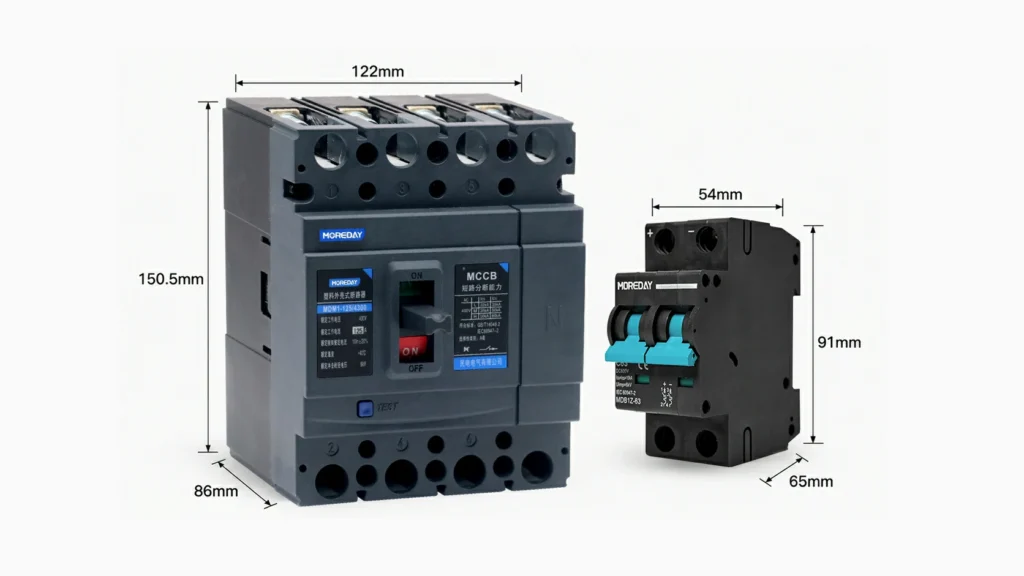
A DC MCB is a compact, DIN rail-mounted device. Its modular form factor — typically 18mm wide per pole — is designed to snap onto standard 35mm DIN rail in seconds, making it ideal for panel boards and combiner boxes where space is at a premium. The practical current ceiling for DC MCBs is 125A, with common ratings running from 1A up through 63A and 100A.
A DC MCCB is a larger, bolted device with a molded case housing — typically made from high-grade thermoset material with a V-0 flame rating. It’s designed for panel mounting rather than DIN rail, and it handles current ranges from around 16A up to 3000A or more, covering everything from sub-main distribution to large-scale utility protection. The physical difference is immediately obvious side by side: a 400A MCCB is roughly the size of a hardcover book; a 100A MCB is narrower than your hand.
Practical implication: For individual string protection in a residential solar system, or branch circuit protection in a combiner box, a DC MCB is the natural choice. For the main DC disconnect on a large-scale solar farm, a battery energy storage system, or a commercial DC distribution panel, you need an MCCB.
2. Breaking Capacity (Icn) — The Number Most Buyers Overlook
Breaking capacity is the maximum fault current a circuit breaker can safely interrupt without being destroyed in the process. This is arguably the most important number in DC circuit breaker selection, and it’s where MCBs and MCCBs diverge most sharply.
Standard DC MCBs typically offer 6 kA to 10 kA breaking capacity, with high-performance models reaching 15–25 kA. DC MCCBs, by contrast, routinely deliver 25 kA to 150 kA, with industrial-grade units going higher still.
Why does this matter? In large solar arrays or battery banks, the available fault current — the current that would flow during a short circuit at that point in the system — can easily exceed 15 kA or 20 kA. If a MCB with a 10 kA rating encounters a 20 kA fault, it cannot interrupt the current safely. The arc will not be extinguished, contacts will melt, and the device itself becomes a fire hazard. This is not a theoretical scenario — it’s a failure mode that field engineers encounter in undersized systems.
Rule of thumb: Always calculate the maximum prospective short-circuit current (PSCC) at the point of installation, then select a device whose breaking capacity exceeds that figure with a reasonable margin. Never assume a MCB is adequate for a high-current node just because its continuous current rating matches.
3. Trip Settings: Fixed vs Adjustable
Every DC circuit breaker has a trip unit — the internal mechanism that decides when to open. In a DC MCB, that trip unit is fixed at the factory. A 32A C-curve MCB will always trip thermally at roughly 1.45× its rated current, and magnetically at 5–10×. You cannot change these thresholds in the field. This is by design: fixed settings mean consistent, predictable behaviour and zero risk of field misconfiguration.
DC MCCBs take a different approach. Depending on the model, they offer:
- Adjustable thermal (overload) trip: Typically settable from 0.4× to 1.0× the rated current, allowing you to tune the device to the actual continuous current of the load rather than the breaker’s nameplate rating.
- Adjustable magnetic (short-circuit) trip: Usually settable across a range such as 2×–10× rated current, which is critical for achieving selectivity — ensuring that only the breaker closest to the fault trips, rather than upstream devices.
- Electronic trip units (on premium MCCBs): Fully programmable long-time, short-time, and instantaneous protection, plus optional ground fault detection, time-delayed tripping, and communication interfaces.
Practical implication: In a small residential PV system where each string is similar and the wiring is straightforward, fixed MCB trip settings work perfectly. In a complex commercial system with varying load profiles, or where upstream/downstream protection coordination is required by code or engineering specification, the adjustability of an MCCB is not a luxury — it’s a necessity.
4. Arc Extinguishing Architecture
Both device types must solve the same fundamental problem: DC arcs are persistent and dangerous because, unlike AC, the current never naturally crosses zero. The solutions are similar in principle but differ in scale.
In a DC MCB, the arc extinguishing chamber contains a series of metal plates (arc splitter plates) that divide the arc into segments, raising the arc voltage above the system voltage to force extinction. The chamber is compact and efficient for lower current and voltage levels.
In a DC MCCB, the arc extinguishing system is larger and more robust — it needs to handle the higher energy content of faults at greater current and voltage. Many DC MCCBs also incorporate a more powerful magnetic blowout system, where the magnetic field generated by the fault current is deliberately used to drive the arc into the chamber more forcefully, accelerating extinction at high fault levels. This is why a DC MCCB of the same voltage rating as a DC MCB can safely interrupt much larger fault currents.
A note on voltage ratings: The arc extinguishing chamber is voltage-rated, not just current-rated. A MCB marked “250V DC” cannot be safely used in a 1000V DC string circuit, even if the current is within range. Always verify that the device’s DC voltage rating equals or exceeds the maximum open-circuit voltage of your system, with a margin that accounts for temperature and tolerance.
5. Enclosure, Environment, and Longevity
DC MCBs are housed in thermoplastic enclosures — lighter and adequate for indoor, controlled environments. Their internal components are not field-serviceable; if a MCB has interrupted a major fault, the standard recommendation is to replace it entirely, since internal arc damage may compromise future performance even if the device resets normally.
DC MCCBs use heavier, more durable molded case construction — typically glass-filled thermoset resin with superior thermal resistance and impact strength. Some MCCB models are partially field-serviceable, with replaceable contact assemblies and arc chutes. For installations in harsh outdoor environments, high-altitude sites, or applications where the breaker may trip repeatedly under demanding conditions, the more robust construction of the MCCB is a meaningful advantage.
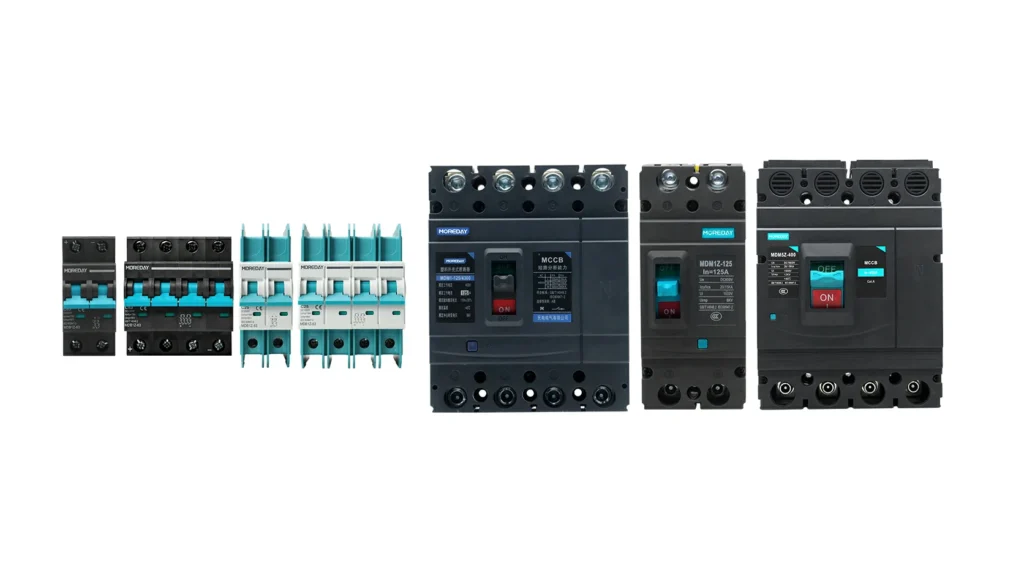
DC MCB vs DC MCCB: Core Differences at a Glance
DC MCB vs DC MCCB
| DC MCB vs DC MCCB | DC MCB | DC MCCB |
|---|---|---|
| Current range | 0.5 A – 125 A | 16 A – 3000 A+ |
| Typical breaking capacity | 6 – 25 kA | 25 – 150 kA |
| Trip settings | Fixed (factory-set) | Adjustable (thermal + magnetic) or electronic |
| Mounting | DIN rail (35 mm) | Panel mount (bolted) |
| Physical size | Compact, modular | Larger, fixed enclosure |
| Voltage rating (DC) | Up to 1500 V DC | Up to 1500 V DC |
| Trip curves | B, C, D | Custom / electronic |
| Field serviceability | Non-serviceable | Limited to full |
| Typical application | String / branch / sub-circuit | Main / feeder / distribution |
| Cost per unit | Lower | Higher |
| Best for | Residential PV, small BESS, combiner boxes | Commercial PV, large BESS, industrial DC |
How to Choose: DC MCB vs DC MCCB A Decision Framework
Rather than prescribing a single rule, the right choice depends on where you are in the system and what the system demands. Here is a straightforward decision path:
Step 1 — Determine the continuous load current. If the maximum continuous current at this point in the circuit is below 100–125A, a DC MCB is physically capable of handling it. Above that threshold, an MCCB is required by rating alone.
Step 2 — Calculate the prospective short-circuit current (PSCC). This requires knowing the source impedance at the fault point. For string-level protection in typical residential PV (few panels, long cable runs), PSCC is usually well within MCB breaking capacity. For main DC combiner outputs, battery bank terminals, or high-capacity charging infrastructure, PSCC can exceed 20–50 kA — requiring an MCCB.
Step 3 — Assess the need for coordination. In multi-tier protection systems (string breaker → combiner breaker → main breaker), selectivity is critical: only the device closest to the fault should trip. Achieving this without adjustable trip settings is possible in simple systems, but in complex installations, MCCB adjustability is the practical path to reliable coordination.
Step 4 — Consider the installation environment. Indoor residential combiner box with standardised strings? DC MCBs are the efficient, cost-effective choice. Outdoor industrial panel, high-altitude site, or an installation subject to repeated fault events? The robustness of an MCCB is worth the investment.
Step 5 — Check voltage rating against system voltage. This applies equally to both device types. A string circuit at 1000V DC requires a breaker rated for at least 1000V DC. Never use a device whose DC voltage rating falls below system maximum open-circuit voltage.
Common Mistakes to Avoid
Using an MCB where the breaking capacity is insufficient. A breaker that cannot interrupt a fault is worse than no breaker at all — it becomes an ignition point. Always verify PSCC against Icn.
Selecting an MCCB when an MCB would do. Over-engineering at the branch circuit level is wasteful. MCBs are purpose-built for string and sub-circuit protection; using a bulky MCCB where a compact MCB is adequate adds cost, takes panel space, and complicates maintenance without improving safety.
Confusing current rating with breaking capacity. A 63A MCB does not necessarily have a 63 kA breaking capacity. These are independent specifications. Read the datasheet carefully.
Ignoring polarity markings during installation. DC MCCBs in particular are often polarity-sensitive — the terminals are marked (+) and (−), and reversing polarity can affect arc extinction performance. Always follow manufacturer wiring instructions.
Where These Devices Fit in a Moreday System
To put this in a real system context: in a typical rooftop solar + battery installation using Moreday components, you would typically find:
- DC MCBs (MDB1Z series) on each PV string at the combiner box input — compact, C-curve, 1000V DC rated.
- DC MCCBs (MDM1Z series) on the main DC output from the combiner box to the inverter, or on the battery bank main disconnect — higher breaking capacity, adjustable trip, rated for 1000V or 1500V DC depending on the system design.
The two devices work together as a coordinated protection layer, each doing what it does best at its level of the system.
DC MCB vs DC MCCB: Summary
DC MCBs and DC MCCBs are not competing products — they are complementary devices designed for different tiers of DC protection. Choosing between them starts with understanding where you are in the system, what fault currents are realistically possible at that point, and whether fixed or adjustable protection is appropriate. Get those three factors right, and the choice becomes straightforward.
For further reading, see our guide on DC Circuit Breaker: All You Need to Know for a full overview of DC protection principles, and our DC MCB product page and DC MCCB product page for Moreday’s full range of rated devices.