
EV Charging
An EV charger — short for electric vehicle charger — is the device that transfers electricity from the grid to your electric vehicle’s battery. As EV adoption accelerates globally, understanding the different types of EV chargers, how they work, and which one is right for your situation has become one of the most practical questions for anyone buying or considering an electric vehicle.
This complete guide covers everything: charging levels (Level 1, Level 2, DC fast charging), connector standards (J1772, NACS, CCS, CHAdeMO, Type 2), installation requirements, charging costs, smart features, and how to choose the right EV charger for your home, business, or on-the-road needs.
Updated in June 2026
What Is an EV Charger and How Does EV Charging Work?
An EV charger — more precisely called Electric Vehicle Supply Equipment (EVSE) — is a device that safely manages the flow of electricity from your power source to your vehicle’s battery. Despite the common term “charger,” the EVSE itself does not store or generate electricity. It acts as a communication and safety interface between the grid and the vehicle’s onboard charger, which is the component actually controlling the charge process inside the car.
When you plug in, the EV and the charger communicate via a control pilot signal to negotiate the maximum current available. The vehicle’s Battery Management System (BMS) then manages how that power is delivered to the battery cells, adjusting current and voltage throughout the session to protect battery health and maximize charging efficiency.
Power is measured in kilowatts (kW) — the speed of charging. Energy is measured in kilowatt-hours (kWh) — how much is stored. A 75 kWh battery charged at 7.5 kW will take 10 hours to fill from empty (in ideal conditions). Understanding this relationship helps you calculate real-world charging times.
The Three Levels of EV Charging Explained
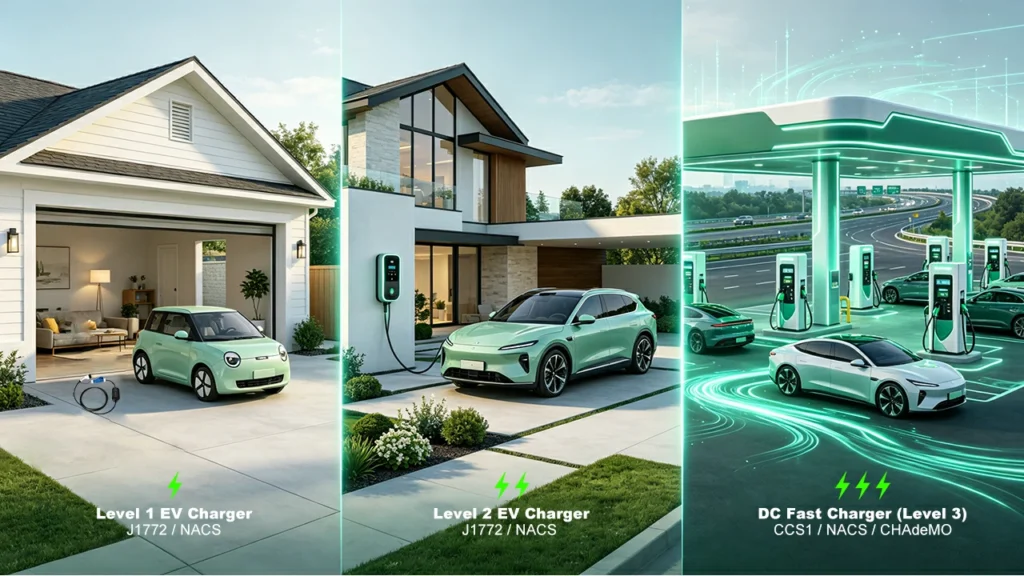
EV chargers are classified into three levels based on power output. Each level represents a significant step up in charging speed, installation complexity, and cost. The right level depends on where you’re charging and how fast you need power replenished.
| Specification | Level 1 EV Charger | Level 2 EV Charger | DC Fast Charger (Level 3) |
| Voltage | 120V AC (US) / 230V AC (EU) | 208–240V AC | 200–1000V DC |
| Power output | 1.4–1.9 kW | 3.3–22 kW | 50–350+ kW |
| Charging speed | 3–5 miles / hour | 10–60 miles / hour | 100–300+ miles / 30 min |
| Time to full (75 kWh battery) | 40–50+ hours | 4–8 hours | 20–45 minutes (10–80%) |
| Typical connector (North America) | J1772 / NACS | J1772 / NACS | CCS1 / NACS / CHAdeMO |
| Installation required | No — standard outlet | Yes — dedicated 240V circuit | Yes — commercial electrical |
| Equipment cost | $150–$300 | $300–$1,000 | $30,000–$150,000+ |
| Installation cost | $0 | $300–$1,500 | $10,000–$50,000+ |
| Where used | Home, emergency backup | Home, work, public parking | Highways, service stations |
| Best for | PHEVs, low-mileage drivers | Daily home and workplace charging | Road trips, commercial fleets |
Level 1 EV Charger
A Level 1 EV charger uses a standard household AC outlet — 120V in North America or 230V in Europe. Every electric vehicle comes with a portable Level 1 charging cable (sometimes called EVSE cord or trickle charger), so no additional equipment is needed. You simply plug one end into the car and the other into a standard wall socket.
Level 1 charging adds 3–5 miles of range per hour, which means a typical BEV with a 75 kWh battery takes 40–50+ hours to charge from empty. In practice, Level 1 is most useful for:
- Plug-in hybrid EVs (PHEVs) with smaller batteries of 8–20 kWh, which fully charge in 4–8 hours overnight
- Low-mileage drivers who commute under 30 miles per day and can recover sufficient range each night
- Emergency backup charging when Level 2 is unavailable
- Temporary charging while a Level 2 installation is being arranged
| ⚠ Never use a Level 1 charger with an extension cord. The additional cable length creates resistance that can cause overheating, voltage drop, and fire risk. Always plug directly into a wall outlet rated for at least 15 amps on a dedicated circuit. |
Level 2 EV Charger
A Level 2 EV charger operates on 240V AC (208V in some commercial settings) and is the most popular choice for residential EV owners and public charging destinations. It delivers 3.3 to 22 kW — typically 7.2 to 11.5 kW in home installations — adding 10 to 60 miles of range per hour. Most EVs can fully recharge from empty overnight with a Level 2 EV charger.
Level 2 EV chargers require professional installation of a dedicated 240V circuit, but the upgrade pays for itself quickly in convenience. Key advantages include:
- Charges most EVs fully overnight (6–8 hours for a 75 kWh battery at 9.6 kW)
- Widely available at public charging destinations: shopping centers, parking garages, workplaces, hotels
- Smart features: scheduling, energy monitoring, load balancing, app control
- Compatible with all road-legal EVs via J1772 or NACS adapters
The charging speed you get from a Level 2 EV charger depends on two factors: the charger’s maximum output (determined by its amperage) and the vehicle’s onboard AC charger limit. A 48A Level 2 charger (11.5 kW) won’t charge faster than 7.2 kW if the car’s onboard charger is capped at 7.2 kW. Always check both specifications.
| Level 2 Amperage | Power Output | Miles Added per Hour | Best For |
| 16A | 3.8 kW | ~10–15 miles | PHEVs, light daily use |
| 24A | 5.8 kW | ~15–22 miles | Smaller EVs, moderate commutes |
| 32A | 7.7 kW | ~22–30 miles | Most residential EVs, overnight charging |
| 40A | 9.6 kW | ~28–35 miles | Most popular residential choice |
| 48A | 11.5 kW | ~32–44 miles | Faster overnight, future-proofing |
| 80A | 19.2 kW | ~55–60 miles | Maximum residential, trucks/SUVs |
DC Fast Charger (Level 3)
DC fast chargers (DCFC) — also called Level 3 chargers — bypass the vehicle’s onboard AC charger and deliver DC power directly to the battery at 50 to 350+ kW. This enables charging from 10% to 80% in 15–45 minutes, making them the backbone of long-distance EV travel on highway corridors.
DC fast chargers require high-power commercial electrical infrastructure (three-phase power, utility coordination) and specialized installation. They are not practical for residential installation. Where you’ll find them:
- Highway rest stops and service areas
- Tesla Supercharger networks (now largely open to non-Tesla vehicles via NACS adapters)
- Electrify America, EVgo, ChargePoint, and other public networks
- Commercial fleet depots and logistics centers
One important nuance: DC fast chargers do not charge at their rated speed throughout the session. Vehicles accept maximum power until roughly 80% state of charge, after which the charge rate tapers significantly to protect battery cells. This is why EV owners are advised to target 80% at DC fast chargers and top up at home — charging the final 20% takes nearly as long as the first 80%.
| 💡 Frequent use of DC fast charging accelerates battery degradation over time. For daily charging, use Level 1 or Level 2 at home. Reserve DC fast charging for road trips and situations where speed is genuinely necessary. |
EV Charger Connector Types: A Complete Overview
The connector is the physical plug that links the EV charger to your vehicle. Understanding connector standards is essential — the wrong connector means you can’t charge, even at the right power level. The landscape is actively evolving in 2025 as NACS becomes the dominant North American standard.
J1772 (SAE J1772) — North American AC Standard
The J1772 connector has been the universal AC charging standard in North America for over a decade. It is used for Level 1 and Level 2 AC charging and features a 5-pin design with a secure latch mechanism. Nearly all non-Tesla EVs sold in North America from 2010 to 2024 used J1772 for AC charging. While vehicles are shifting to NACS, J1772 chargers will remain common for years and all NACS vehicles include a J1772 adapter.
NACS / SAE J3400 — The New North American Standard
NACS (North American Charging Standard), originally Tesla’s proprietary connector, was standardized by SAE International as J3400 in 2023 and is now the dominant connector standard for new EV models in North America. Ford, GM, Rivian, Honda, Nissan, Toyota, Volvo, and virtually all major automakers have committed to NACS for models from 2025 onward.
NACS is used for both AC Level 1/2 and DC fast charging through the same port — eliminating the need for separate AC and DC connectors. Tesla’s Supercharger network (over 60,000 stalls globally) is now broadly accessible to NACS-compatible non-Tesla vehicles.
CCS (Combined Charging System) — DC Fast Charging Standard
CCS combines the J1772 AC inlet with two additional DC pins below it, enabling the same vehicle to use Level 1, Level 2, and DC fast charging through one port. CCS1 is the North American variant; CCS2 is used in Europe. As NACS adoption grows, CCS1 is being phased out from new North American models, though the network of CCS1 public chargers remains significant and adapters are available.
CHAdeMO — Japanese DC Fast Charging Standard
CHAdeMO was the dominant DC fast charging standard for Asian manufacturers (Nissan, Mitsubishi, Kia) for over a decade. It is now being phased out in North America and Europe as manufacturers migrate to CCS or NACS. New CHAdeMO vehicles are rare in Western markets, but the Nissan Leaf continues to use it in some markets. Existing CHAdeMO infrastructure is declining.
Type 2 (IEC 62196) — European AC Standard
Type 2 is the universal AC charging standard in Europe, used for Level 2 charging at home and at public AC stations. It supports 1-phase and 3-phase charging at up to 22 kW. DC fast charging in Europe typically uses CCS2, which extends the Type 2 connector with two additional DC pins — analogous to CCS1 in North America.
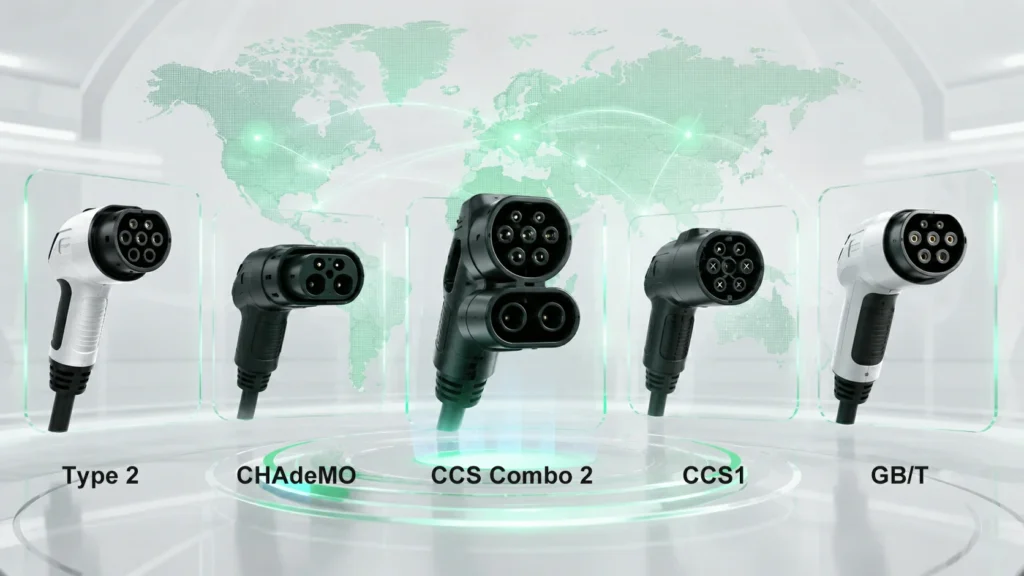
| Connector | Region | Charge Type | Max Power | Status (2025) |
| J1772 | North America | AC Level 1 & 2 | 19.2 kW | Being replaced by NACS on new models; infrastructure remains |
| NACS / J3400 | North America | AC L1/L2 + DC fast | Up to 350+ kW | New standard; adopted by all major automakers |
| CCS1 | North America | DC fast | Up to 350 kW | Phasing out on new models; significant public infrastructure |
| CCS2 | Europe / Global | AC + DC fast | Up to 350 kW | Dominant standard in EU; required on public chargers |
| CHAdeMO | Japan / some markets | DC fast | Up to 400 kW | Declining — few new vehicles; legacy infrastructure |
| Type 2 | Europe | AC Level 2 | Up to 22 kW | Universal AC standard in EU for home and public |
| GB/T | China | AC + DC | Up to 250 kW | Mandatory standard for China market |
EV Charging Speed: How to Calculate What You’ll Actually Get
EV charging speed is often misunderstood because there are three different limits that determine your real-world charging rate — and the slowest one always wins.
The Three Limits That Govern Your Charging Speed
- Charger output rating:The maximum power the EV charger can deliver (e.g., a 48A Level 2 charger outputs 11.5 kW).
- Vehicle’s onboard AC charger limit:The maximum AC power your car can accept (e.g., a Tesla Model 3 Standard Range accepts up to 7.2 kW AC). If your car’s limit is lower than the charger’s output, you’ll charge at the car’s limit — not the charger’s.
- Available circuit capacity:The dedicated circuit powering the charger determines the actual amps available (e.g., a 50A breaker supports a 40A charger).
Formula: Miles per hour = (Charger kW, limited by car’s onboard charger) ÷ (vehicle’s kWh per mile consumption)
Example: 11.5 kW charger + car with 7.2 kW onboard limit + car efficiency of 0.25 kWh/mile = 7.2 ÷ 0.25 = 28.8 miles of range added per hour.
| 💡 When choosing a Level 2 EV charger for home use, match it to your vehicle’s onboard AC charger limit plus some future-proofing headroom. Paying for a 48A charger when your car accepts only 32A AC delivers no speed benefit — but may be worthwhile if you’ll charge a future vehicle. |
Home EV Charger Installation: What You Need to Know
Installing a Level 2 EV charger at home transforms the ownership experience. Instead of worrying about public charger availability or slow Level 1 trickle charging, you wake up every morning to a full battery. Here’s what the installation process involves.
Electrical Panel Assessment
Before any installation, an electrician assesses your home’s electrical panel. A Level 2 EV charger requires a dedicated 240V circuit with 40–60 amps of capacity. Key considerations:
- 200A service is the minimum recommended panel size for a Level 2 EV charger. Many older homes with 100A panels require an upgrade ($1,500–$3,000).
- The charger needs a dedicated circuit — it should not share a breaker with other appliances.
- The breaker should be rated at 125% of the charger’s continuous draw (a 40A charger requires a 50A breaker).
Hardwired vs. Plug-In Installation
Level 2 EV chargers can be installed in two ways:
- Hardwired:Connected directly to the electrical panel with no plug. More permanent, slightly cleaner installation, required for some high-amperage units (above 48A). Cannot be easily moved.
- Plug-in (NEMA 14-50 or NEMA 6-50):The charger plugs into a dedicated 240V outlet. More flexible — can be moved or replaced without an electrician. NEMA 14-50 is the most common standard for portable Level 2 chargers.
Indoor vs. Outdoor Installation
EV chargers installed in a garage can use an indoor-rated unit. Outdoor installations (driveways, carports) require a charger with a minimum IP54 weather rating, ideally IP65 or higher. Cable management and proper conduit routing are important for long-term reliability.
Installation Time and Cost
| Installation Scenario | Typical Cost (US, 2025) | Notes |
| Simple installation (200A panel, garage nearby) | $300–$600 | Straightforward wiring run, minimal conduit |
| Standard installation (panel upgrade not needed) | $600–$1,200 | Moderate wiring run, permit included |
| Complex installation (long cable run, outdoor) | $1,200–$2,000 | Trenching, conduit, weatherproof hardware |
| Panel upgrade from 100A to 200A (if needed) | Add $1,500–$3,000 | Often required in homes built before 1990 |
| Total range (typical residential) | $600–$3,500 | Excluding panel upgrade if required |
| ✔ Most jurisdictions require a permit for Level 2 EV charger installation. Always use a licensed electrician — DIY EV charger installation without permits can void homeowner’s insurance and create liability issues if a fire or electrical fault occurs. |
EV Charger Costs: Equipment, Installation, and Ongoing Charging
Cost to Charge an EV at Home
Home charging is significantly cheaper than public charging and dramatically cheaper than gasoline. The cost per kWh at home equals your local electricity rate — typically $0.12–$0.20/kWh in the US, averaging $0.18/kWh nationally (EIA, 2025).
Cost example for a 75 kWh EV (full charge from empty): At $0.18/kWh, a full charge costs approximately $13.50 — equivalent to roughly 3–4 gallons of gas. To drive 300 miles costs roughly $13.50 at home vs. $45–$60 in gasoline at current prices.
| Charging Method | Typical Cost | Notes |
| Level 1 at home | $0.12–$0.20/kWh | Same as home electricity rate; cheapest option |
| Level 2 at home | $0.12–$0.20/kWh | Same rate; higher power = shorter session |
| Level 2 public (network) | $0.20–$0.35/kWh | ChargePoint, Blink; varies by network and location |
| DC fast charging (public) | $0.30–$0.60/kWh | Tesla Supercharger: ~$0.40/kWh; Electrify America: ~$0.48/kWh |
| Gasoline equivalent (comparison) | ~$0.12–$0.15/mile driven | Based on $3.50/gal, 25 mpg average |
| EV at home charging cost | ~$0.04–$0.06/mile driven | Based on $0.18/kWh, 3.5 miles/kWh |
Cost to Buy an EV Charger
| EV Charger Type | Equipment Cost | Key Features |
| Level 1 portable cable | Included with vehicle | 120V, 12–16A; no installation needed |
| Basic Level 2 (16–32A) | $150–$350 | Simple, reliable; good for low-mileage drivers |
| Mid-range Level 2 (40–48A) | $350–$600 | Wi-Fi, app control, scheduling; most popular tier |
| Premium smart Level 2 (48A) | $600–$900 | Load balancing, solar integration, energy monitoring |
| Commercial Level 2 (dual port) | $800–$2,500 | OCPP, network management, multi-user billing |
| DC fast charger (50 kW) | $30,000–$60,000 | Commercial installation only |
| DC fast charger (150–350 kW) | $75,000–$150,000+ | Ultra-fast; requires dedicated utility connection |
Smart EV Charger Features: What to Look For in 2025
The best EV chargers in 2025 are connected devices with software intelligence. Beyond simply delivering power, smart EV chargers offer features that reduce energy costs, protect your electrical system, and integrate with your broader home energy ecosystem.
Scheduled Charging
Off-peak electricity rates (typically midnight to 6am in most utility areas) can be 30–50% lower than peak rates. A smart EV charger allows you to program charging windows to automatically align with your utility’s lowest-cost periods. Some smart chargers connect directly to Time-of-Use (TOU) rate data from your utility and adjust automatically.
Load Balancing / Power Sharing
Load balancing prevents your home’s electrical panel from being overloaded when the EV charger runs simultaneously with high-draw appliances like ovens, HVAC, or other chargers. Smart load balancing monitors real-time panel load and automatically reduces charger output when the total approaches the panel’s capacity limit. This is particularly important in homes with 100A or 150A service.
Solar Integration
If your home has solar panels, a solar-aware EV charger can prioritize charging when excess solar generation is available — effectively charging your car for free using energy that would otherwise be exported to the grid. Some systems dynamically adjust charger output based on real-time solar production, maximizing self-consumption.
Energy Monitoring and Reporting
Good EV chargers provide detailed session data: kWh delivered per session, charging cost, carbon footprint, and cumulative totals. This data is valuable for business expense tracking, utility rebate documentation, and understanding your energy consumption patterns.
Remote Access and App Control
Wi-Fi or cellular connected chargers can be controlled via smartphone app: start/stop sessions remotely, receive notifications when charging completes or if there’s a fault, and monitor status from anywhere. For commercial installations, this enables network management, user authentication, and billing.
OCPP Compatibility (Commercial)
Open Charge Point Protocol (OCPP) is the open standard for communication between EV chargers and charging network management software. For commercial operators deploying multiple chargers, OCPP compatibility ensures you’re not locked to a single vendor’s ecosystem and enables load management, billing, and remote diagnostics across the network.
Where to Charge Your EV: Home, Workplace, and Public Charging
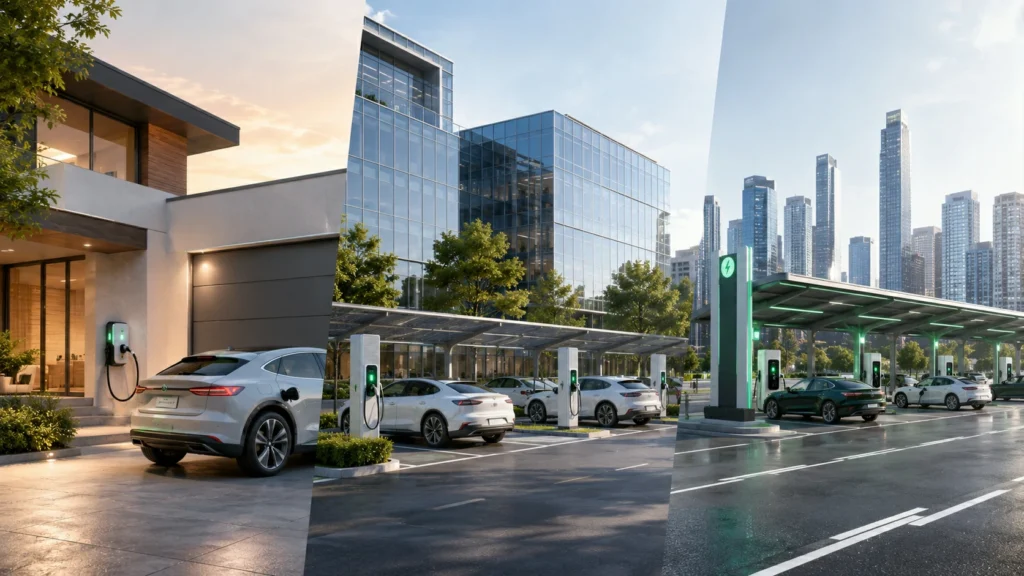
Home Charging: The Foundation
Around 80% of EV charging in North America happens at home, and for good reason — it’s the cheapest, most convenient option. Most EV owners adopt a simple routine: plug in when they arrive home, unplug when they leave. With Level 2 at home, the car is almost always fully charged for the day ahead.
Home charging also allows you to take advantage of time-of-use electricity rates, solar self-consumption, and smart charging schedules that aren’t possible at public stations.
Workplace Charging
Workplace Level 2 EV chargers allow employees to top up during working hours, effectively doubling the usable charging time in a day. For businesses, workplace charging is an increasingly valued employee benefit and supports corporate sustainability goals. Network-managed Level 2 chargers with access control and billing capabilities are the standard for commercial workplace installations.
Public Charging Networks
Public charging stations bridge the gap for drivers without home charging access (apartment residents, renters) and enable long-distance travel. The major public EV charger networks include:
- Tesla Supercharger:The largest DC fast charging network globally with 60,000+ stalls. Now open to non-Tesla vehicles with NACS connectors or adapters. Widely regarded as the most reliable network.
- Electrify America:The largest non-Tesla DC fast charging network in the US, with 800+ stations (mostly 150–350 kW). Funded partly by Volkswagen’s diesel emissions settlement.
- EVgo:Focused on urban and suburban fast charging, with growing presence at grocery stores, parking garages, and shopping centers.
- ChargePoint:The largest network by total station count, with a mix of Level 2 and DC fast charging at workplaces, retail, and public locations.
- Blink Network:Large Level 2 network with presence in apartment complexes, hotels, and retail locations.
Destination Charging
Destination charging refers to Level 2 EV chargers at locations where drivers park for extended periods: hotels, resorts, restaurants, shopping malls, and airports. Unlike highway fast chargers, destination chargers are designed for dwell time charging — providing enough range during a 2–4 hour stop rather than a quick 20-minute top-up.
How to Choose the Right EV Charger for Your Needs
With dozens of EV charger options on the market, here is a practical decision framework based on your situation:
For Homeowners
- Determine your daily driving distance. If you drive under 40 miles per day, a 32A Level 2 EV charger is more than sufficient. For higher mileage or larger EVs (trucks, SUVs), consider 40A or 48A.
- Check your vehicle’s onboard AC charger limit in the owner’s manual. There’s no benefit to buying a 48A charger if your car accepts only 32A AC.
- Assess your electrical panel. If it’s 100A, budget for a potential upgrade or choose a lower-amperage charger with load management.
- Choose connector type. For 2025–2026 vehicles with NACS ports, buy a NACS charger or a dual-connector model. For older J1772 vehicles, J1772 remains fully compatible.
- Prioritize smart features if you have TOU electricity rates, solar panels, or multiple EVs.
For Businesses and Commercial Applications
- Define your use case: employee parking (Level 2), customer destination charging (Level 2), or fleet fast-charging (DC fast).
- Calculate daily charging demand based on the number of vehicles and average daily kWh needed.
- Choose OCPP-compliant hardware to avoid vendor lock-in and enable flexible network management.
- Plan for load management from the start — adding more chargers later without load management often triggers costly electrical upgrades.
- Check available utility incentives for commercial EV charger installation, which can significantly reduce upfront costs.
| Your Situation | Recommended EV Charger |
| PHEV owner, drives under 30 miles/day | Level 1 (included with vehicle) — sufficient; no upgrade needed |
| BEV owner, apartment/rental without home charging | Rely on workplace Level 2 + public network; portable Level 1 as backup |
| BEV owner, home with garage, drives 40–80 miles/day | Level 2, 32–40A — complete overnight charge every night |
| BEV owner, high mileage or EV truck/SUV | Level 2, 48A or 80A — faster overnight; handles large batteries |
| Two-EV household | Level 2 with load balancing, or two separate circuits |
| Small business, employee parking | Networked Level 2, 32–48A per port, OCPP, access control |
| Fleet depot, commercial vehicles | Mixed Level 2 + DC fast; load management system essential |
| Highway corridor, retail location | DC fast charger, 150–350 kW; requires utility coordination |
EV Charger Incentives and Tax Credits
Government incentives can significantly reduce the cost of purchasing and installing an EV charger. These programs change frequently — verify current availability with your tax advisor or utility.
United States
- Federal Alternative Fuel Vehicle Refueling Property Tax Credit (Form 8911):30% of the cost of equipment and installation, up to $1,000 for residential installations and up to $100,000 for commercial installations. Applies to chargers installed at qualifying locations.
- NEVI Program:The National Electric Vehicle Infrastructure Formula Program provides $5 billion in federal funding to build out EV charging along designated highway corridors. Funding flows to states, which select projects — relevant for commercial operators interested in public fast charging.
- State and utility rebates:Many states and utilities offer additional incentives. California’s CVRP, Colorado’s Charge Ahead Colorado, and hundreds of utility-specific rebate programs can add $200–$1,500 to residential installations.
Europe
- OZEV Grant (UK):The Electric Vehicle Homecharge Scheme (EVHS) provides grants for eligible EV charger installations at rental properties and flat owners.
- EU Alternative Fuels Infrastructure Regulation (AFIR):Requires member states to deploy public EV charging across the TEN-T core and comprehensive networks, driving significant public infrastructure investment.
- National incentives:Germany, France, Italy, Netherlands, and other EU countries offer residential EV charger installation grants of €300–€1,500 depending on the program.
| 💡 When claiming tax credits, keep receipts for both equipment and installation labor. Both qualify for the federal 30% credit. Smart chargers approved by your utility may also qualify for additional utility-specific rebates — ask your installer. |
Bidirectional Charging: V2H and V2G
The latest development in EV charger technology goes beyond one-directional charging. Bidirectional chargers allow an EV battery to not only receive power but also send power back — to your home (Vehicle-to-Home, V2H) or to the grid (Vehicle-to-Grid, V2G). This transforms the EV from a cost center into an energy asset.
Vehicle-to-Home (V2H)
V2H technology allows your EV’s battery to power your home during a grid outage or during peak-rate hours. An EV with a 75–100 kWh battery can power an average home for 2–4 days during an outage. Compatible vehicles include the Ford F-150 Lightning (up to 9.6 kW export), Hyundai Ioniq 5 and 6, Nissan Leaf (some models), and Kia EV6.
V2H requires a bidirectional EV charger (different hardware from standard chargers), a transfer switch or inverter, and a compatible vehicle. Installation costs are higher than standard Level 2 charger installation.
Vehicle-to-Grid (V2G)
V2G extends the concept to the power grid — utilities can draw on aggregated EV battery capacity during periods of peak demand, paying EV owners for the service. Several US utilities and European TSOs are piloting V2G programs. As of 2025, V2G remains in early commercial deployment, with California, the UK, and parts of Europe leading adoption.
EV Charging Best Practices for Battery Health
How you charge your EV directly affects the long-term health and capacity of its battery. Following these practices extends battery life and preserves range over years of ownership:
- Target 20–80% state of charge for daily use: Most battery chemistries (especially NMC) experience the least degradation when kept between 20% and 80%. Only charge to 100% for planned long trips.
- Avoid frequent DC fast charging: High power and heat stress battery cells. Use Level 2 for daily charging and reserve DC fast for travel. Most manufacturers allow and account for occasional fast charging, but daily fast charging accelerates degradation.
- Avoid deep discharge: Regularly depleting to below 10% stresses cells. Most vehicles have a buffer that prevents true zero, but staying above 20% is best practice.
- Charge in moderate temperatures: Cold batteries charge slower and experience more stress. In cold climates, use the vehicle’s pre-conditioning feature to warm the battery before plugging in. Avoid leaving a fully charged battery in high heat for extended periods.
- Use scheduled charging: Set your Level 2 charger to begin charging a few hours before you need the car, so it reaches your target state of charge close to departure rather than sitting at 100% for hours.
Commercial and Fleet EV Charging
Commercial EV charging requirements differ significantly from residential. Fleet operators, property managers, and businesses deploying EV chargers need to consider load management, network management software, billing, and scalability from the beginning.
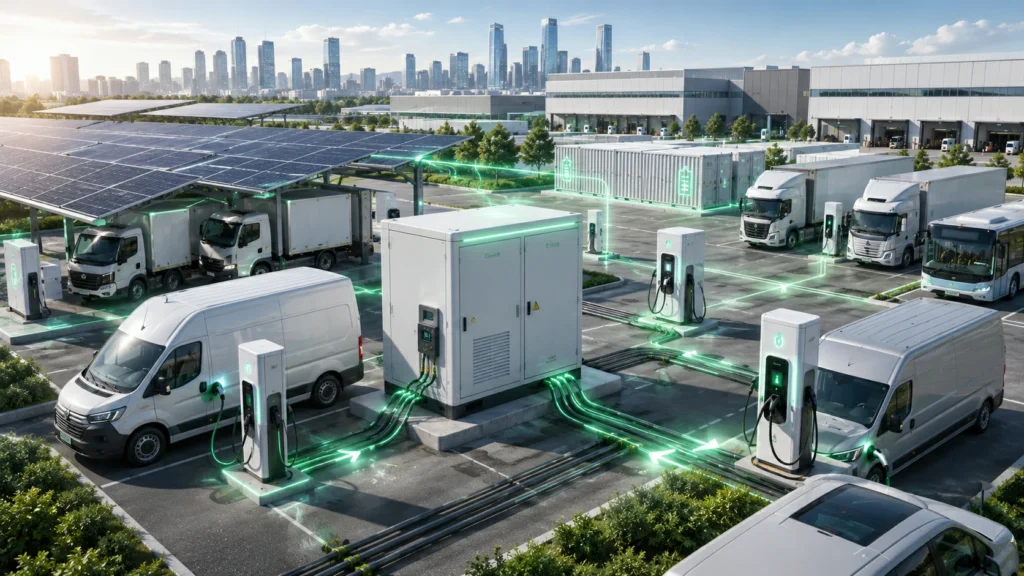
Fleet Depot Charging
Fleet charging — for delivery vehicles, service fleets, bus depots — typically combines Level 2 charging for overnight replenishment with DC fast charging for vehicles that need rapid turnaround. Key considerations include:
- Total daily energy demand:Calculate the kWh needed per vehicle per day and multiply by fleet size to determine total daily demand. This drives utility connection sizing.
- Managed charging:Smart fleet charging software schedules vehicle charging based on departure times, grid rates, and available capacity — preventing simultaneous charging spikes that trigger demand charges.
- Demand charge management:Commercial electricity rates include demand charges based on peak power draw. Unmanaged charging can dramatically increase utility bills. Load management is not optional for large fleets.
Multi-Unit Dwelling (MUD) Charging
Apartment buildings and condominiums present unique EV charger deployment challenges. Individual unit metering, shared electrical infrastructure, and limited parking panel capacity require careful load management design. Solutions include:
- Shared Level 2 chargers in parking areas with RFID or app-based user authentication and usage billing
- Panel-level load management to distribute available capacity across multiple active charging sessions
- Utility make-ready programs that pre-wire parking spaces for future EV charger installation
Conclusion
The EV charger landscape in 2026 is simultaneously simpler and more capable than ever. Simpler because connector standards are converging on NACS in North America and CCS2 in Europe, reducing compatibility concerns. More capable because smart EV chargers now integrate with home energy management, solar systems, and utility rate optimization in ways that were unavailable even a few years ago.
For most homeowners, the decision path is clear: Level 2, 40–48A, with smart features that match your electricity rate structure and energy setup. For road trips, the growing network of Tesla Superchargers (now broadly accessible) and Electrify America stations makes long-distance EV travel practical across North America. And for commercial operators and fleet managers, the combination of load-managed Level 2 and DC fast charging, built on open OCPP standards, provides the flexibility to scale without costly infrastructure lock-in.
The right EV charger isn’t the fastest or the most feature-rich — it’s the one that matches your actual driving patterns, electrical setup, and budget, while leaving room to grow with your needs.