
DistributionEnergy StorageSolar
Nearly every guide on this topic presents a fork in the road. Open transition on one side, closed transition on the other, pick one. That framing is so common that a lot of specifiers never find out there’s a third path, and it’s often the one they actually needed.
Here’s the thing: the open vs closed transition transfer switch question has a middle answer called delayed transition, and for one very common category of load, it’s the correct choice while both of the popular options are wrong. This guide covers all three properly, then gets into the part that matters if your backup source is solar or battery rather than a diesel generator, because that changes the question in a way most articles on this subject haven’t caught up with.
New to transfer switches generally? Start with what a transfer switch is and how it works. Already know the basics but unsure about hardware class? That’s a separate decision, covered in PC class vs CB class ATS.
Open VS Closed Transition Transfer Switch: Quick Answer
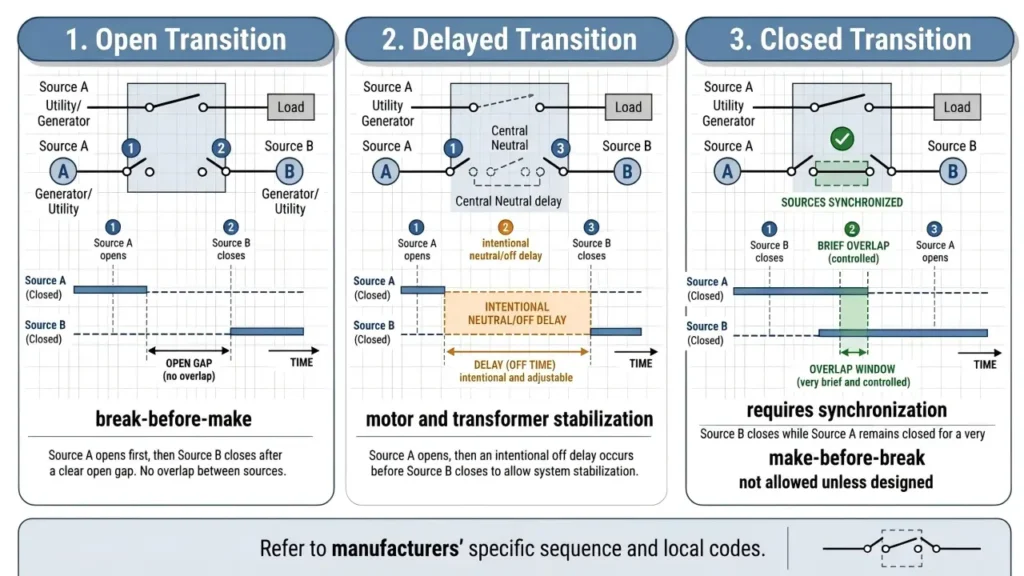
Open transition disconnects from the old source before connecting to the new one. There’s a brief dead gap, usually well under a second. This covers the overwhelming majority of installations and it’s the default for good reason.
Closed transition connects to the new source before releasing the old one, so the load never loses power. The two sources are briefly paralleled, which is exactly why it’s restricted.
Delayed transition is open transition with a deliberate, extended pause in the middle. It looks like a worse version of open transition until you’re switching motor loads, at which point it’s the only one of the three that won’t eventually destroy something.
The Relay Race, and the Moving Walkway
A relay race handoff is a decent way to picture the first two. Open transition is a sloppy handoff where the baton is genuinely in the air for a moment. Nobody’s holding it. It works fine, it’s what almost everyone does, and the race carries on.
Closed transition is both runners gripping the baton at the same time before the first lets go. Smoother. But both runners have to be moving at exactly the same speed at that instant, or someone gets their arm yanked.
Delayed transition needs a different picture. Imagine stepping off a moving walkway that’s going one direction and onto another one going the opposite way. If you step straight across, your own momentum fights the new floor and you fall over. What you need is to stand still for a second and let your momentum die first. That deliberate pause is delayed transition, and the momentum is what a spinning motor does after you cut its power.
Open Transition: The Default, and Usually Right
Open transition is break-before-make. The switch opens the connection to source A, and only then closes the connection to source B. For a fraction of a second the load is connected to nothing at all.
This is the standard for something like 90% of ATS applications, and it isn’t a compromise. The dead gap is a safety feature: with no possibility of both sources being connected at once, there’s no possibility of backfeeding one source into the other. That matters enormously when the reason you’re transferring is that source A has failed, because “failed” can mean a fault on the utility side that utility crews are currently working on.
This is also why any transfer switch, regardless of what it’s configured for normally, has to fall back to open transition when one of the sources isn’t present or isn’t acceptable. Closed transition is only possible when both sources are healthy and synchronised. During an actual outage, that condition doesn’t exist, so every transfer switch is an open transition switch when it counts.
What the gap costs you: lights blink, sensitive electronics may reboot, anything without a UPS or internal buffer sees a real interruption. For most commercial and residential loads, nobody notices or cares.
Closed Transition: Seamless, and Gated
Closed transition is make-before-break. The switch closes onto source B while source A is still connected, then opens source A. The load never sees a gap.
The appeal is obvious, and there’s one use case where it’s genuinely transformative: scheduled generator testing. Codes in many jurisdictions require periodic exercise of standby generators. With open transition, every test means an interruption to the very loads the generator exists to protect. With closed transition, you can transfer, run the test, and transfer back without anyone in the building noticing.
Now the catch, and it’s a big one.
Check this before you specify anything: during a closed transition, your generator is momentarily running in parallel with the utility grid. That is a grid interconnection event, and it typically requires explicit approval from your local utility. Many utilities restrict it heavily. Some prohibit it outright. This approval is not a formality you handle at commissioning — it can determine whether the equipment you’ve specified is legal to operate at all.
There’s a second constraint. Closed transition only proceeds if both sources are synchronised within tight limits on phase, voltage and frequency, and typically within a narrow time window. If synchronisation isn’t achieved in time, a well-designed switch aborts to open transition or delayed transition. A poorly-specified one may simply fail to transfer. If you’re buying closed transition, ask what the switch does when synchronisation fails, because that’s the behaviour you’ll actually get on a bad day.
And one practical note that catches people out: you cannot field-upgrade an open transition switch to closed transition later. Different contacts, different control logic, different sensing hardware. It’s a purchase decision, not a configuration setting.
Delayed Transition: The Forgotten One
Delayed transition is open transition with an intentional pause at the neutral position. Instead of opening source A and closing source B as fast as possible, the switch opens source A, sits in the off position for a programmed interval, then closes source B. The delay is adjustable and is commonly set anywhere from a couple of seconds to half a minute depending on the load.
Why on earth would you deliberately make the outage longer? Because of the moving walkway problem.
When you cut power to a running motor, it doesn’t stop instantly. It keeps spinning, and while it spins it generates its own voltage — residual voltage — which decays over a few seconds. Reconnect power while that residual voltage is still significant and still out of phase with the incoming source, and you get a violent transient. The motor is fighting the supply. This can mean tripped breakers, mechanical shock through couplings and gearboxes, and over enough repetitions, a failed motor or a cracked shaft.
A fast open transition is precisely the scenario that causes this, because it reconnects while residual voltage is at its highest. Delayed transition solves it by waiting for the residual voltage to decay before reconnecting.
So if your load includes substantial motors — pumps, compressors, chillers, lifts, large HVAC plant — delayed transition should be on your list, and a fast transfer is not automatically the better product.
There’s an alternative approach worth knowing about: an in-phase monitor, which watches the phase relationship and triggers the transfer at a moment when the motor’s residual voltage happens to be in phase with the incoming source. It achieves the same protection without the long pause. It’s a more sophisticated and generally more expensive solution. Either can be correct; the wrong answer is a plain fast open transition on a motor-heavy load.
Why Solar, Storage and EV Charging Change the Question
This is where most articles on this topic simply stop being relevant, because the entire open/closed framework was built around utility-plus-generator systems.
Closed transition with a grid-tied solar inverter isn’t a switch feature you can buy. Grid-tied inverters are required by interconnection standards to detect grid loss and stop energising their grid-parallel output. That’s anti-islanding protection, and it exists to keep utility line workers safe. A standard grid-tied inverter physically will not sit there in parallel with a dead grid waiting for your ATS to do a smooth handover, because it is designed and certified specifically not to. The relevant standards here are IEEE 1547 and UL 1741 in North American practice, with equivalent requirements in most other grid codes.
So the question “should I use closed transition between grid and solar?” is really the question “am I authorised and equipped to operate a grid-parallel system?” — a different conversation, involving your utility and your inverter’s certification, not your switch supplier.
A hybrid inverter may already contain the transfer switch. Hybrid and battery inverters typically have a dedicated backup output port, and internally they open the grid connection and energise that backup port when the grid fails. The transfer is happening inside the inverter. Before specifying an external ATS, it’s worth establishing what job it’s actually doing: is it transferring the load, or is it isolating the system, or is it handling sources the inverter doesn’t manage? The answer changes what you need, and sometimes it reveals you need a different device entirely. Our overview of solar transfer switch applications covers where an ATS does and doesn’t belong in a PV system.
EV charging has a transfer problem, but it’s not the motor problem. An EV charging session isn’t damaged by a brief power gap in the way a motor is. What happens instead is that the charger and vehicle lose their communication handshake and the session terminates. The car doesn’t resume charging by itself; depending on the equipment, it may need the cable reseated or the session restarted manually. For a home installation that’s an annoyance. For a commercial charging site with paying customers, every open transition transfer is a set of interrupted sessions and a set of support calls. That’s a commercial argument for minimising transfers, not necessarily for closed transition, and it’s usually better solved with charger-side settings and load management than with switch selection.
If your system also has rapid shutdown requirements, the transfer sequence has to be coordinated with the isolation sequence — rapid shutdown solar design covers how those interact.
Comparison
| Open Transition | Delayed Transition | Closed Transition | |
|---|---|---|---|
| Sequence | Break before make | Break, pause, make | Make before break |
| Power gap | Brief, typically well under a second | Deliberate, seconds to tens of seconds | None |
| Sources ever paralleled? | Never | Never | Yes, momentarily |
| Utility approval needed? | No | No | Usually yes, and sometimes refused |
| Main purpose | Standard reliable transfer | Protecting motor loads from out-of-phase reconnection | Uninterrupted transfer, especially for generator testing |
| Relative cost | Lowest | Low, often a setting on the same hardware | Highest |
| Works during a real outage? | Yes | Yes | No, reverts to open transition |
| Best for | Most commercial, residential and solar backup installations | Pumps, compressors, chillers, lifts, motor-heavy plant | Data centres, healthcare, facilities with mandated generator testing |
How to Choose
Answer these in order and you’ll usually land on the right one before you reach the end.
- Does your load include substantial motors? If yes, you need delayed transition or an in-phase monitor. Don’t specify a plain fast open transition.
- Do you have code-mandated generator testing that can’t interrupt the load? If yes, closed transition is the reason it exists. Start the utility approval conversation early.
- Have you confirmed your utility permits momentary paralleling? If no, closed transition is off the table regardless of what the load wants.
- Is your backup source a grid-tied or hybrid inverter? If yes, resolve the anti-islanding and internal-transfer questions before choosing anything.
- Can your load tolerate a sub-second gap? If yes, and none of the above apply, open transition is correct and anything else is money spent on a problem you don’t have.
- Is this a life-safety circuit? Then the applicable fire code and the fire-pump-service provisions of IEC 60947-6-1 or UL 1008 govern, and they may constrain your choice.
Common Mistakes
Assuming faster is better. For motor loads, faster is actively worse. Transfer speed is a specification to match to the load, not a score to maximise.
Specifying closed transition without checking utility rules. The most expensive mistake on this page. Find out what your utility permits before the equipment is ordered, not after.
Expecting closed transition to help during an outage. It can’t. Closed transition requires both sources to be healthy and synchronised. When the grid is down, every switch is an open transition switch.
Planning to upgrade later. Open to closed is not a field upgrade. Different hardware entirely.
Confusing transition type with hardware class. Transition type is the switching sequence. PC or CB class is the mechanical and protective architecture. They’re independent choices, and you have to make both. PC class vs CB class ATS covers the second one.
Treating transition type as a substitute for a UPS. If your load truly cannot tolerate any interruption under any circumstances including a genuine outage, a transfer switch alone isn’t the answer — you need stored energy in the path.
MOREDAY’s ATS Range
MOREDAY’s automatic transfer switch range spans residential through industrial: the MDQ2-63 at fixed 220V/400V and the MDQ3-63 with selectable 110V/220V/400V and 2P/4P in the same 63A tier, the MDQ5R-100 for mid-size solar and storage installations, and the MDQ8 isolation type for larger commercial and industrial systems. Where automatic operation isn’t required, the NSIS AC Changeover Switch provides manual changeover.
Transition behaviour and available timing settings vary by model, so if you have a motor-heavy load or a transfer timing requirement, that’s worth confirming against the specific model rather than the series. Send your load schedule and single-line diagram to MOREDAY’s engineering team and we’ll confirm the right configuration.
FAQ
Which transition type is most common?
Open transition, by a wide margin. It covers the large majority of installations, and for most loads it’s not a compromise.
Can a closed transition switch work during a blackout?
No. Closed transition needs both sources present and synchronised. During an outage one source is gone, so the switch performs an open transition. Closed transition is for planned transfers, not emergencies.
Do I need utility approval for closed transition?
Usually yes, because the generator briefly parallels with the grid. Requirements vary by utility and some don’t allow it at all. Confirm before specifying equipment.
What is delayed transition for?
Motor loads. It pauses in the off position so a spinning motor’s residual voltage decays before reconnection, preventing damaging out-of-phase transients.
Can I add closed transition to an existing switch?
Generally not. Closed transition requires different contact arrangements and control logic. Treat it as a purchase decision.
Does transition type affect whether I need PC or CB class?
No. They’re independent. You choose the switching sequence and the hardware architecture separately.
My system is solar with a hybrid inverter. Which do I need?
Possibly none of them at the inverter output, because many hybrid inverters transfer internally. Establish what the external switch is for first, then choose. Anti-islanding requirements also rule out true grid-parallel closed transition unless your system is specifically certified and authorised for it.
The Bottom Line
Open transition is the default and it’s usually right. Closed transition is a specialist tool for planned transfers, gated by utility approval, and useless during an actual outage. Delayed transition is the one to remember, because if you have motors on the load side, it’s the answer while the other two are both quietly wrong.
And if your backup source is an inverter rather than an engine, take the anti-islanding question seriously before anything else. It doesn’t just narrow the options. It sometimes tells you the switch you were about to buy isn’t the device the job needs.
Standards referenced: IEC 60947-6-1, Low-voltage switchgear and controlgear — Transfer switching equipment; UL 1008, Standard for Transfer Switch Equipment; IEEE 1547 and UL 1741, interconnection and anti-islanding requirements for distributed energy resources.