
DistributionSolar
Picking a DC combiner box by string count alone is the single most common sizing mistake in PV system design. A 12-string array doesn’t just need a box with 12 input channels — it needs the right fuse rating on every input, the right output breaker rated for the combined current of all strings together, and the right voltage class for the array. Get any one of those wrong and the box either fails to protect the system or trips constantly under normal operation.
This guide walks through DC combiner box sizing step by step, using the same logic that determines whether a 4-string, 6-string, 12-string, 16-string, or 24-string box is the right fit — a decision covered at a high level in our DC combiner box guide, but worth walking through in full here.
DC Combiner Box Sizing:
Step 1 — Count Your Strings, Not Just Your Panels
The number of input channels a combiner box needs is determined by string count, not panel count or system wattage. A 12-string array needs a combiner box rated for at least 12 inputs — with headroom for planned future expansion, since retrofitting a smaller box later means replacing the enclosure entirely, not just adding a module.
Step 2 — Size Each String Fuse to the Module, Not the Box
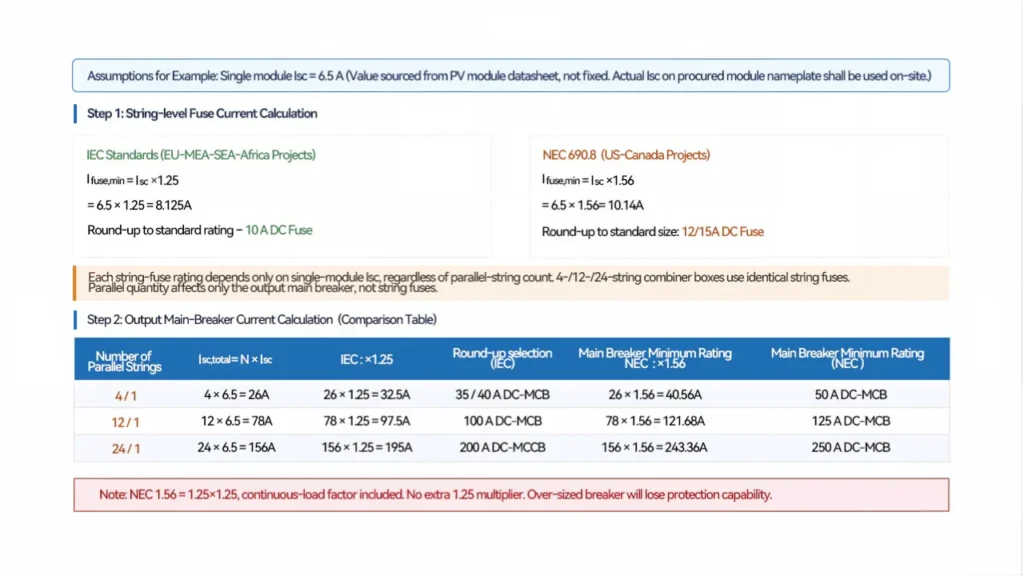
Every string input in a DC combiner box carries its own fuse, and that fuse is sized to the PV module’s specifications, not to the box’s overall rating:
- Fuse current rating should sit above the string’s expected operating current but below the module’s maximum series fuse rating specified on the datasheet.
- Fuse voltage rating must be at or above the array’s maximum system voltage under cold-weather Voc conditions.
Undersizing string fuses causes nuisance tripping under normal irradiance swings; oversizing them removes the protection the fuse exists to provide in the first place.
Step 3 — Size the Output Breaker for Combined Current, Not a Single String
This is where DC combiner box sizing most often goes wrong: the output-side DC MCB or MCCB must be rated for the sum of all connected strings’ current, not any individual string’s current. A box combining 12 strings at 12A each needs an output breaker rated for the full combined current with appropriate safety margin — not a breaker sized as if only one string were feeding it. See our DC circuit breaker sizing guide for the derating and margin calculations that apply at this stage.
Step 4 — Match Voltage Class Across Every Component
The combiner box’s rated voltage, every string fuse, and the output breaker all need to match the array’s voltage class (600V / 1000V / 1500V) — mixing classes anywhere in the chain limits the entire circuit’s safe operating voltage to the lowest-rated component. See our guide on [combiner boxes for 1000V vs 1500V systems] for how this changes the box’s internal component selection.
Step 5 — Leave Room for Growth, But Don’t Oversize Blindly
Choosing a box one size up from current string count is common practice for planned array expansion, but oversizing significantly beyond planned growth adds cost and enclosure footprint without benefit. Match the box to your actual expansion plan, not a generic “bigger is safer” assumption.
Quick Reference: Matching Box Size to String Count
| String count | Typical combiner box configuration |
|---|---|
| 4–6 strings | 4/1 or 6/1 configuration |
| 8–12 strings | 12/1 configuration |
| 13–16 strings | 16/1 configuration |
| 17–24 strings | 24/1 configuration |
Always confirm output breaker current rating against the specific combined current of your array — the configuration name refers to input count, not the pre-selected breaker size for every possible combination.
Common Mistakes in DC Combiner Box Sizing
Sizing the output breaker as if it protects one string. As covered in Step 3, this is the most frequent and most consequential sizing error — the output breaker sees the combined current of every connected string.
Assuming string count determines voltage rating. A 4-string box and a 24-string box can both be built for 1000V or 1500V — voltage class and string count are independent specifications that both need to be confirmed.
Buying the largest available box “to be safe.” Beyond genuinely planned expansion, oversizing adds unnecessary cost and enclosure size without a corresponding safety benefit.
Copying a fuse rating from a different project. Fuse sizing depends on the specific module’s electrical characteristics — a rating that was correct for one module’s Isc can be wrong for another.
FAQ
How many strings need a combiner box instead of direct connection to the inverter?
Systems with only one or two strings often connect directly to the inverter, depending on the inverter’s input configuration. Once three or more strings run in parallel, a combiner box with string-level fusing becomes the standard way to protect against reverse-current faults between strings.
Can I use a 12-string combiner box for a 6-string array to leave room for expansion?
Yes, this is common practice, but confirm the output breaker is still correctly sized for your current 6-string combined current — it should not be sized for the box’s full 12-string capacity if you’re not using all inputs yet.
Does combiner box sizing change between 1000V and 1500V systems?
The sizing logic (string count → fuse rating → output breaker rating) stays the same, but the specific components inside the box — terminal spacing, fuse and breaker voltage ratings — must be rated for the correct voltage class throughout.
What happens if the output breaker is undersized for the combined string current?
An undersized output breaker will nuisance-trip under normal combined operating current, taking the entire combiner box’s output offline even though no fault exists — a design error, not a fault condition.
What are the standards for photovoltaic system protection?
NEC 690.9 (Overcurrent protection requirements for PV systems) or IEC 60364-7-712