
DistributionSolar
A 1500V combiner box isn’t a 1000V box with a higher number printed on the label — the jump in system voltage changes the physical spacing requirements inside the enclosure itself, not just the voltage rating of the fuses and breaker it holds. Get this wrong and the failure mode isn’t reduced performance, it’s insulation breakdown between adjacent live parts that were never designed to sit that close together at 1500V.
This guide covers what actually changes in a combiner box for 1000V vs 1500V systems, building on the sizing logic covered in our combiner box sizing guide — sizing determines how many strings a box handles, voltage class determines what’s physically different inside it.
Combiner Box 1000V vs 1500V: Why Physical Spacing Changes, Not Just Ratings
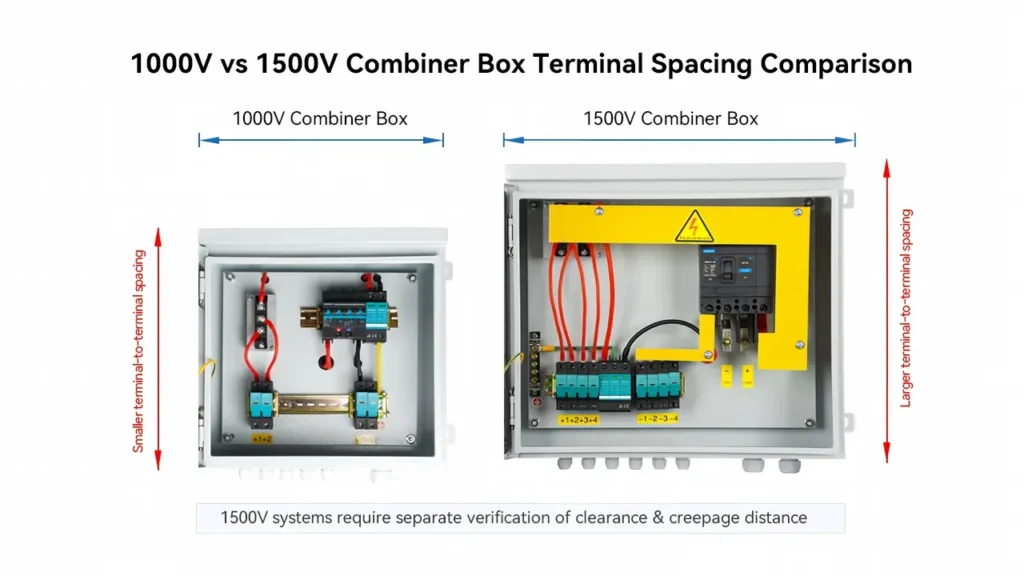
Every live conductor inside a combiner box — busbars, terminal blocks, string input points — needs enough physical separation from adjacent conductors and from the enclosure itself to prevent arcing and insulation breakdown. That separation requirement is defined by two measurements: clearance (the shortest distance through air between two conductive parts) and creepage distance (the shortest distance along the surface of the insulating material between them), both governed by IEC 60664-1, the insulation coordination standard that explicitly added 1500V DC thresholds in its most recent edition. Both measurements scale with system voltage — which is the real engineering story behind Combiner Box 1000V vs 1500V selection.
A combiner box built for 1000V and one built for 1500V use the same fundamental layout principles, but the 1500V version needs greater clearance and creepage distance at every terminal, busbar junction, and string input — which is why a 1500V-rated enclosure is typically physically larger or uses a different internal layout than its 1000V counterpart at the same string count, even when both hold the same number of inputs.
Combiner Box 1000V vs 1500V: Quick Comparison
| Criteria | 1000V Combiner Box | 1500V Combiner Box |
|---|---|---|
| Terminal/busbar spacing | Standard clearance and creepage distance | Increased clearance and creepage distance throughout |
| String fuse voltage rating | Rated ≥1000V DC | Rated ≥1500V DC — not interchangeable |
| Output breaker | 1000V-rated DC MCB/MCCB | 1500V-rated DC MCCB (see our DC MCB vs DC MCCB guide for why 1500V typically means MCCB, not MCB) |
| Enclosure size at same string count | More compact | Often larger to accommodate spacing requirements |
| Typical application | Commercial systems up to ~1MW | Utility-scale and large commercial arrays |
| Component cost | Lower | Higher, offset by fewer strings/combiners needed system-wide |
Why This Matters More at the String Input Terminals
String input terminals are where this shows up most in practice — each input carries a live PV string conductor immediately adjacent to the next string’s terminal, and at 1500V the spacing between them has to account for a higher potential difference under fault conditions. This is also why a string fuse rated for 1000V cannot simply be swapped into a 1500V box’s fuse holder without confirming the entire terminal assembly — not just the fuse — is rated for the higher voltage class.
Output-Side Protection Changes Too
As covered in our DC MCB vs DC MCCB comparison, 1500V DC protection typically moves from modular MCBs to MCCBs because of the same physical constraints — longer arc chutes and greater internal spacing are needed to safely break a fault at the higher voltage. A combiner box designed for 1500V output current will most often integrate an MCCB at the output stage rather than a modular MCB, which also affects the box’s internal layout and enclosure size.
Common Mistakes
Assuming a 1000V combiner box can be “upgraded” by swapping in 1500V-rated fuses alone. The fuse holder, terminal spacing, and busbar clearance around it also need to be rated for 1500V — changing the fuse alone doesn’t change the enclosure’s fundamental spacing.
Mixing 1000V and 1500V rated components in the same box. If any single component — a string fuse, a terminal block, the output breaker — is only rated to 1000V, the box’s safe operating voltage is limited to that component, regardless of what the enclosure itself is rated for.
Choosing 1500V without checking whether the project’s scale justifies it. As covered in our DC MCB 1000V vs 1500V guide, 1500V’s cost benefit comes from needing fewer strings, combiners, and cable runs system-wide — on smaller projects, the higher component cost isn’t always offset.
Ignoring altitude derating. Like DC breakers, insulation and arc performance at a given clearance distance is affected by air density — confirm the manufacturer’s altitude derating data for high-altitude installations rather than assuming sea-level spacing is universally sufficient.
FAQ
Can a 1500V combiner box be used on a 1000V system?
Generally yes from a safety standpoint, since the higher-rated enclosure typically covers the lower voltage class, but it isn’t the economical choice — 1500V-rated components and the larger enclosure carry a cost premium not offset by any benefit on a 1000V array.
Can I use a 1000V combiner box on a 1500V system by only replacing the fuses?
No. The terminal spacing, busbar clearance, and creepage distance throughout the enclosure are part of what makes it a 1000V or 1500V rated product — replacing only the fuses doesn’t change the physical spacing the rest of the box was built around.
Does a 1500V combiner box always cost significantly more than a 1000V one at the same string count?
Typically yes for the component itself, due to larger physical spacing requirements and the shift to MCCB-based output protection — but system-wide, 1500V architecture usually reduces the total number of strings and combiner boxes needed, which can offset the per-unit premium at scale.
How do I confirm a combiner box is genuinely rated for 1500V rather than just badged as 1500V-compatible?
Check the manufacturer’s datasheet for explicit clearance and creepage distance specifications referenced against IEC 60664-1, alongside the voltage rating, and confirm the string fuse holders and output breaker are independently rated for 1500V DC — voltage rating on the enclosure label alone isn’t sufficient confirmation in any genuine Combiner Box 1000V vs 1500V evaluation.