
DistributionEV Charging
DC circuit protection for EV charging stations operates under conditions that most DC system designers never encounter elsewhere: voltages climbing toward 1000V, currents exceeding 400A, power electronics switching in microseconds, and — increasingly — bidirectional current flow as vehicle-to-grid (V2G) capability becomes standard. Getting the protection architecture right is not optional engineering polish; it is what stands between a charging station and a fire involving an asset that can release enormous stored energy in a fault.
This guide covers the complete DC protection picture for EV charging infrastructure: how to size DC circuit breakers across the voltage classes in use today, where mechanical breakers reach their limits and semiconductor fuses take over, the residual current protection requirements, and the protection considerations introduced by bidirectional charging.
The Voltage and Power Landscape: What You’re Actually Protecting
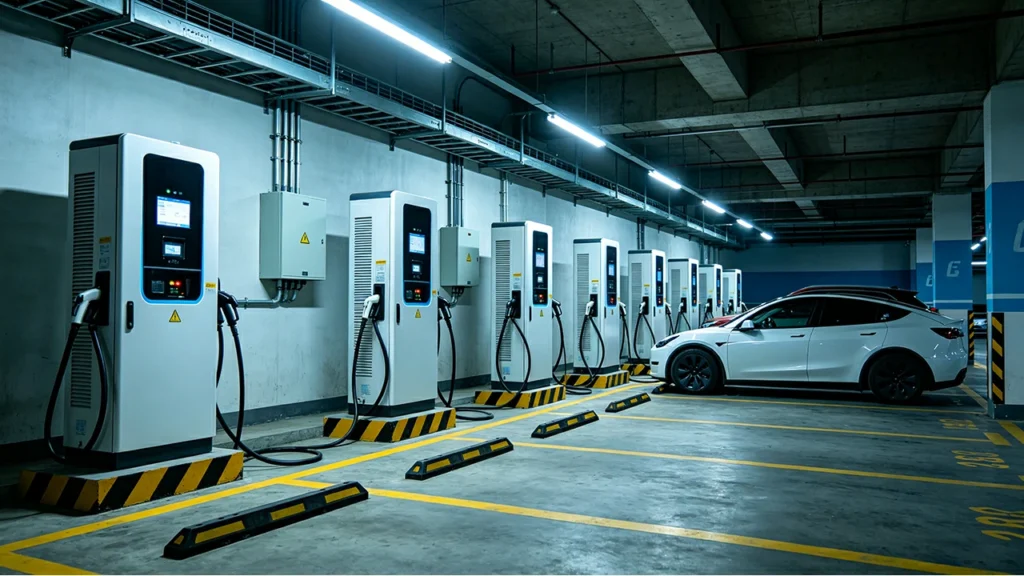
DC circuit protection for EV charging stations must be designed around the specific voltage class and power level of the charger — there is no single universal specification.
Entry-level DC fast chargers typically operate at 400–500V DC, delivering 50–150 kW with nominal currents in the 100–375A range, depending on output power and voltage.
Mid-range fast chargers are converging on an 800V DC architecture, aligned with the 800V battery platforms now common in newer EVs. At 800V, a 150 kW charger draws approximately 188A continuously.
High-power chargers (HPC) push to 1000V DC and beyond, with power levels of 350 kW and higher, requiring currents of 350–400A or more at full output.
The industry trend is unambiguous: voltage and power levels are both increasing. A protection system specified today should be sized with margin for near-term capacity increases, not just the charger’s current nameplate rating — replacing protection infrastructure mid-life is far more expensive than specifying adequate headroom at installation.
Why Standard AC Breakers Cannot Be Used on the DC Side
This point bears repeating because it remains a recurring and dangerous error: the DC output side of an EV charger — from the rectifier/converter stage through to the vehicle connector — must use devices explicitly rated for DC operation, never AC-rated breakers, regardless of how the current and voltage figures compare.
AC circuit breakers rely on the natural zero-crossing of alternating current — occurring 100 or 120 times per second depending on mains frequency — to extinguish the arc that forms when contacts separate under fault current. DC current has no zero crossing. An AC breaker attempting to interrupt a DC fault will see the arc persist, generating sustained heat that can weld the contacts, destroy the device, and ignite surrounding materials. This single distinction is why every protective device between the charger’s rectification stage and the vehicle connector must carry a verified DC rating — current rating, voltage rating, and breaking capacity all independently certified for DC operation under standards such as IEC 60947-2.
The AC supply side — from the utility connection to the charger’s input — uses conventional AC protection devices. The DC requirement applies specifically downstream of the rectification/conversion stage.
Sizing the DC Circuit Breaker: Current and Voltage
Current Rating
The starting point is the charger’s nominal DC output current at full power, calculated as:
I (A) = P (W) ÷ V (V)
A 150 kW charger operating at 800V draws 150,000 ÷ 800 = 187.5A nominal.
EV charging is classified as a continuous load — operating for periods well beyond three hours across a charging session and across a day of operation — which mandates the standard 125% continuous duty factor, consistent with both IEC 60364-7-722 and NEC Article 625.41:
Minimum breaker rating = Nominal current × 1.25
For the 187.5A example: 187.5 × 1.25 = 234.4A → select the next standard size, 250A.
Skipping the 125% factor is a common and consequential mistake. It is not a conservative safety margin that can be optionally omitted — it is a mandatory derating requirement based on thermal testing of breaker contacts and terminations under sustained current. Undersized devices run hot continuously, accelerating degradation of contacts and connections, and creating exactly the kind of high-impedance intermittent fault that is hardest to diagnose in the field.
Voltage Rating
Select the breaker’s DC voltage rating based on the charger’s architecture, with margin for transient conditions:
- 400–500V DC chargers: specify breakers rated at minimum 500V DC
- 800–920V DC chargers: specify breakers rated at minimum 1000V DC — the additional margin accommodates voltage transients during regenerative feedback from the vehicle and battery voltage variation across state of charge
- 1000V DC chargers: specify breakers rated at 1000V DC minimum, with 1500V DC preferred where future-proofing for next-generation higher-voltage architectures is a design priority
Given the clear industry trajectory toward 800V and 1000V systems, specifying DC circuit breakers rated for at least 1000V DC — even on installations currently operating at 500V — is a reasonable hedge against near-term capacity upgrades that would otherwise require full protection system replacement.
Breaking Capacity: Why 10 kA Is a Floor, Not a Target
DC circuit protection for EV charging stations must account for fault currents substantially higher than the device’s continuous current rating. The minimum recommended interrupt capacity for DC fast charging applications is 10 kA, with 20 kA or higher preferred for higher-power installations.
This figure is not arbitrary. Fault current in a DC fast charging circuit is determined by the available short-circuit current from the charger’s power conversion stage and any contribution from connected battery storage or — increasingly — from the vehicle itself in bidirectional configurations. A breaker whose breaking capacity is matched only to its continuous current rating, without margin for the actual prospective fault current, risks the same catastrophic failure mode as an AC breaker on a DC circuit: an arc that the device cannot extinguish.
Calculate, don’t assume. Obtain the prospective fault current at the breaker’s installation point from the charger manufacturer’s specifications, or from a calculation based on the power conversion stage’s source impedance. Select breaking capacity with margin above this figure — not simply the 10 kA floor as a default without verification.
Where Mechanical Breakers End and Semiconductor Fuses Begin
This is the protection boundary that many DC circuit protection guides for EV charging gloss over, and it matters more than almost any other design decision in fast charger protection architecture.
Mechanical DC circuit breakers — even well-designed ones — have response times in the range of 20–100 milliseconds. This is fast by the standards of conventional electrical protection, and entirely adequate for protecting cabling, the vehicle connector, and the charger’s enclosure from sustained overcurrent and short-circuit conditions.
It is not fast enough to protect the power semiconductors — IGBTs and similar devices — inside the charger’s power conversion stage. An internal short circuit or “shoot-through” fault within the power electronics can produce fault currents of 10–50× rated current within microseconds. By the time a mechanical breaker’s trip mechanism has even begun to actuate, the semiconductor has already failed.
This is why DC fast chargers require a layered protection architecture, not a single device:
- Semiconductor-specific fast-acting fuses (aR-class or equivalent), with clearing times under 5 milliseconds, protect the power conversion module itself. These are sized to ensure their let-through energy (I²t) remains below the rated I²t of the IGBT or other semiconductor they protect — a specification found in the device manufacturer’s datasheet, not a general rule of thumb.
- DC circuit breakers provide overcurrent and short-circuit protection for the charger’s input and output cabling, the connector, and the overall circuit — operating at the millisecond-to-hundred-millisecond timescale appropriate for cable and equipment protection, with the added benefit of manual reset and isolation capability that a fuse does not provide.
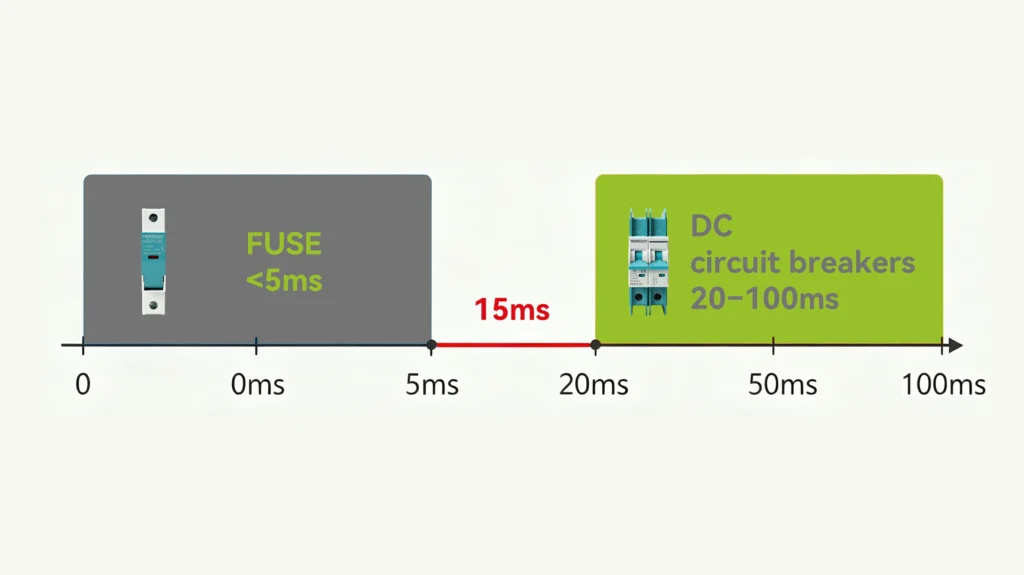
These two device types are not redundant or interchangeable. A charger protected only by a DC circuit breaker, without semiconductor-rated fuses ahead of the power conversion stage, is at meaningful risk of catastrophic component failure on internal faults the breaker simply cannot respond to in time. A charger protected only by fuses, without circuit breakers for cable and connector protection, lacks the manual isolation and reusable disconnect capability essential for safe maintenance.
Surge Protection: A Frequently Overlooked Layer
DC fast chargers are predominantly installed in exposed outdoor environments — parking structures, highway corridors, commercial lots — where transient overvoltage exposure is a genuine and recurring risk, not a theoretical one.
Type 1 Surge Protective Devices handle direct or near-direct lightning strike energy and are installed at the service entrance. Outdoor charging installations fed by overhead power lines require Type 1 protection.
Type 2 SPDs address induced surges from switching events — utility grid switching, large motor startups, capacitor bank operation — and are installed at the equipment level, closer to the charger itself.
Commercial DC fast charger installations typically require both protection types, frequently combined in a single Type 1+2 device for installation efficiency. This SPD layer is separate from, and complementary to, the overcurrent protection provided by DC circuit breakers and fuses — overcurrent protection responds to fault current, surge protection responds to transient overvoltage, and a complete protection architecture addresses both.
Residual Current Protection: A Brief Note (Full Detail in Our Type B RCD Guide)
EV charging installations require residual current protection at each charging point — typically a maximum 30 mA RCD for personal protection, governed by IEC 60364-7-722 and equivalent national standards. The critical selection question is whether a Type A, Type F, or Type B device is required, and this depends on the charger’s internal rectifier topology and whether it includes a certified RDC-DD (Residual DC Detection Device).
This decision involves enough technical nuance — magnetic core saturation, single-phase versus three-phase rectifier topology, RDC-DD certification — that we cover it in full detail in a dedicated guide: Type B RCD: Why EV Charging and Solar Inverters Need It. The short version for DC fast charging specifically: three-phase fast chargers generate smooth DC leakage current that can saturate a Type A RCD’s detection core, making Type B protection — or an equivalent Type A/F plus certified RDC-DD combination — a requirement rather than a recommendation.
Temperature Derating in Outdoor Charging Installations
DC circuit breakers in outdoor charging cabinets are subject to ambient conditions far more demanding than the standard 40°C calibration reference. Direct sun exposure on enclosures, combined with internal heat generation from the power conversion electronics, can push internal cabinet temperatures well above ambient — frequently into the 50–65°C range during peak operation in hot climates.
For installations in consistently hot environments, apply an additional 10–15% current derating beyond the manufacturer’s standard derating curve, or specify breakers with integrated temperature monitoring that can flag thermal stress before it becomes a nuisance-tripping or reliability problem. Breakers that appear to fail intermittently in service, particularly during summer peak-demand periods, are frequently suffering from inadequate temperature derating rather than any defect in the device itself.
Inrush Current: Accounting for Capacitor Charging
EV chargers draw a brief but significant inrush current during startup as the DC-link capacitors in the power conversion stage charge. This inrush can reach 3–5× the charger’s rated continuous current for a duration on the order of milliseconds to tens of milliseconds.
The DC circuit breaker’s trip curve must tolerate this inrush without nuisance tripping while still responding appropriately to genuine fault conditions. C-curve characteristics — with a magnetic trip threshold of 5–10× rated current — are the standard choice for DC fast charger output circuits, providing tolerance for the capacitor charging inrush (typically within the 5–10× window) while maintaining reliable fault response above that threshold. This mirrors the trip curve logic used in solar PV string protection, where startup and transient currents require the same B/C/D curve reasoning — covered in detail in our guide to DC MCB Trip Curves B, C and D.
Vehicle-to-Grid (V2G) and Bidirectional Protection Requirements
Bidirectional charging — where the vehicle can both draw power from and supply power to the grid or building load — introduces a protection requirement that traditional, source-to-load DC charging architectures do not face.
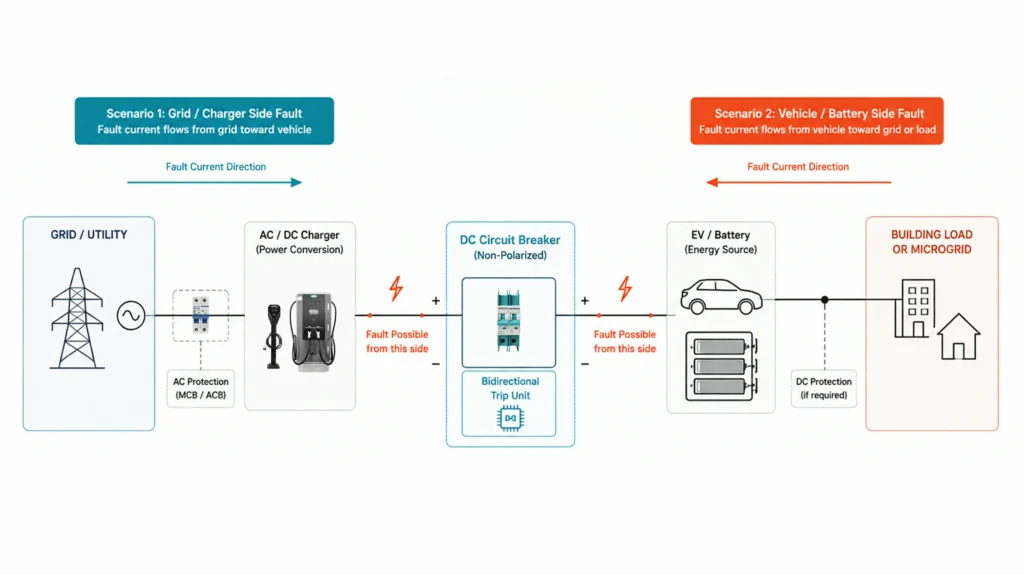
In a conventional unidirectional charger, fault current can only originate from the charger’s source side (the grid, through the power conversion stage) flowing toward the vehicle. In a V2G-capable installation, fault contributions can originate from either direction — from the utility/charger side, or from the connected vehicle’s battery feeding current back through the charging circuit during a fault.
This has two direct implications for DC circuit protection:
Non-polarized, bidirectional-rated devices are required. A polarized DC circuit breaker — one that relies on permanent magnets oriented for current flow in a single direction to assist arc extinction — will fail to interrupt a fault correctly if current is flowing in the reverse direction at the moment of the fault. Every DC circuit breaker specified for a V2G-capable installation must be explicitly verified as non-polarized in the manufacturer’s documentation, exactly as required for battery energy storage system protection — see our guide on DC Circuit Breaker for Battery Energy Storage for the underlying bidirectional protection principles, which apply equally here.
Trip units must monitor both directions. Advanced electronic trip units capable of detecting and responding to fault current regardless of direction are necessary for full V2G protection — a simple fixed-threshold magnetic trip designed for unidirectional current flow may not provide symmetrical protection performance in both directions.
As V2G deployment scales, this bidirectional requirement will become standard specification practice across EV charging infrastructure, not a niche consideration limited to dedicated V2G pilot installations.
Common Mistakes in EV Charging DC Protection Design
Specifying breaking capacity at the bare 10 kA minimum without verification. Always calculate or obtain the actual prospective fault current at the installation point; the 10 kA figure is a floor for lower-power installations, not a universal specification.
Relying on a DC circuit breaker alone to protect power semiconductors. Mechanical breaker response times of 20–100ms cannot prevent IGBT failure under internal shoot-through fault conditions occurring in microseconds. Semiconductor-rated fast fuses are a separate, necessary protection layer.
Treating Type A RCDs as sufficient for three-phase DC fast chargers. Smooth DC leakage from three-phase rectification can saturate a Type A device’s detection core. See our dedicated Type B RCD guide for the full technical explanation.
Ignoring outdoor temperature effects on breaker current rating. Standard 40°C calibration does not reflect real conditions in sun-exposed outdoor cabinets in hot climates. Apply appropriate derating.
Specifying polarized DC breakers for V2G-capable installations. This is the bidirectional equivalent of the BESS polarized-breaker mistake — a device that cannot reliably interrupt reverse-direction fault current is a serious safety gap as bidirectional charging becomes standard.
Summary
DC circuit protection for EV charging stations requires a layered architecture, not a single device selection. Mechanical DC circuit breakers — correctly sized for current, voltage, and breaking capacity, with C-curve trip characteristics to tolerate inrush — handle cable and connector protection. Semiconductor-rated fast fuses protect the power conversion electronics at timescales mechanical devices cannot reach. Surge protection addresses transient overvoltage from the outdoor exposure this equipment routinely faces. And as bidirectional charging becomes standard, every device in the protection chain must be explicitly verified as non-polarized and capable of symmetrical fault interruption regardless of current direction.
For a full overview of DC protection device types and selection principles, see our DC Circuit Breaker: All You Need to Know guide.
External references: IEC 60364-7-722 — Low-voltage electrical installations, Part 7-722: Requirements for special installations or locations — Supplies for electric vehicles (iec.ch); NEC Article 625 — Electric Vehicle Power Transfer System (nfpa.org)