
DistributionSolar
Rooftop solar PV systems are widely used in residential, commercial, and industrial buildings. While they offer clean energy and cost savings, they also introduce high-voltage DC circuits on rooftops, which require carefully designed protection systems.
Unlike AC circuits, DC systems behave differently during faults. Improper DC protection design can increase risks such as:
- Persistent DC arcing
- Reverse current faults
- Overvoltage caused by lightning
- Fire hazards in rooftop environments
This guide explains how to properly design DC protection for rooftop PV systems in a practical and structured way.
Understand the Structure of a Rooftop PV DC System
Before designing protection, it’s important to understand the typical DC power path:
- PV modules generate DC power
- Modules are connected into strings
- Strings may connect to a DC combiner box
- DC power flows to the inverter
Protection can be placed at multiple levels:
- String level
- Array level
- Inverter input level
Each level serves a different purpose.
👉 If you are new to system structure, refer to:
What Is a Solar PV System? (Components & Working Principle)
Step 1 – String-Level Overcurrent Protection
Why It Is Needed
When multiple PV strings are connected in parallel, a fault in one string can cause reverse current from other strings.
This may:
- Overheat cables
- Damage modules
- Increase fire risk
Design Principle
If 3 or more strings are connected in parallel, string-level overcurrent protection is generally required.
Common Solution
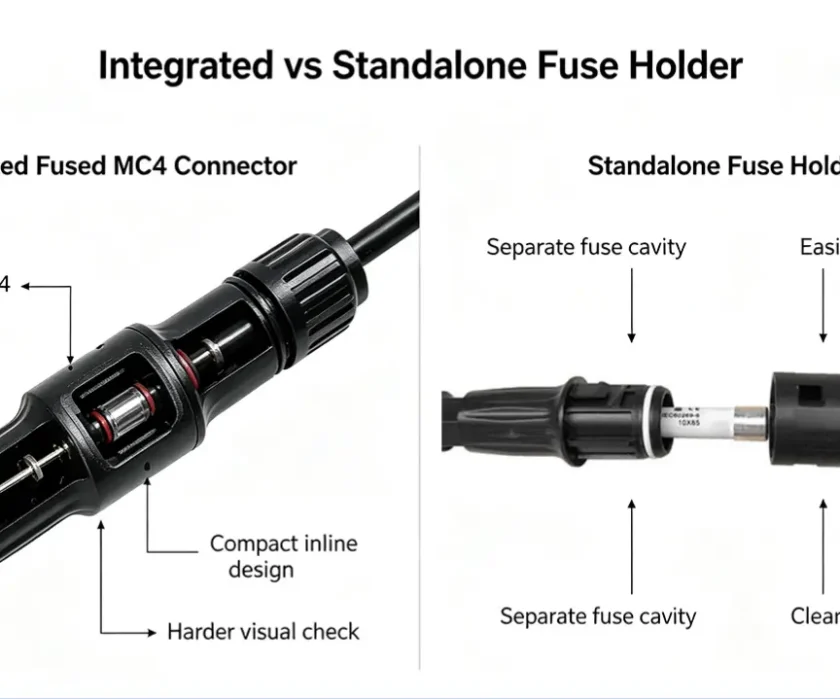
- Install DC fuses for each string
- Fuse rating must match module specifications
- Ensure fuse voltage rating ≥ system maximum DC voltage
For small rooftop systems with only one or two strings, fuses may not always be required depending on system configuration and standards.
Step 2 – DC Isolation for Maintenance and Emergency
Rooftop PV systems must allow safe shutdown for:
- Maintenance work
- Firefighter access
- Emergency disconnection
DC Isolator Placement
Common locations:
- Near the PV array
- Integrated in the DC combiner box
- Near the inverter input
Design Considerations
- Rated for full load DC current
- Rated for system voltage (600V / 1000V / 1500V)
- Designed specifically for DC switching
⚠️ DC switches must be arc-resistant and designed for DC interruption — AC switches are not suitable.
Step 3 – Surge Protection Against Lightning
Rooftop installations are exposed to lightning and transient overvoltage.
Even indirect lightning strikes can induce high surge voltage through:
- Long DC cable runs
- Building grounding systems
- Nearby lightning activity
Recommended Protection
Install DC Surge Protection Devices (SPD):
- Type 2 SPD for most rooftop systems
- Installed inside DC combiner box or inverter input
- Properly connected to grounding system
Correct grounding is critical for SPD effectiveness.
Step 4 – Proper Cable and Temperature Consideration
Rooftops can reach very high temperatures, especially in industrial buildings.
High temperature affects:
- Cable ampacity
- Fuse performance
- Enclosure heat dissipation
Design Recommendations
- Apply temperature derating for current calculations
- Use UV-resistant, DC-rated cables
- Ensure enclosure ventilation or suitable IP-rated design
Ignoring rooftop temperature conditions can lead to long-term reliability issues.
Step 5 – DC Arc Risk Awareness
DC arcs are more dangerous than AC arcs because:
- DC current does not cross zero naturally
- Arcs can persist longer
- Fire risk is higher
Risk factors in rooftop systems:
- Loose MC4 connectors
- Damaged cables
- Improper crimping
- Aging insulation
Protection design should be combined with:
- Proper installation practices
- Periodic inspection
- High-quality DC connectors
Step 6 – Coordination with Inverter Design
Modern inverters may include:
- Internal DC isolation
- String monitoring
- Reverse polarity protection
However, relying only on inverter protection is not recommended for larger rooftop systems.
External DC protection ensures:
- Better fault isolation
- Reduced stress on inverter
- Improved overall system safety
Typical DC Protection Layout for Rooftop PV
For a medium-sized rooftop commercial system:
- String-level DC fuses
- DC combiner box
- DC Type 2 SPD
- DC isolator switch
- Proper grounding
For very small residential systems with few strings:
- Direct string-to-inverter connection
- Inverter-integrated isolator
- DC SPD depending on local standards
Protection design must always match system size and risk profile.
Common Mistakes in Rooftop DC Protection Design
- Using AC-rated switches on DC circuits
- Ignoring reverse current risk
- Omitting SPD in lightning-prone areas
- Undersizing fuses
- Poor grounding design
These mistakes can significantly increase long-term system risk.