

DistributionSolar
A DC Combiner Box Maintenance Checklist is only useful if it catches problems before they become failures — and most generic checklists stop at “inspect for damage,” which misses the specific, predictable failure modes that actually show up in DC combiner boxes over years of field exposure: loosened terminals from thermal cycling, degraded seals letting in dust, and fuses that have silently blown without anyone noticing at the plant level.
This guide is a practical DC Combiner Box Maintenance Checklist built around those specific failure modes, complementing the sizing and IP rating decisions made at installation with what to actually check once the box has been in service.
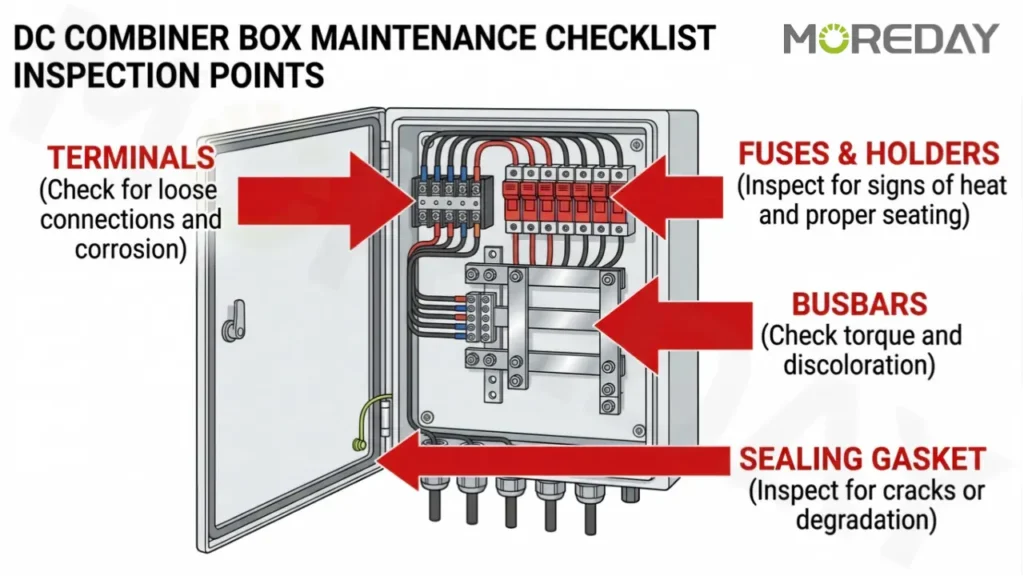
DC Combiner Box Maintenance Checklist inspection diagramWhy a DC Combiner Box Maintenance Checklist Needs to Be Specific, Not Generic
A combiner box sits at a high-stress point in the DC circuit — every string’s current passes through its terminals, fuses, and busbars, and it’s typically mounted outdoors, exposed to thermal cycling, UV, and moisture over a 20+ year system lifetime. A generic “inspect for damage” checklist misses the failure modes specific to this exposure. The checklist below is built around what actually degrades in a combiner box, not a generic electrical panel inspection template.
The 7-Point DC Combiner Box Maintenance Checklist
1. Terminal Torque and Connection Integrity
Thermal cycling — daily heating and cooling as current flows and stops — gradually loosens terminal screws over years. Check torque against the manufacturer’s specified value at each scheduled inspection, and look for discoloration or heat-damage marks on terminals, which indicate a connection that has already been arcing intermittently.
2. Fuse Status Per String
A blown string fuse doesn’t announce itself at the plant level — it just quietly removes that string’s contribution to total output. Check each string fuse’s status individually (many combiner boxes include visual fuse indicators) rather than relying on total output current alone to infer that all strings are functioning.
3. Enclosure Seal and Gasket Condition
The IP rating covered in our combiner box IP rating guide only holds as long as the enclosure’s seals remain intact. Inspect door gaskets, cable gland seals, and any access panel seals for cracking, compression set, or UV degradation — a degraded seal silently drops real-world protection well below the box’s rated IP level.
4. Signs of Moisture or Dust Ingress
Even with intact seals, check the enclosure interior for any sign of moisture staining, corrosion on busbars or terminals, or dust accumulation — early evidence of ingress before it causes an actual fault.
5. Surge Protection Device (SPD) Status Indicator
Most SPDs include a visual status indicator showing whether the device has absorbed a surge event and needs replacement. A combiner box maintenance visit should always include checking this indicator — an expired SPD provides no protection while looking identical to a functioning one from the outside.
6. Busbar and Wiring Insulation Condition
Inspect busbars and internal wiring insulation for cracking, discoloration, or brittleness, particularly in high-UV or high-temperature installation environments where insulation degrades faster than the rated component lifetime might suggest.
7. Output Breaker Function Test
Where the maintenance schedule and system design allow, periodically test the output-side DC MCB or MCCB’s manual trip function to confirm it operates correctly — a breaker that has never been exercised can develop mechanical stiffness that delays its response during an actual fault.
How Often Should You Run This Checklist?
| Environment | Recommended inspection interval |
|---|---|
| Standard rooftop/ground-mount, temperate climate | Annually |
| Coastal, high-humidity, or high-dust environments | Every 6 months |
| Utility-scale sites with remote monitoring | Annual physical inspection, supplemented by continuous string-level monitoring between visits |
Common Mistakes
Relying on total output current alone to confirm all strings are healthy. As covered in point 2, a single blown fuse doesn’t meaningfully move total output on a large array — checking string fuses individually is the only reliable method without dedicated monitoring.
Skipping seal inspection because “the box still looks sealed.” Seal degradation is often invisible without close inspection — compression set and UV embrittlement don’t always show obvious external signs before failure.
Treating an SPD as a permanent, maintenance-free component. SPDs are sacrificial by design; an aged or surge-exhausted unit needs to be identified and replaced, not assumed functional indefinitely.
Skipping torque checks because “nothing looks loose.” Terminal loosening from thermal cycling is a gradual mechanical process that isn’t visually obvious until a connection has already started arcing.
FAQ
How long does a full DC combiner box maintenance checklist take per box?
This varies with box size and string count, but a thorough inspection covering all 7 points typically takes a trained technician 20–40 minutes per box, longer if any issues requiring further diagnosis are found.
Can string-level monitoring replace physical maintenance inspections?
No — monitoring catches electrical underperformance in near real time, but it can’t detect physical issues like seal degradation, terminal corrosion, or SPD wear that haven’t yet caused a measurable electrical fault. The two are complementary, not substitutes.
What’s the most common failure found during DC combiner box maintenance?
Loosened terminal connections from thermal cycling and blown string fuses are the two most frequently identified issues in field inspections, which is why they’re the first two items on this checklist rather than an afterthought.
Does following this DC Combiner Box Maintenance Checklist affect warranty or performance guarantee claims?
Documented, regular maintenance is often a condition of manufacturer warranties and third-party performance guarantee agreements — keeping dated records of each inspection using a checklist like this one supports those claims if a dispute arises. View More