
DistributionSolar
A single failed string sitting in the middle of a 16-string array can lose 15–20% of that combiner box’s output for weeks before anyone notices — because the symptom it produces, a modest dip in total plant output, looks identical to a cloudy week. String-level monitoring in a combiner box exists specifically to close that blind spot, by reporting current and voltage at each individual string input rather than only the combined output the plant-level meter already sees.
This guide covers what string-level monitoring in a combiner box actually adds, where the payback case is strongest, and where it’s genuinely not worth the extra line item. View the complete guide to combiner boxes.
What String-Level Monitoring in a Combiner Box Actually Measures
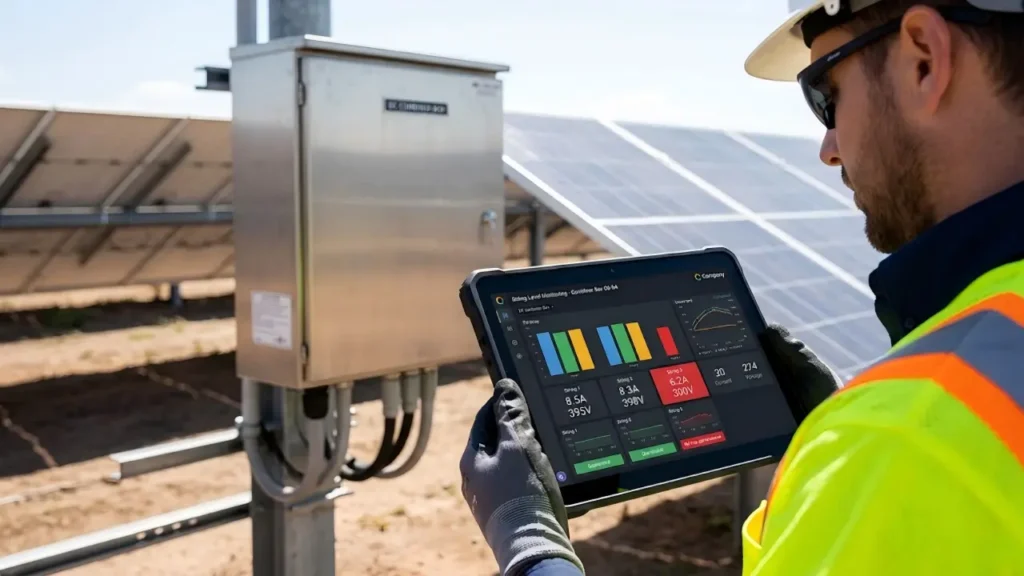
Standard combiner boxes report only combined output current and voltage — the sum of every connected string. A combiner box with a string-level monitoring module adds current (and often voltage) sensing at each individual input, so a technician or O&M platform can see string #7 producing 20% below its neighbors without waiting for that gap to show up in the plant’s overall performance ratio.
Why Plant-Level Monitoring Alone Misses These Faults
A blown string fuse or a failed bypass diode on a single string is a small event relative to total plant output — often just a few percent of one combiner box’s contribution to the whole array. On a large site, that kind of single-string loss can sit well below the threshold that trips an alert on plant-level performance ratio dashboards, which is exactly why documented cases of underperforming strings have gone undetected for weeks to months at a time, quietly compounding into meaningful annual production loss well before anyone flags it in a monthly report.
5 Reasons String-Level Monitoring in a Combiner Box Pays for Itself
1. It catches faults that plant-level KPIs structurally can’t see. A single string’s underperformance rarely moves the needle on total plant output enough to trigger a standard alert, which is precisely the gap string-level data closes — a gap formally recognized in IEC 61724-1, the international standard governing PV performance monitoring classes and granularity.
2. It turns troubleshooting into a lookup, not a search. Without per-string data, diagnosing an underperformance issue means physically inspecting every string in an array. With it, the technician goes directly to the flagged combiner box and input.
3. It reduces the accumulated cost of “small” losses. Individually, a single failed string’s lost output looks minor. Left undetected across a full season — or worse, unnoticed until a scheduled annual inspection — that same small loss compounds into a material line item, particularly across large arrays running many combiner boxes.
4. It supports warranty and performance-guarantee documentation. Performance guarantee agreements and manufacturer warranty claims increasingly expect a documented maintenance and monitoring record, an approach detailed in NREL’s Best Practices for PV O&M guide — string-level data provides exactly that evidence trail.
5. It scales O&M efficiency as plants get larger. A small rooftop array can be visually inspected end-to-end during a single site visit. A large ground-mount plant with hundreds of strings across dozens of combiner boxes cannot — at that scale, remote string-level data isn’t a convenience, it’s the only practical way to maintain fault visibility.
When String-Level Monitoring Might Not Be Worth It
- Small residential or small commercial systems with only a handful of strings, where a technician can visually and electrically check every string during a routine visit without needing remote per-string telemetry.
- Sites with frequent, low-cost physical access, where the labor cost of periodic manual checks stays lower than the added hardware and data-platform cost of monitoring.
- Projects with tight upfront capital constraints where the monitoring module’s cost delays other higher-priority protection components — string-level monitoring is diagnostic, not protective, and shouldn’t come at the expense of proper fusing and overcurrent protection.
Common Mistakes
Assuming monitoring replaces the need for proper string fusing. Monitoring tells you a fault happened — it doesn’t prevent or clear one. A combiner box still needs correctly sized string fuses and an output breaker regardless of whether monitoring is installed.
Assuming all “monitored” combiner boxes report the same granularity. Some products only report combined output data even when marketed as having monitoring features — confirm the datasheet explicitly states per-string current and voltage reporting, not just an aggregate output reading.
Adding monitoring without a plan to act on the data. A monitoring module generates alerts; someone still needs to review them and dispatch a response. Monitoring without an O&M process behind it captures data without capturing the value that data is supposed to deliver.
FAQ
How much production loss can a single undetected string failure cause?
It varies with array size and string configuration, but published O&M case studies have documented individual string failures going unnoticed for weeks to months on larger plants, since the loss from one string is often too small to visibly move a plant-level performance ratio, even though it compounds into a real annual cost.
Is string-level monitoring the same as module-level (panel-level) monitoring?
No. String-level monitoring reports data per string — a group of series-connected modules — while module-level monitoring, typically enabled by microinverters or DC optimizers, reports data per individual panel. String-level monitoring is sufficient for most standard installations; module-level offers finer granularity but at higher cost and complexity.
Does adding string-level monitoring improve system performance directly?
Not directly — monitoring doesn’t generate more energy. It protects existing expected performance by catching underperformance early enough to fix it before losses compound, which is a meaningful distinction when evaluating the return on adding it.
Can string-level monitoring be added to an existing combiner box, or does it need to be built in?
This depends on the specific combiner box model — some product lines offer monitoring as a factory-installed optional module rather than a field-retrofit component, so confirm with the manufacturer whether your existing box supports adding it after installation.