
DistributionEV Charging
Type B RCD is one of the most searched — and most misunderstood — terms in modern electrical installation. Most articles tell you that a Type B RCD detects smooth DC leakage. Fewer explain why that matters, or when you actually need one versus when a Type A will do the job. And almost none address the question that installers are really asking: does every EV charger and every solar inverter require a Type B RCD, or not?
This guide answers that question precisely. We’ll explain the physics behind the requirement, how single-phase and three-phase systems differ, what RDC-DD changes about the calculation, and how the requirement applies to solar PV installations where the rules are less uniform than in EV charging.
What a Type B RCD Actually Is
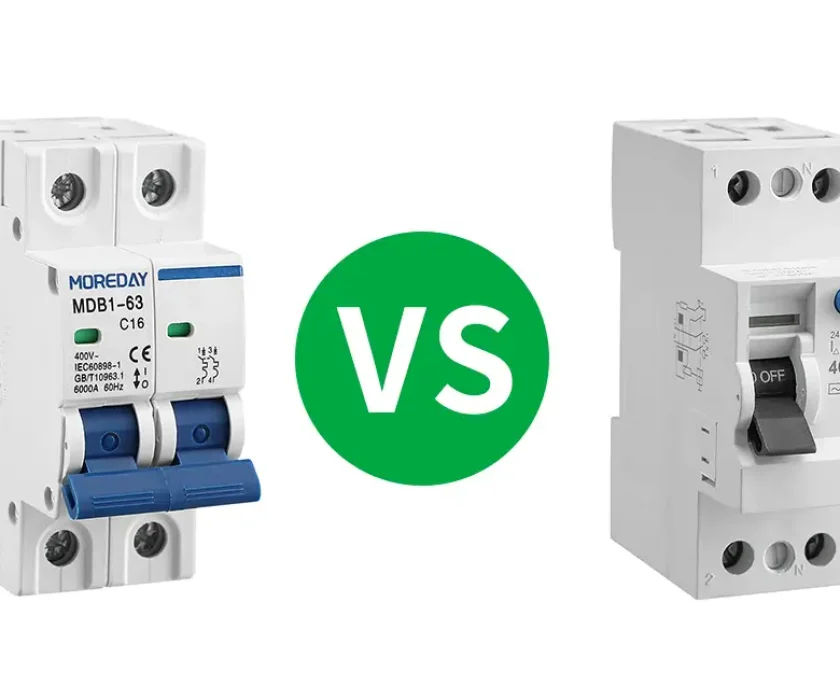
A Residual Current Device works by continuously comparing the current flowing out through the live conductor with the current returning through the neutral. Under normal conditions, these are equal. When a fault occurs — a person receiving a shock, insulation breakdown to earth — some current takes an unintended path and doesn’t return through the neutral. The RCD detects this imbalance and disconnects the circuit, typically within 30 milliseconds.
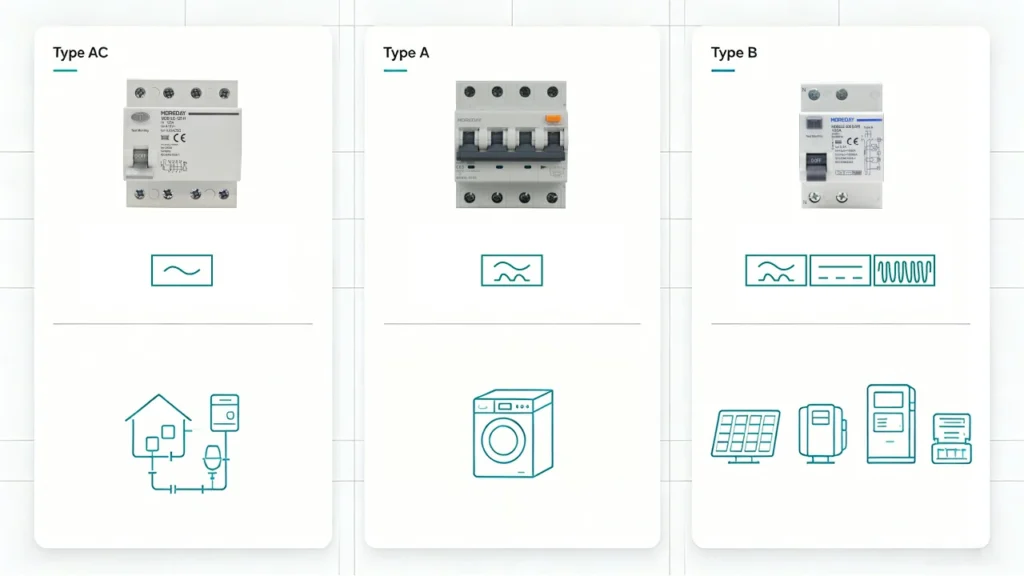
The difference between RCD types is not sensitivity — all standard RCDs trip at 30 mA. The difference is which waveforms of residual current they can reliably detect:
- Type AC: Detects sinusoidal AC residual current only. Suitable for purely resistive or simple inductive loads.
- Type A: Detects sinusoidal AC and pulsating DC residual currents. Suitable for most appliances with single-phase rectifiers — washing machines, dishwashers, single-phase EV chargers with internal protection.
- Type B: Detects sinusoidal AC, pulsating DC, and smooth DC residual currents, including high-frequency components up to several kHz. Required where power electronics can generate smooth DC leakage.
The distinction between pulsating DC and smooth DC is where the technical complexity lies — and it’s the reason Type B RCDs exist.
The Core Problem: Magnetic Core Saturation
To understand why smooth DC leakage defeats a Type A RCD, you need to understand how an RCD detects fault current in the first place.
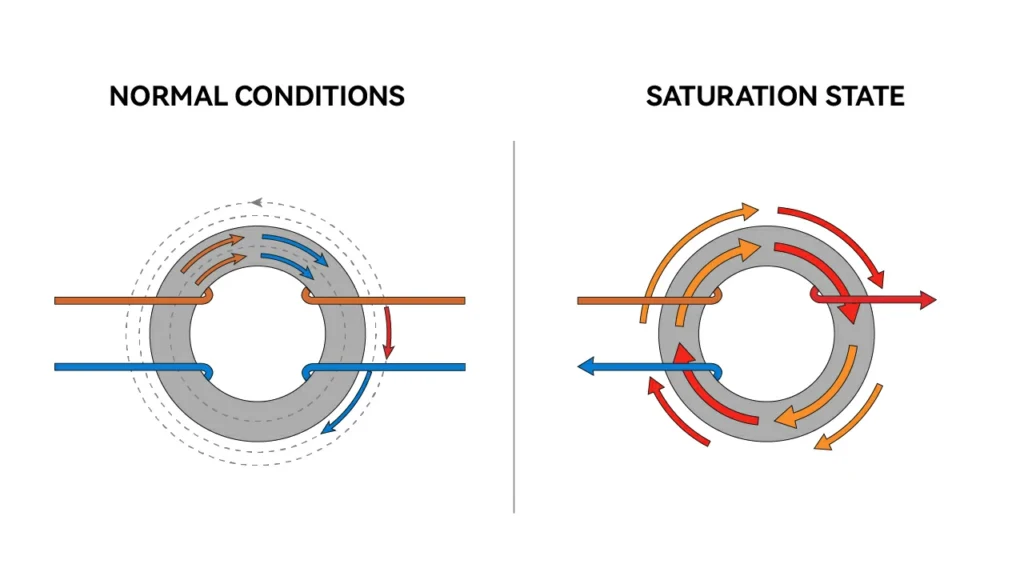
Inside every RCD is a toroidal current transformer — a ring of magnetic core material with the live and neutral conductors passing through it. Under normal conditions, the magnetic fields generated by the outgoing and returning currents cancel each other out. A fault current creates a net imbalance, which induces a signal in the detection winding, triggering the trip.
This mechanism depends on the core material responding to changes in magnetic flux. AC current, by its nature, reverses direction continuously — the magnetic flux in the core cycles between positive and negative with every half-cycle. This cycling keeps the core “reset” and responsive.
Smooth DC current is different. A constant DC current creates a constant, unidirectional magnetic field in the core. If this DC field is large enough, it can saturate the core — driving it into a region where it can no longer respond to changes in flux. A saturated core cannot detect an additional fault current. The RCD’s trip mechanism becomes blind.
This is not a defect in the RCD. A Type A device is designed and tested for AC and pulsating DC environments. When smooth DC leakage is present, the physics of magnetic saturation mean the device may fail to trip — even at fault currents well above the 30 mA threshold. In the worst case, a person receiving a lethal shock on a circuit “protected” by a Type A RCD exposed to DC saturation may not be disconnected at all.
A Type B RCD uses a more complex detection circuit — typically including separate AC and DC sensing paths and a core geometry that resists saturation — allowing it to detect fault currents across the full spectrum from AC through smooth DC.
Why EV Chargers Generate Smooth DC Leakage
EV chargers convert AC grid power to DC for the vehicle battery. The internal electronics — rectifiers, power factor correction stages, DC/DC converters — inevitably generate some leakage to earth. The waveform of that leakage depends on the charger’s internal circuit topology.
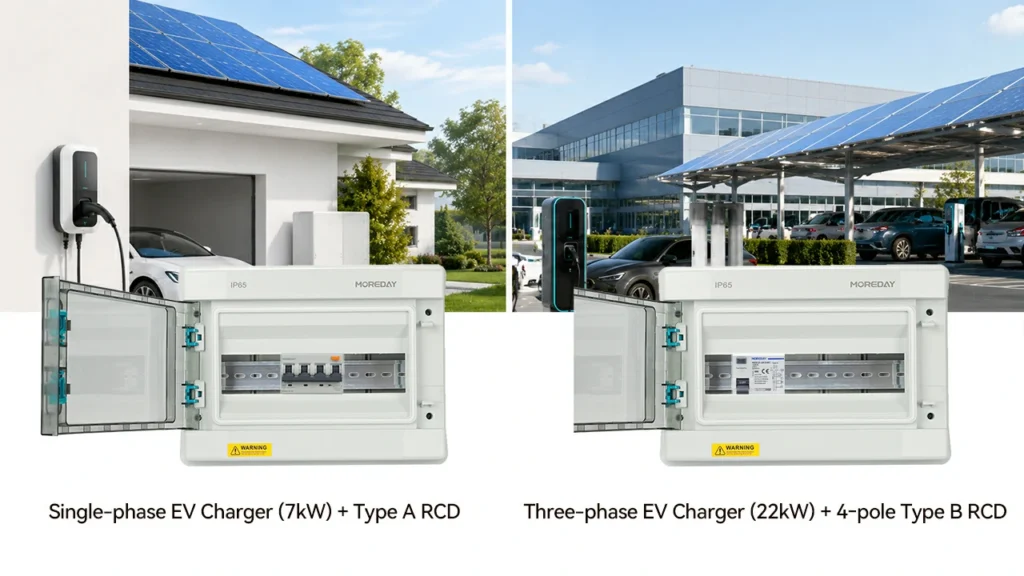
Single-phase EV chargers (Mode 3, up to 7.4 kW) use a single-phase bridge rectifier internally. A single-phase rectifier produces pulsating DC — a waveform that drops to zero twice per mains cycle. Pulsating DC does not cause magnetic core saturation. A Type A RCD can detect pulsating DC leakage without difficulty.
Three-phase EV chargers (Mode 3, 11–22 kW) use a three-phase bridge rectifier. A three-phase rectifier produces a much smoother DC output — the six-pulse waveform never drops to zero, and the residual ripple is at six times the mains frequency. The leakage current produced by this circuit has a significant smooth DC component. This is precisely the waveform that saturates a Type A RCD core.
The practical conclusion: single-phase EV chargers do not inherently require a Type B RCD on the supply circuit. Three-phase EV chargers do — unless equivalent protection is provided by the charger itself.
The RDC-DD Exception: When Type A Is Sufficient
The requirement for Type B RCD protection on EV charging circuits has been partially addressed by a device category that many installers are unfamiliar with: the RDC-DD (Residual DC Detection Device).
An RDC-DD is an internal monitoring circuit built into many modern EV chargers. It continuously monitors the DC leakage current within the charger’s own circuitry. When DC leakage reaches 6 mA — the threshold below which it cannot saturate a Type A RCD — the RDC-DD interrupts the charger’s internal circuit before the leakage can reach the external supply. This prevents DC saturation of the external RCD entirely.
Where a charger includes a certified, functional RDC-DD:
- The external RCD on the supply circuit can be Type A (or Type F), not Type B
- The total system protection is equivalent — the RDC-DD handles the DC component internally, the Type A handles residual AC leakage externally
- Most modern single-phase Mode 3 chargers from reputable manufacturers include an RDC-DD as standard
What this means in practice: Before specifying a Type B RCD for an EV charging circuit, check the charger manufacturer’s installation documentation. If the charger includes a certified RDC-DD, a Type A RCBO is the correct — and more cost-effective — external protection. If the documentation does not explicitly confirm RDC-DD protection, or if the charger is older or unspecified, Type B is the safe and compliant default.
For installations with multiple EV charging points on a shared supply, cumulative DC leakage from several chargers may exceed the 6 mA threshold even if each individual charger includes an RDC-DD. In these cases, a Type B RCD upstream of the shared circuit provides a reliable safety backstop regardless of individual charger configurations.
Regulatory Requirements for EV Charging
The requirement for Type B RCD protection in EV charging installations is addressed across multiple standards, with variations by region:
IEC 61851-1 (international standard for EV conductive charging systems) requires that the EV supply equipment include protection against DC fault currents. This can be achieved by a Type B RCD or by an alternative arrangement providing equivalent protection — including an RDC-DD in combination with a Type A RCD.
BS 7671:2018+A2:2022, Regulation 722.531.3.101 (UK wiring regulations) specifies that each EV charging point must be individually protected by an RCD with a rated residual operating current not exceeding 30 mA. The permitted types are Type A, Type F, or Type B — but Type A is only permitted where the charger provides suitable DC fault current protection (i.e., includes an RDC-DD).
IEC 60364-7-722 (international installations standard for EV supply) similarly permits Type A protection where the equipment provides suitable DC leakage control, and requires Type B or equivalent where it does not.
The regulatory picture is consistent: Type B is the universal safe choice; Type A is permitted where the charger’s internal protection is explicitly confirmed. Installers who default to Type B on all EV charging circuits are never wrong. Those who use Type A must be able to demonstrate that the charger’s documentation supports it.
Solar Inverters and Type B RCD: A More Nuanced Picture
The relationship between solar PV inverters and Type B RCD requirements is more complex than EV charging, because inverter designs vary significantly in their isolation architecture.
The key variable is transformer isolation.
A galvanically isolated inverter — one that includes a transformer between the DC PV input and the AC output — provides inherent separation between the DC and AC sides. DC leakage from the PV array cannot propagate through a transformer to the AC supply. The RCD on the AC supply circuit of a transformer-isolated inverter therefore does not need to detect DC leakage, because no smooth DC leakage can reach it. A Type A RCD is appropriate for the AC supply of a transformer-isolated inverter.
A transformerless inverter — now the dominant design in residential and commercial solar installations — uses power electronics to directly convert DC to AC without a transformer. This design is more efficient and less expensive, but it means there is a direct electrical path between the DC PV side and the AC output. DC leakage from the PV array or from the inverter’s power electronics can appear on the AC side. The RCD protecting the AC supply circuit of a transformerless inverter must be capable of detecting smooth DC leakage — a Type B RCD.
IEC 62109-2 (safety of power converters for use in PV power systems) addresses this directly: transformerless PV inverters must either include built-in DC ground fault detection that prevents DC injection above defined limits, or the installation must use a Type B RCD on the AC supply circuit.
Most modern transformerless inverters from established manufacturers include some form of internal DC leakage monitoring. However, unlike the EV charging case where RDC-DD is a well-defined, standardised device, the solar inverter market uses a range of proprietary monitoring approaches. The safest approach — and the one recommended where the inverter documentation does not explicitly address the external RCD requirement — is to specify a Type B RCD on the AC supply circuit of any transformerless inverter.
Practical guidance for solar PV:
- Transformer-isolated inverter → Type A RCD acceptable on AC supply
- Transformerless inverter with certified internal DC monitoring (confirmed in manufacturer documentation) → check manufacturer specification; Type A may be acceptable
- Transformerless inverter without explicit DC monitoring confirmation → Type B RCD on AC supply
- Three-phase transformerless inverter → Type B RCD (4-pole) on AC supply in virtually all cases
Pole Configuration: 2-Pole vs 4-Pole Type B RCDs
Selecting the correct Type B RCD also requires matching the pole configuration to the supply:
2-pole Type B RCD: For single-phase circuits (live + neutral). Used on single-phase EV charging points where Type B is required, and on single-phase solar inverter AC connections.
4-pole Type B RCD: For three-phase + neutral circuits. Required for three-phase EV chargers (11–22 kW) and three-phase solar inverter connections. A 2-pole device on a three-phase circuit would leave two phases unprotected — a serious safety gap.
The current rating must also be matched to the circuit: 25A, 40A, and 63A are the common ratings for EV charging applications at 30 mA sensitivity. For solar inverter AC circuits, the rating is determined by the inverter’s maximum AC output current with the standard 125% continuous duty factor applied.
Type B RCD vs Type B+ and Type Bfq
Two extended variants of the Type B RCD appear in specifications for demanding installations:
Type B+ RCD: Provides all the detection capabilities of Type B plus improved sensitivity to high-frequency residual currents up to 20 kHz. Relevant for installations with high-frequency switching power supplies, certain EV charger topologies, and variable speed drives that generate high-frequency leakage.
Type Bfq RCD: Extends frequency coverage to 50 kHz or beyond. Specified for industrial inverter-driven equipment and specialised EV charging infrastructure where very high switching frequencies are present.
For standard residential and commercial EV charging and solar PV installations, a standard Type B RCD is appropriate. Type B+ or Bfq devices are specified where the equipment manufacturer’s documentation identifies high-frequency leakage as a concern, or where the installation includes industrial-grade power electronics.
Common Specification Mistakes
Assuming every EV charger needs Type B. Modern single-phase chargers with RDC-DD certification do not. Over-specifying Type B on circuits where Type A is compliant and sufficient adds unnecessary cost without improving protection.
Using a Type A RCD on a three-phase EV charger supply. Three-phase chargers generate smooth DC leakage. A Type A device on this circuit may be blinded by DC saturation. This is a genuine safety failure, not merely a compliance issue.
Applying the EV rule to solar without checking inverter type. Transformer-isolated inverters do not require Type B on the AC supply. Blanket application of the EV charging rule to all solar installations leads to unnecessary cost on isolated-inverter systems.
Fitting a 2-pole Type B RCD on a three-phase circuit. Two phases are left without residual current protection. Always match pole count to phase configuration.
Ignoring cumulative leakage in multi-charger installations. Even where each charger has RDC-DD protection, cumulative DC leakage across multiple circuits can exceed safe limits. A Type B device upstream of the shared supply is good practice in any installation with three or more charging points.
Summary
Type B RCD protection is required wherever power electronics can generate smooth DC leakage currents that would saturate the core of a standard Type A device. In EV charging, this means three-phase chargers and any single-phase charger without a certified internal RDC-DD. In solar PV, it means transformerless inverters where the manufacturer’s documentation does not confirm equivalent internal DC monitoring.
The decision framework is not “always Type B” — it is “Type B unless the equipment itself provides verified equivalent DC leakage control.” That distinction matters both for safety and for system cost.
For related reading, see our DC Circuit Breaker: All You Need to Know for DC protection fundamentals, and our DC MCB vs DC MCCB guide for device selection at the DC side of PV and storage systems.
External reference: IEC 62423 — Type F and Type B residual current operated circuit-breakers with and without integral overcurrent protection (iec.ch)