
DistributionSolar
Combiner Box IP Rating is one of those specs buyers skim past because it looks like a formality — until a supposedly weatherproof enclosure lets in enough moisture during a coastal storm season to corrode terminals two years ahead of schedule. IP65, IP66, and IP55 look like minor variations of the same rating, but the difference between them is a specific, testable engineering distinction, not a marketing tier.
This guide breaks down what each digit in a combiner box IP rating actually means, and — building on the sizing factors covered in our combiner box sizing guide — how to match the right rating to your actual installation environment instead of defaulting to “the highest number available.” View the complete guide to combiner boxes.
Fact 1: Combiner Box IP Rating Is Two Separate Numbers, Not One Score
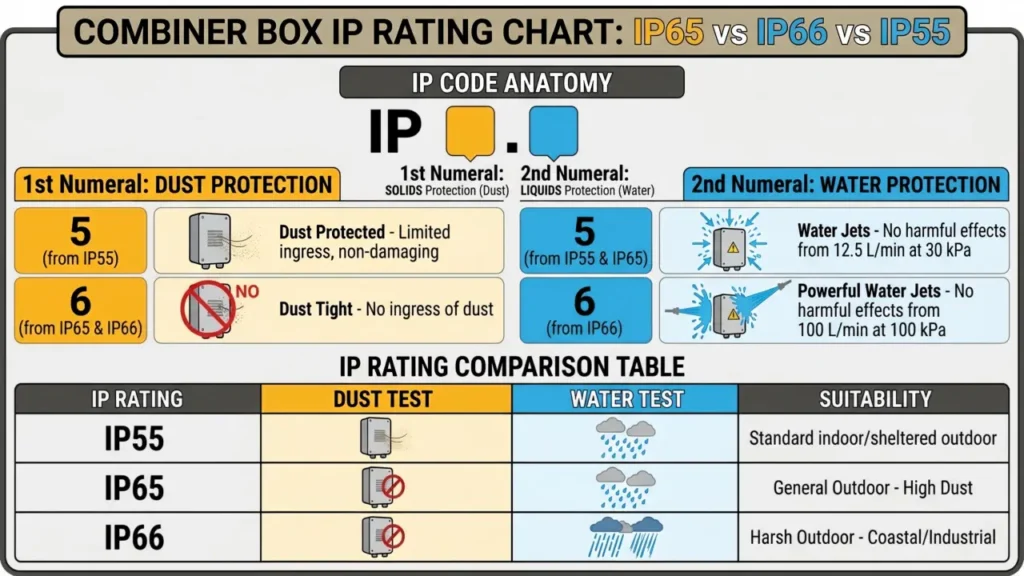
Every IP rating follows the same structure, defined by IEC 60529: the first digit rates protection against solid objects and dust (0–6), and the second digit rates protection against water ingress (0–9). A combiner box IP rating of IP65 means a dust rating of 6 and a water rating of 5 — two independent test results, not a single combined grade.
Fact 2: IP65 vs IP66 Is About Water Pressure, Not Dust
IP65 and IP66 share the same dust rating (6 — fully dust-tight, no ingress permitted at all). The difference is entirely in the second digit:
- IP65 (water rating 5): protected against low-pressure water jets from any direction.
- IP66 (water rating 6): protected against powerful, high-pressure water jets from any direction.
In practice, this means IP66 is the rating to specify where a combiner box may be exposed to high-pressure wash-down during maintenance, heavy wind-driven rain, or aggressive coastal spray — conditions where IP65’s lower-pressure jet resistance may not be sufficient over years of exposure.
Fact 3: IP55 vs IP65 Is About Dust, Not Water
IP55 and IP65 share the same water rating (5). The difference is in the first digit:
- IP55 (dust rating 5): “dust protected” — limited dust ingress is permitted, provided it doesn’t interfere with equipment operation.
- IP65 (dust rating 6): “dust tight” — no dust ingress permitted at all.
For most outdoor ground-mount and rooftop solar installations, dust-tight IP65 is the safer baseline, since fine dust accumulation over years can affect terminal connections even where it doesn’t cause an immediate fault. IP55 is generally reserved for sheltered or indoor installations where dust exposure is limited by the surrounding structure.
Fact 4: Matching Combiner Box IP Rating to Environment
| Environment | Recommended minimum rating | Why |
|---|---|---|
| Sheltered indoor electrical room | IP55 | Limited dust and no direct water exposure |
| Standard outdoor rooftop or ground-mount | IP65 | Full dust protection plus standard rain and jet resistance |
| Coastal, high-humidity, or frequent wash-down sites | IP66 | Higher-pressure water resistance for salt spray and aggressive cleaning |
| Desert or high-dust environments | IP65 or higher | Dust-tight rating is the priority factor, water rating secondary |
Fact 5: A Higher Combiner Box IP Rating Isn’t Always the Right Choice
Specifying IP66 for a sheltered indoor installation adds enclosure cost without a corresponding protection benefit — the higher rating exists to solve a specific exposure problem, not to serve as a universal safety margin. The right approach is matching the rating to documented site conditions, not defaulting to the highest number on the datasheet.
Common Mistakes
Assuming IP rating and NEMA rating are interchangeable. Some markets specify NEMA 3R, 4, or 4X ratings instead of IP codes. The two systems use different test methods, and a rough equivalence table should never substitute for checking the actual rating your project specification requires.
Ignoring seal degradation over time. An enclosure’s IP rating reflects its condition when tested new. Damaged gaskets, cracked cable glands, or improperly re-sealed access panels after maintenance can reduce real-world protection well below the rated level.
Choosing rating based on marketing copy rather than the datasheet’s tested IP code. Terms like “weatherproof” or “outdoor-rated” aren’t standardized — always confirm the specific IPXY code and its IEC 60529 basis.
Assuming a higher water digit implies protection the product doesn’t actually have. IP ratings for immersion (digits 7–8) don’t automatically confer jet-resistance (digits 5–6) unless the product is explicitly tested and rated for both.
FAQ
What Combiner Box IP Rating do I need for a standard rooftop solar installation?
IP65 is the standard baseline for most outdoor rooftop and ground-mount installations, providing full dust-tight protection and resistance to rain and standard water jets.
Is IP66 always better than IP65 for a combiner box?
IP66 offers higher water-jet pressure resistance, which matters in coastal, high-wash-down, or storm-exposed sites. For standard inland installations without those specific exposures, IP65 typically provides adequate protection without the added cost of IP66.
Can an IP55-rated combiner box be used outdoors?
It’s not generally recommended for direct outdoor exposure, since IP55’s dust rating (5) permits limited dust ingress. IP55 is better suited to sheltered or indoor installations where dust and water exposure are already limited by surrounding structures.
Does combiner box IP rating affect the fuses and breakers inside it?
No — IP rating describes the enclosure’s protection against external dust and water ingress. The voltage and current ratings of the fuses, breakers, and terminals inside are separate specifications that need to be confirmed independently, as covered in our combiner box sizing guide.