
Solar
Choosing between a T branch vs Y branch MC4 connector comes up constantly once a system needs to combine more than one string in parallel. Our MC4 connector types guide covers the basics: the two families are electrically equivalent at the same branch count, and the choice mostly comes down to routing preference.
That’s true as far as it goes, but it skips two questions that actually come up on site. What does “routing preference” mean in practice, and is it better to daisy-chain two 2-way connectors instead of buying one 3-way? This guide answers both.
T Branch vs Y Branch MC4 Connector: Quick Answer
At the same branch count, a T branch and Y branch MC4 connector carry the same current rating and serve the same function — combining or splitting parallel strings. The real differences between T branch and Y branch connectors are physical: body shape, connection point count when you scale up, and how each one sits in a tight junction box or conduit run.
Neither the T branch nor the Y branch family is a “better” default — the right pick depends on your specific layout.
The Real Difference: Physical Layout and Routing
A T branch connector keeps one input roughly in line with the output, with the additional branch input(s) coming off at an angle — closer to a straight-through fitting with a tap. A Y branch connector splits more symmetrically, with the branches meeting the output at a shared angle rather than one staying in line.
In practice, this shows up as a routing decision, not a performance one. If your cable run naturally continues in one direction with a single string tapping in, a T branch connector can sit more naturally in the layout.
If two or more strings are converging from different directions into one junction point, a Y branch connector’s more symmetric geometry often fits the physical space better and puts less strain on any one cable’s bend radius. Neither is “better” in the abstract — it depends on how your specific strings are physically laid out on the array.
Junction Box Space and Cable Strain
Space inside a combiner box or at a rooftop junction point is often the deciding factor between a T branch and Y branch connector in practice, even more than the electrical spec sheet. A T branch connector’s inline body can be easier to route along an existing conduit run without an awkward bend, while a Y branch connector’s angled body sometimes needs a little more clearance on either side to avoid putting lateral strain on the cable jacket at the strain relief point.
Neither issue shows up on a datasheet — it only becomes obvious once you’re physically routing cable in the actual enclosure. That’s why it’s worth planning the branch connector choice around the specific junction box or layout rather than picking whichever family is in stock.
Branch Count: 2-Way, 3-Way, 4-Way, and Beyond
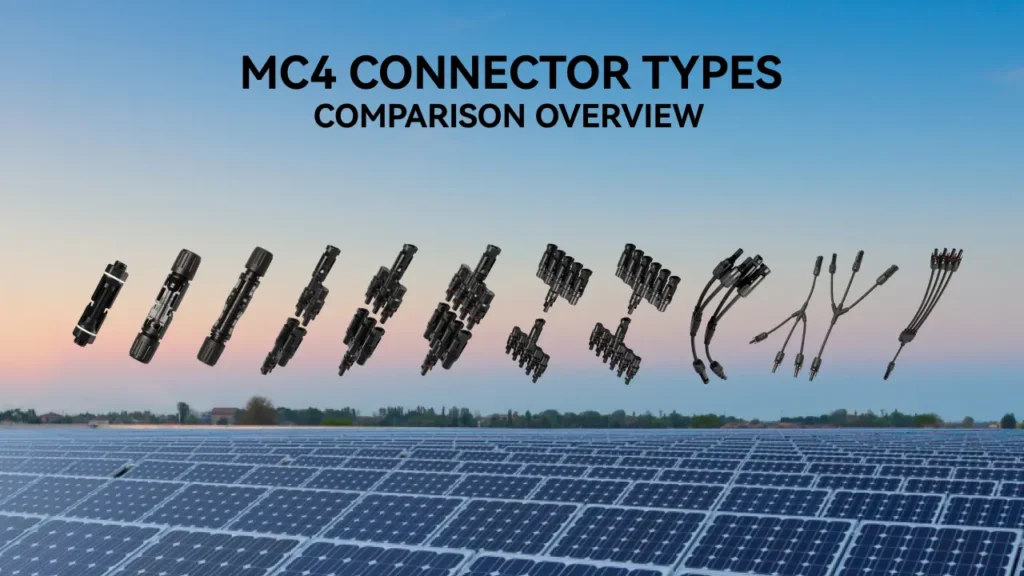
T branch connectors are commonly available from T2 (2 inputs) up through T6 (6 inputs); Y branch connectors are more commonly found as Y2 through Y4. Availability above 4-way varies more by manufacturer for the Y branch family than the T branch family.
If you need to combine 5 or 6 parallel strings at a single point, confirm your supplier actually stocks a Y5/Y6 before designing around one — a T5/T6 is more consistently available across brands.
Moreday’s Y Branch MC4 Solar Connector covers 2-in-1 through 4-in-1 configurations at up to 30A per branch.
Should You Daisy-Chain Two 2-Way Connectors Instead of Buying a 3-Way?
This is the question that doesn’t get asked often enough. If you need to combine 3 parallel strings and don’t have a 3-way branch connector on hand, it’s mechanically possible to plug one 2-way connector’s output into a second 2-way connector’s input, combining 3 strings across two connectors instead of one.
It works, but it isn’t equivalent to a single 3-way connector, for two reasons:
- Every additional connector is another mated pair, and another potential point of contact resistance. A single T3/Y3 connector has one internal junction combining three inputs; two daisy-chained 2-way connectors have two separate mated junctions in series, each one a place where a slightly under-torqued or degraded connection can develop heat over time.
- The intermediate connector in the chain now carries the combined current of two strings through a connector rated as a 2-way unit, which is fine as long as its rated current comfortably covers that combined load — but it’s an extra spec to double-check rather than something a single properly-rated 3-way connector requires you to think about.
For a permanent installation, a single connector rated for the actual number of strings you’re combining is the more reliable choice. Daisy-chaining is reasonable as a temporary or small-scale fix — common in off-grid and RV setups — but isn’t the first choice for a rooftop or commercial install meant to last 25 years.
Overcurrent Protection: When You Need It
Once you’re combining 3 or more parallel strings through either a T branch or Y branch connector, most electrical codes require individual string overcurrent protection. This applies equally to both families, since it’s a function of branch count, not branch shape.
Under NEC 690.9, the trigger is whether the combined current from the other parallel strings could exceed a single string’s conductor or module rating. In practice, that threshold is almost always reached at 3 or more parallel strings, and the required fuse or breaker rating is calculated as the string’s Isc × 1.25, rounded up to the next standard device size.<sup>[1]</sup>
Our MC4 connector types guide covers fused MC4 connectors as the common way to add this protection without a separate combiner box.
Cost and Availability Considerations
Price scales with branch count more than with T vs Y shape — a 4-way connector costs more than a 2-way regardless of which family it belongs to, since it carries more current-rated contacts and more housing material. Between a T branch and Y branch connector at the same branch count, price differences are typically minor and driven more by brand and certification than by shape.
Availability is the bigger practical factor: T branch connectors are more consistently available at higher branch counts (5–6 way) across suppliers, while Y branch connectors are the more common default for standard 2–4 way parallel combining.
Which Should You Choose?
Work through these three questions:
- How many strings are you combining? 2–4 strings, either family works; 5–6 strings, confirm your supplier stocks that branch count in your preferred shape, since T branch is more consistently available at that range.
- How do the strings physically converge at the junction point? One string continuing an existing run → T branch often routes more naturally. Multiple strings meeting from different directions → Y branch’s symmetric geometry often fits better.
- Do you need per-string overcurrent protection? At 3+ combined strings, plan for it regardless of which family you choose.
FAQ
[1] Source: ExpertCE — Sizing PV Conductors & OCPD per NEC Article 690
Related reading: MC4 Connector: The Complete Guide to Solar PV Connections · MC4 Connector Types: The Complete 2026 Comparison Guide · MC4 Connector Cable Size: A Sizing and Voltage Drop Guide