
Solar
If you’ve unboxed a Canadian Solar panel and noticed the connector doesn’t quite look like the MC4 connector on the rest of your string, you’ve run into the MC4 vs T4 connector question. They look similar, they’re both used for the same job, and they’re not the same thing — which matters the moment you try to mate one to the other.
This guide compares MC4 vs T4 connectors on the specs that actually affect an installation, and answers the question every installer eventually asks: can you safely mix them? By the end of this MC4 vs T4 connector comparison, you’ll know exactly what to check before ordering, and what to do if you’ve already got both types on the same system.
Quick Answer
| MC4 | T4 | |
|---|---|---|
| Manufacturer | Stäubli (original); many IEC 62852-certified alternatives | Tlian, a Canadian Solar subsidiary |
| IP rating | IP67 | IP68 |
| Operating temperature | -40°C to 90°C (typical) | -40°C to 90°C |
| Cable size | 2.5–10mm² depending on variant | 4mm²/6mm² |
| Cross-mateable with the other? | Not officially endorsed by either manufacturer | Not officially endorsed by either manufacturer |
| Where you’ll find it | Most solar panel brands | Canadian Solar panels |
The short version: don’t assume MC4 and T4 connectors are interchangeable just because they look alike. More on why below.
What Is a T4 Connector?
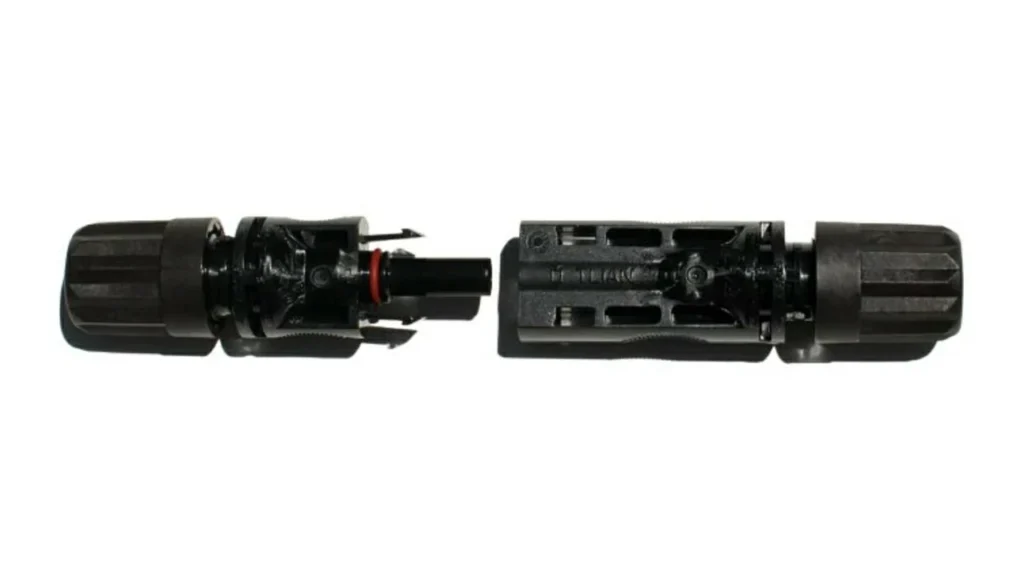
The T4 connector is manufactured by Tlian, a subsidiary of Canadian Solar, and ships pre-installed on Canadian Solar modules. According to Tlian’s own T4-PC-1 datasheet, the connector is rated IP68 and rated for an operating temperature range of -40°C to 90°C, with cable options in 4mm² and 6mm² sizes. Like MC4, it uses a male pin and female socket pair with a spring-clip locking mechanism, and the datasheet’s own installation notes carry the same warning found across the connector industry: never disconnect a T4 connector under load.<sup>[1]</sup>
What Is an MC4 Connector?
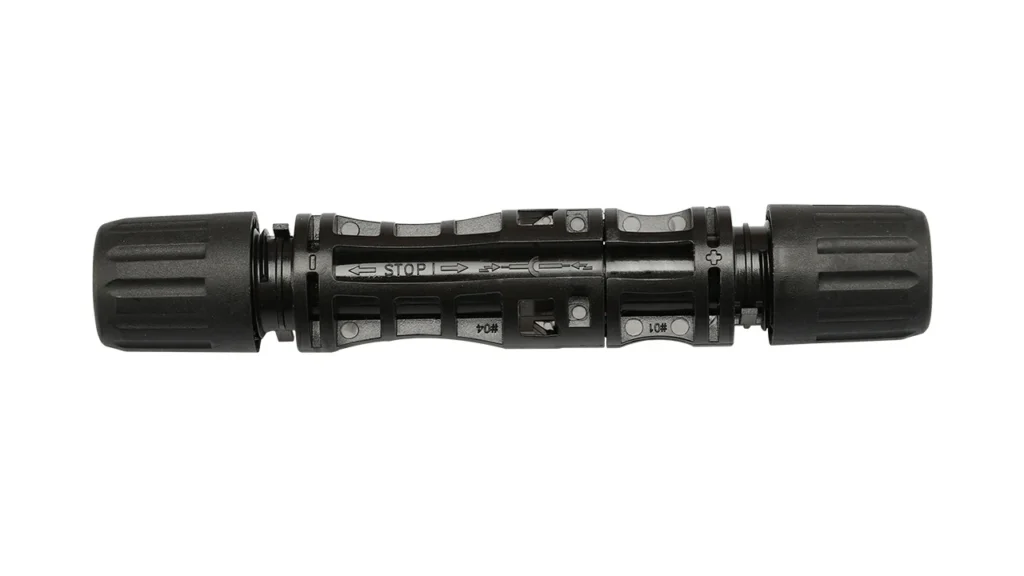
MC4 is the original Stäubli connector design (originally Multi-Contact), and remains the most widely used solar connector worldwide, with IEC 62852-certified equivalents produced by many manufacturers since the original patent expired. For the full breakdown of how an MC4 connector is built, rated, and installed, see our complete MC4 connector guide — this article focuses specifically on how it compares to T4.
MC4 vs T4 Connector: Where the Specs Actually Differ
IP rating: T4 is rated IP68, one step above MC4’s standard IP67 — the practical difference is that IP68 is tested for continuous, sometimes deeper, submersion, while IP67 covers temporary submersion up to 1m. For a rooftop or ground-mount array where sustained submersion isn’t a realistic condition, this difference rarely changes a real-world outcome.
Current rating: Sources online disagree meaningfully here — some cite T4 at up to 30–40A, others cite figures well above that for specific high-current variants. Ratings vary by cable size and specific product line for both MC4 and T4, so check the datasheet for your exact connector model rather than relying on a single number from a blog post, including this one.
Cable size: T4 is built around 4mm² and 6mm² cable; MC4 spans a wider range from 2.5mm² fused/diode variants up to 10mm² high-current variants — see our MC4 connector types guide for the full breakdown by variant.
Locking mechanism geometry: this is the detail that actually matters for compatibility. Both use a spring-clip lock, but the clip geometry differs enough between MC4 and T4 that a mated pair can sometimes latch without fully seating — which is the root of the cross-mating risk covered next.
Can You Mate MC4 and T4 Connectors Together?
This is the question that actually brings most people to this article, usually after finding a T4-terminated Canadian Solar panel in a string of otherwise-MC4 equipment.
Physically, the two often appear to click together. Electrically and mechanically, neither Stäubli nor Tlian officially endorses cross-brand mating between their connector families — Stäubli’s own position on third-party MC4-form connectors generally is that it has not recognized any as certified plug-compatible with its product line, and the same caution applies to any two connector families from different manufacturers, T4 included. A connection that “clicks” without both housings’ internal clips fully engaging can loosen over time, and a loose DC connector under load is one of the more common root causes behind a DC arc fault.
We’ve written a full breakdown of exactly why cross-brand connectors behave this way — and how to check whether an existing mated pair on your system is actually seated correctly — in our MC4 Connector Compatibility guide. If you’re troubleshooting a mixed MC4/T4 string, start there.
Do You Need an Adapter Cable?
If your project genuinely needs to join an MC4-terminated string to T4-terminated Canadian Solar panels, the safer path is a manufacturer-made MC4-to-T4 adapter cable rather than force-mating the two connector housings directly. An adapter cable terminates each end in the correct, factory-matched connector for that side, so neither connection is relying on two different clip geometries engaging correctly.
Which Should You Choose for a New Installation?
For a new installation, the MC4 vs T4 connector decision usually isn’t one you make independently — the connector ships with whichever panel brand you select. The practical decision point is: if you’re specifying panels from more than one manufacturer for the same string, confirm the connector type on each one before ordering, so you’re not solving an MC4 vs T4 mismatch after the panels are already on the roof. Moreday’s MC4 Connector range covers standard replacement and extension needs if you need to standardize a string onto one connector type.
MC4 vs T4 Connector: Installation Tools
One more practical difference worth knowing before you’re on a roof: MC4 connectors require a dedicated crimping tool matched to the pin size, plus a torque wrench for the end cap — see our crimping guide for the full process. T4 connectors use the same general crimp-and-lock approach, but the tool and die are specific to Tlian’s pin geometry and aren’t interchangeable with a standard MC4 crimping kit. If you’re servicing a mixed MC4/T4 site, budget for both tool sets rather than assuming one crimper covers everything — this is one of the more common surprises installers run into the first time they work on a Canadian Solar array after years of MC4-only jobs.
FAQ
[1] Source: Tlian T4-PC-1 Connector Datasheet (Canadian Solar subsidiary)
Related reading: MC4 Connector: The Complete Guide to Solar PV Connections · MC4 Connector Types: The Complete 2026 Comparison Guide · MC4 Connector Compatibility: The Cross-Brand Mating Problem Explained · DC Arc Faults in Solar Systems