
Solar
“MC4 connector” sounds like one product, but it’s actually a family of related devices. Ask five installers to list the MC4 connector types they’ve specified this year and you’ll get five different answers — standard pairs, fused connectors, T-branch, Y-branch, high-current variants, and now even 2000V versions. Getting the type wrong doesn’t always cause an immediate failure; it usually shows up months later as a hot spot on a thermal scan or a nuisance disconnection during a storm.
This guide sorts every commercially available MC4 connector type into the five ways that actually matter when you’re specifying one: voltage/current rating, certification and region, function, branch configuration, and gender. If you want the full picture of how an MC4 connector works internally — contact system, locking mechanism, IP67 sealing — see our complete MC4 connector guide first. This article goes deeper specifically on the “which type do I need” question that the pillar guide only summarizes.
MC4 Connector Types at a Glance
| Type | Function | Typical Rating | Best for |
|---|---|---|---|
| Standard pair (1000V) | Series string connection | 30A, IP67 | Residential rooftop |
| Standard pair (1500V) | Series string connection | 30–45A, IP67 | Commercial / utility |
| High-current / 2000V-class | Series string connection, high-power strings | Up to 55–69A | Utility-scale, high-output modules |
| MC4 with fuse | Overcurrent protection at panel level | 20–30A | Parallel strings needing per-string protection |
| MC4 with diode | Bypass protection | 10–30A | Partial shading, aging modules |
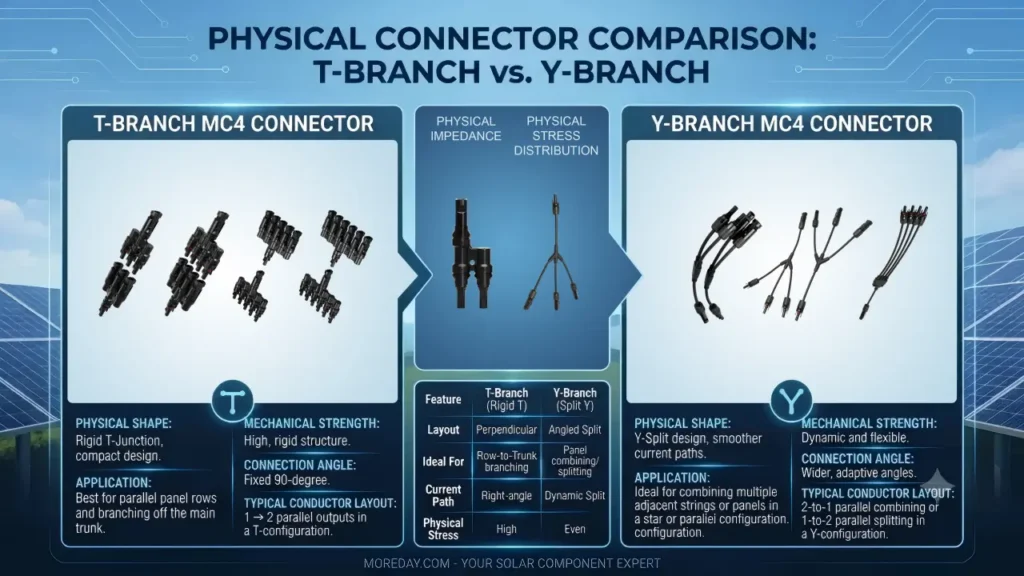
| T-branch (T2–T6) | Combine 2–6 parallel strings | Sum of input currents | No dedicated combiner box |
| Y-branch (Y2–Y4) | Same as T-branch, different form factor | Sum of input currents | Tight routing / specific orientation needs |
Across these seven MC4 connector types, the specification questions are the same every time: voltage, current, protection, and configuration. The sections below walk through each one.
MC4 Connector Types by Voltage and Current Rating
The first split among MC4 connector types that matters is electrical rating, because this is the one mistake that can’t be corrected after the panels are on the roof.
1000V DC connectors are the default for residential and small commercial arrays, rated at 30A continuous with 4–6mm² cable. 1500V DC connectors use wider internal creepage and clearance distances to handle the higher string voltages common on utility-scale and larger commercial systems, and are available in 30A or 45A variants depending on cable size.
The 2000V Generation
A genuinely new development worth knowing about: Stäubli, the original MC4 manufacturer, now produces a 2000V-rated connector line (“Original MC4-Evo 2000”) that combines the contact design of the standard MC4 with the higher-current MC4-Evo 2 housing, dual-certified to TÜV Rheinland and UL. It’s aimed at utility-scale projects where pushing string voltage from 1500V to 2000V reduces conductor losses and lowers the levelized cost of energy across a large plant. This isn’t a rumor circulating in installer forums — it’s a shipping product line, though at the time of writing it’s specified almost exclusively on large utility projects rather than commercial or residential jobs, where 1500V remains the practical ceiling for most inverter and combiner box equipment on the market.
For most buyers reading this guide, the practical takeaway is: confirm your inverter and combiner box are also rated for whatever connector voltage you specify. A 2000V-rated connector on a 1500V inverter string doesn’t add any benefit — the system voltage is still capped by the lowest-rated component in the circuit.
As module wattage climbs past 600W, string currents are climbing too, and connector manufacturers have responded with high-current MC4 connector types rated up to roughly 45–69A on 10mm² cable — noticeably higher than the 30A most residential installers are used to specifying. If you’re working with high-output modules, check the connector’s continuous current rating against the module’s actual short-circuit current at STC, not just the “MC4” label on the packaging — not every MC4-form connector on the market is rated for the same current, even within the same nominal voltage class.
For Moreday’s dual-rated high-current option, see the PV-MD-MC4-S connector, built for combiner box outputs and other high-current applications where 1000V and 1500V systems share the same hardware.
MC4 Connector Types by Certification and Region
Which MC4 connector types are appropriate for a project often depends on where it’s being installed, not just its electrical specification.
In North America, MC4-type connectors sold for grid-connected PV work are typically listed to UL 6703 — Standard for Connectors for Use in Photovoltaic Systems — and this listing is what electrical inspectors and AHJs check for. In Europe, the Middle East, and most of Asia, IEC 62852 and TÜV Rheinland certification are the reference points buyers and installers look for.
The two certification frameworks test overlapping but not identical parameters, and a connector certified under one scheme isn’t automatically compliant for a market that requires the other. For any export-facing or multi-region project, confirm which certification documentation is required before ordering — a supplier that can produce both UL 6703 and IEC 62852 documentation for the same MC4 connector type, as Moreday does across its standard and 1500V ranges, avoids a costly re-order if a project’s certification requirement changes mid-procurement.
MC4 Connector Types by Function
Beyond the plain male/female pair, several MC4 connector types integrate a protective component directly into the housing rather than requiring a separate device elsewhere in the circuit.
MC4 with fuse puts a string-level fuse inside the connector body, available in 20A and 30A ratings across 1000V and 1500V variants with 2.5–6mm² cable. This is useful in parallel-wired systems where individual string overcurrent protection is required — per IEC 60364-7-712 or NEC 690.9 — but a dedicated combiner box isn’t practical for the array layout. The integrated approach removes one connection point from the circuit compared to a separate inline fuse holder, which is itself one fewer place where contact resistance can develop over the system’s service life.
MC4 with diode integrates a bypass diode, rated at 1000V in 10A, 15A, and 20–30A variants. It adds shading protection beyond what’s built into the module’s own junction box, and is often used to protect older modules whose internal bypass diodes have degraded, or in arrays with a known partial-shading pattern from a nearby obstruction.
Both function types plug into a string exactly like a standard MC4 connector — the difference is entirely inside the housing, so there’s no change to installation technique or crimping tools required.
MC4 Connector Types by Branch Configuration: T vs Y
When multiple strings need to combine into one output without a combiner box, you’re choosing between two families of MC4 connector types built for exactly that job.
T-branch (T2 through T6) connectors combine 2 to 6 parallel string inputs into a single output, named by input count. Y-branch (Y2 through Y4) connectors do the same job with a Y-shaped body instead of a T-shaped one — electrically, the T and Y families of MC4 connector types are equivalent at the same branch count; the choice mostly comes down to cable routing and physical layout preference on the specific array.
One detail that’s easy to miss across both branch families: at 3+ parallel strings combined into one branch connector, most electrical codes require individual string overcurrent protection, which is where the fused MC4 variant above often gets paired with a T3/Y3 or larger branch connector rather than used alone. And at higher branch counts, the output conductor carries the sum of every input string’s current — a T6 output has to be sized for six strings’ worth of current, not one, so the output cable and any downstream connector need to be checked against the combined figure, not the per-string rating.
Moreday’s Y Branch MC4 Solar Connector covers the 2-in-1 through 4-in-1 configurations at up to 30A per branch.
Male vs Female: Identifying MC4 Connector Types by Gender
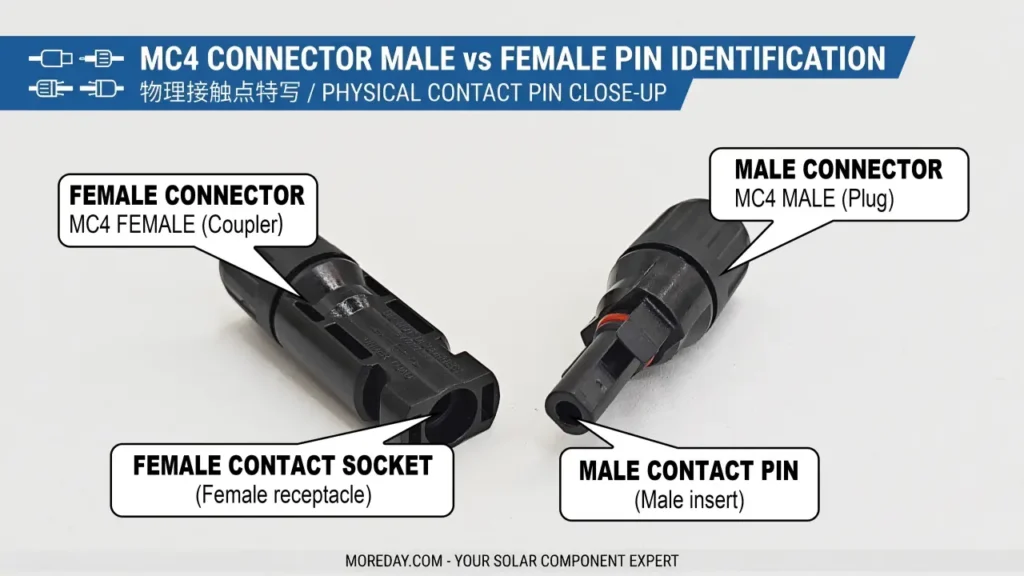
Every MC4 pair, regardless of which of the other MC4 connector types it belongs to, has a male half (a protruding pin) and a female half (a socket). By convention the female connector is typically wired to the positive lead, though this isn’t universal across every module manufacturer, so it’s worth confirming polarity from the datasheet rather than assuming it from connector gender alone. This male/female pairing is also what prevents two positive or two negative leads from being accidentally joined without an intermediate branch connector.
Matching Cable Size to MC4 Connector Types
Every one of the MC4 connector types above depends on using the correct cable cross-section — the compression gland inside the housing is sized for a specific outer diameter range, and using cable outside that range compromises the IP67 seal regardless of how well the connector itself is rated.
| Cable size | Typical outer diameter | Compatible MC4 connector types |
|---|---|---|
| 2.5mm² | ~4.5–6mm | Fused and diode variants (lower current) |
| 4mm² | 5–7mm | Standard 1000V pair, most branch connectors |
| 6mm² | 6–8.5mm | Standard 1500V pair, T4–T6/Y4 output legs |
| 10mm² | 8–10.5mm | High-current / dual-rated (PV-MD-MC4-S), branch connector outputs |
If you’re unsure which cable a given connector type was designed around, check the gland range on the datasheet rather than the cable’s AWG or mm² rating alone — two cables with the same conductor size can still have different jacket diameters depending on the manufacturer.
MC4 vs “MC4-Compatible”: Where Cross-Brand Types Cause Problems
Not every connector marketed as an MC4 connector type is interchangeable with every other. Since the original Multi-Contact patent expired, many manufacturers have produced IEC 62852-certified MC4-form connectors, but certification of an individual connector’s performance doesn’t guarantee it will safely mate with a different brand’s connector — Stäubli, the original manufacturer, states plainly that it has not recognized any third-party product as plug-compatible with its MC4 line.<sup>[1]</sup>
This matters most when you’re troubleshooting an existing system with mixed connector brands, or extending a string with panels from a different manufacturer than the original install. We’ve written a full breakdown of why this happens and how to fix it in our MC4 Connector Compatibility guide — read that before mixing brands on any string, regardless of which of the MC4 connector types is involved.
It’s also worth distinguishing genuine MC4 connector types from connectors that only sound similar:
- T4 connectors (Amphenol) — a different locking geometry, commonly pre-installed on Canadian Solar panels, not cross-mateable with MC4 without an adapter.
- MC3 — the discontinued predecessor, 3mm pin, no locking mechanism, found only on older installs.
- SOLARLOK / Radox — TE Connectivity and Stäubli’s specialised industrial designs, not MC4-compatible despite superficial similarity.
Cost Considerations Across MC4 Connector Types
Price varies meaningfully across MC4 connector types, and the gap isn’t always proportional to the electrical difference. A standard 1000V pair is the least expensive per unit; fused and diode variants typically add a modest per-unit premium for the integrated component; branch connectors scale roughly with input count, since more current-carrying paths and more housing material go into a T5 or T6 than a T2; and high-current or 2000V-class connectors carry the largest premium, reflecting both the higher-grade contact material and the smaller production volumes at this end of the range.
For most buyers, the more consequential cost decision isn’t which connector type to pick — it’s making sure the type ordered actually matches every string’s real voltage and current, since replacing an under-specified connector after installation costs far more in labour than the price difference would have been at purchase.
How to Choose the Right MC4 Connector Type
Work through these five questions in order, and you’ll land on the correct type from among the seven covered in this guide:
- What’s the system voltage? → sets 1000V vs 1500V vs 2000V-class.
- What certification does the project require? → sets UL 6703 vs IEC 62852/TÜV documentation.
- What’s the actual string current at STC, including high-output modules? → sets standard vs high-current variant.
- Do you need per-string overcurrent or bypass protection built in? → sets standard vs fused vs diode.
- Are strings combining in parallel without a combiner box? → sets whether you need a T or Y branch connector, and at what branch count.
Every application on Moreday’s MC4 Connector range maps to one of these five decision points. Once you’ve settled on a type, our installation guide covers the crimping and mating process, and the MC4 Connector Tool kit covers the crimping and disconnection tools every type in this guide requires.
FAQ
How many types of MC4 connectors are there? There’s no single official count, since MC4 connector types can be classified by voltage/current, certification, function, or branch configuration — but the practical list a buyer needs to know is: standard pair (1000V/1500V/2000V-class), fused, diode, T-branch (T2–T6), and Y-branch (Y2–Y4).
Are all MC4 connector types interchangeable across brands? No. IEC 62852 or UL 6703 certification confirms a connector’s individual performance but doesn’t guarantee safe mating with a different manufacturer’s product. Use one brand throughout a string — see our compatibility guide for the full explanation.
Is a 2000V MC4 connector real? Yes. Stäubli’s “Original MC4-Evo 2000” line is a genuine, dual-certified (TÜV Rheinland and UL) product built for 2000V DC utility-scale projects. It’s not yet common outside utility-scale work, since most inverters and combiner boxes on the market are still built around a 1500V ceiling.
What’s the difference between T-branch and Y-branch MC4 connectors? They perform the same function — combining parallel strings into one output — with different physical shapes. Electrical ratings are equivalent at the same branch count; the choice is a routing preference.
Do I need a fused MC4 connector or a separate string fuse? If your parallel configuration requires per-string overcurrent protection and a dedicated combiner box isn’t practical, an MC4 connector with an integrated fuse serves the same purpose with one fewer connection point in the circuit.
What MC4 connector type should I use for high-output modules (600W+)? Check the module’s short-circuit current against the connector’s continuous current rating rather than assuming a standard 30A connector is sufficient — high-current variants rated up to roughly 45–69A exist specifically for this scenario.
[1] Source: Stäubli — The Original MC4
Related reading: MC4 Connector: The Complete Guide to Solar PV Connections · MC4 Connector Compatibility: The Cross-Brand Mating Problem Explained · DC Arc Faults in Solar Systems